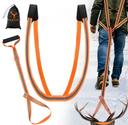
How we ranked these, in order
There are exactly two comparable specs in this category, and almost every listing buries both under a photograph of a buck. The ranking runs on them first:
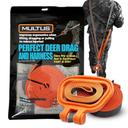
- Is there a published load rating, and does it say what it excludes? Ratings here run from “not published at all” to 1,000 lb. One pick — the MULTUS — is the only one that states a limit as well as a number: “Not rated for overhead lifting or supporting body weight.” That sentence is worth more than 200 lb of headline rating, because it tells you the maker knows what the number means. A rating with no stated exclusions is a marketing figure.
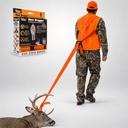
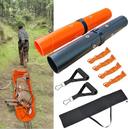
- Webbing width. This is the number that decides whether a loaded strap is comfortable or whether it saws into your shoulder for half a mile, and only two of the five publish it. The top pick is 3 inches; the Allen is 2 inches; the MULTUS and the CHERAINTI publish nothing. Under load, width distributes; length does not.
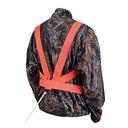
- Harness or hand drag. A dual-shoulder harness moves the pull to your hips and legs. A hand drag puts it in one arm and bends you over. Both have a place — a hand drag is faster to rig and better in thick stuff where you need to steer the animal — but if you are going to pull a deer more than a couple of hundred yards alone, buy the harness.
- Weight, reflectivity and warranty, then cost. The spread on weight here is 0.37 lb to unpublished; two picks are reflective rather than merely orange, which matters because almost every drag-out finishes in the dark. Our score is a value-per-dollar judgment on compiled specs, disclosed at how we rank — not a test result.
The missing number: nobody rates a drag for friction
Here is the honest limit on every rating on this page, and it cuts against the cheap picks hardest. A load rating describes a static pull. Dragging a deer is not a static pull. It is a repeated shock-load through leaf litter, over blowdowns, up a sidehill, with the strap snatching tight every time the animal hangs on a stob.
A mature whitetail buck field-dressed is a long way under 400 lb, so on paper every pick here has margin. In practice the force on the strap when a 180 lb animal stops dead against a root and you keep walking is well above 180 lb, and nobody publishes a figure for that — not the 1,000 lb top pick and certainly not the Allen, which publishes nothing. That is why we rank the two picks that name a width above the two that only name a capacity: width is a fact about the strap, while a capacity with no test standard behind it is a number somebody chose.
What it means for buying: do not buy on the headline rating. The 1,000 lb figure on the top pick is not useful because you will drag a half-ton animal; it is useful because a strap built to carry that number has webbing and stitching with margin for the shock loads nobody rates. And if you are dragging anything bigger than a deer, that margin stops being theoretical — see our pack frames for hauling meat, because at elk weights the answer stops being a drag at all.
Why a drag, and not a cart
We rank budget game carts on this site and a cart is genuinely easier work on a two-track. But a cart has one failure mode a strap does not: it can be illegal where you are standing.
The George Washington and Jefferson National Forests publish a standing order that lists, among the acts prohibited in their designated wilderness areas, “Possessing or using a wagon, cart, or other vehicle” — cited to 36 CFR 261.57(h). The Ochoco National Forest publishes the same restriction for its own wilderness. Hunting is not what those orders prohibit. The cart is. A hunter who walks into designated wilderness with a cart in the truck and no strap in the pack has no legal way to get an animal out except on their back or on a drag.
That is the single best argument for a cheap strap living permanently in your pack. The rules change by forest and by district, every state adds its own layer, and a strap weighs under half a pound. Confirm the rules for the unit you are hunting before you drive — our guide to finding public land covers where those orders are published.
Drag or sled, decided honestly
These are two different tools and the terrain decides, not the price.
- Buy a strap for timber and brush. A harness-dragged deer slides past saplings and over blowdowns that a 73-inch sled catches on every time. In thick cover a sled is actively worse than nothing — you spend the walk unhooking it.
- Buy a sled for snow, mud, sand and sharp rock. On those surfaces the sled is not just easier, it is the better choice for the meat. The Texas Parks and Wildlife hunter-education course names the three things that spoil meat: “heat, moisture and dirt.” A bare drag through 400 yards of mud is a tutorial in all three. On a sled the animal rides above the ground.
- Buy both if you hunt both. Combined they are still cheaper than most single pieces of hunting gear, and the strap lives in the pack while the sled lives in the truck.
One thing a sled does not fix: TPWD also notes that field dressing should happen soon after the harvest because “This first step begins the cooling down of the meat.” Nothing on this page substitutes for getting the animal opened and cooling. If the drag is long and the weather is warm, dress it where it fell and quarter it in the field rather than buying a bigger strap — and carry it out in game bags.
The dark, and the thing orange does not do
Almost every deer drag finishes after legal light, and this is where two picks separate themselves for a reason that has nothing to do with load.
Four of the five picks are blaze orange. Only two — the MULTUS and the CHERAINTI set — publish reflective webbing. The difference is not cosmetic. Orange is a daylight signal: it works because sunlight hits it. Once the only light in the woods is another hunter’s headlamp, orange webbing returns very little and reflective webbing lights up. You are a person bent over, moving slowly, dragging an animal through cover, at the exact hour when other hunters are walking out. That is the worst silhouette in hunting, and reflective strap is the cheapest fix available.
Two practical additions, neither of which is on this page: wear your orange on your torso rather than trusting the strap to do it, and carry a headlamp with a real published runtime so the drag is not the thing that kills your battery. We rank those at best budget blaze orange and best budget headlamp.
What none of them publish
Worth knowing before you spend, because the gaps are consistent across the category and they are not the gaps the listings want you looking at.
Three of the five publish no weight at all — including the top pick, which is the one most likely to live in a pack. Only two publish a webbing width. Not one publishes a test standard behind its load rating: no ANSI reference, no safety factor, no method. The Allen, the cheapest and oldest product here from the brand with the longest history, publishes no load rating at all — and it is still a legitimate budget buy, because 2-inch webbing with a sternum strap and a waist belt is a real harness and the price is close to a rounding error against a tag. This is not unique to drags: the same documentation gap runs through budget turkey decoys, where the most expensive pick on the page publishes no warranty term and the cheapest publishes no body material.
What that means in practice: buy the widest strap you can afford, prefer the listing that admits a limit over the one that only advertises a ceiling, keep it in your pack rather than your truck, and treat the rating as a sign of build margin rather than a promise. Then put the money you saved into the parts of the kill that actually get ruined — a sharp knife and getting the animal cool.