How to Set a Duck Decoy Spread
Spread advice is mostly shapes drawn on napkins. Three things are actually published and agreed on: leave the ducks somewhere to land, keep it inside shotgun range, and put most of the decoys upwind of that hole. Everything else is weather.
How this is funded: we earn a commission if you buy through our links, at no extra cost to you. It never changes which product we recommend, and we’ll tell you plainly when we’d skip one. Full disclosure.
Most decoy-spread advice is a shape. J-hook, V, U, X, fishhook, crescent - drawn on a napkin, repeated for forty years, and almost never tied to anything you can check. The shapes are not wrong, exactly. They are just downstream of three rules that actually matter, and if you get those three right the shape mostly draws itself.
This guide is the companion to our budget duck decoy roundup. That page answers what to buy. This one answers what to do with it at 5 a.m., and it is built from two published sources rather than from received wisdom: the Texas Parks and Wildlife hunter-education course, which states the spread principle in a single sentence, and Ducks Unlimited’s published spreads from named hunters, which are where the actual decoy counts in this guide come from.
The one sentence that contains the whole thing
Here is the state hunter-education course, verbatim: “The basic strategy in setting a decoy spread is to leave a space in front, to the left and right of your blind or shooting position for the ducks to land in.” And immediately after it: “The area should be close enough to be in effective range of shotguns.”
That is the job. Not realism, not pattern, not count. You are building a group of birds on the water with an obvious empty space in it, and that space has to be somewhere you can shoot. Everything below is a consequence of those two sentences.
Rule 1: the wind decides, not the water
Ducks land into the wind. That single fact is why you cannot plan a spread the night before and why two hunters on the same pond on different mornings should set up differently.
The practical consequence is that your landing hole must sit on the downwind side of the main body of decoys, because that is the direction birds will approach it from. The hunter-education course takes it one step further and points out the shooting implication: because ducks always land into the wind, “many hunters like to set up so the wind is blowing from the left or right, offering a passing shot.” A straight downwind setup puts birds coming directly at your face, which is both the hardest shot and the fastest way to get picked off by six pairs of eyes.
The course adds one more orientation note worth stealing: many hunters face blinds north, both because “many newly arriving ducks will be coming from the north,” and because “most duck hunting is done at dawn, facing north will keep the sun out of your face.” Wind first, sun second, and if the two agree, take it.
Rule 2: build the hole, then build around it
Beginners set decoys and then notice where the gap ended up. Reverse that. Stand where you will be sitting, decide where you want a bird to put its feet, confirm that spot is comfortably inside your shotgun range, and only then start throwing decoys.
The published placement rule is specific: put most of the decoys slightly upwind of the landing spot and keep an open hole in the center of the spread. One of the published green-timber spreads shows exactly what that looks like in practice - no more than three dozen decoys with the bulk on the upwind side of the hole and only about six on the far downwind side. The six downwind birds are not decoration; they are what a bird on approach sees first, and they draw the line of travel into the pocket.
The weather variable on the hole is width. The published rule is to widen the opening in wind, because a bird fighting a stiff breeze cannot thread a tight pocket and will slide off and look elsewhere. Tighten it back up on a calm day, when a bird can hover and pick its spot.
Rule 3: fewer decoys than you think, grouped not scattered
This is the rule that saves a budget hunter the most money, and the published counts back it up hard. Five spreads from named hunters, as published by Ducks Unlimited:
- Shallow-water dabblers: two to three dozen decoys, split by species into small groups along the edges of the wetland vegetation surrounding the landing hole, with the spinning-wing decoy 10 to 15 yards from the hunters.
- Green timber:“maybe three dozen at most,” most on the upwind side of the hole, about six on the far downwind side.
- Prairie pothole: an original four-dozen spread cut down to two dozen, set tight against the bank the blind sits on, on a slough roughly 30 yards wide, leaving most of the water open.
- Backwater mallards: four decoys. Four. Rigged on a jerk string on the far upwind side of a small pond.
- Late-season geese: a dozen floaters funneling birds into a landing zone, with two dozen sleeper shells and one or two full bodies on an ice shelf, shooters off to one side.
Note that the biggest of those is three dozen, that one of them is four decoys, and that one of them involves actively removinghalf the spread. The guiding idea behind all of it, from the same source, is “The key is to imitate what you see.” If you are watching pairs and small groups on the water, a hundred-decoy spread is a lie the birds can read.
The grouping detail matters as much as the count. Mix species that actually share the habitat, but set each species in its own clusters rather than spacing everything evenly - real ducks on water sit in species groups, and an evenly distributed rainbow looks like nothing in nature. Vary posture the same way: mix feeding, resting and alert decoys, use sentry postures sparingly, and put resting decoys out later in the day when real birds are loafing.
Motion: where to put it, and where you may not
Motion is the single biggest force multiplier on a small spread and the item most likely to be restricted where you hunt. Deal with the legality first.
Federal migratory-bird regulation says nothing at all about motion or spinning-wing decoys - it is silent on the subject, which is precisely why the question has local answers. And the local answers are real. The Arkansas Game and Fish Commission barred spinning-wing and motion decoys on its own wildlife management areas and agency-owned lakes, beginning with two WMAs in 2015 and then, in the agency’s own words, “expanded to all AGFC-owned wildlife management areas the next year.” That notice is from 2017 and we cite it as proof that area-level motion rules exist and must be looked up, not as a current statement of Arkansas law. Some of these restrictions cover wind-powered spinners as well as battery ones.
Where motion is legal, the placement rule is to put it near the blind, where birds want to land - one published spread puts the spinner 10 to 15 yards from the hunters. And the published backup for a dead battery is a jerk string, which is also the answer on heavily pressured public water: the same source advises skipping spinning-wing decoys where hunting pressure is high, because the birds have seen them. A jerk string is a length of cord, a few decoys and an anchor, and it makes real ripples for almost nothing.
Rigging: the invisible half of a good spread
A spread you cannot set in the dark is a spread you will not set. The hunter-education course is matter-of-fact about the conditions: “Setting the decoys therefore is usually done in complete darkness prior to the morning hunt,” and a headlamp matters because it “give[s] off good light and keep[s] your hands free.” You need both hands. Plan for that.
Match the rig to the water, using the published depth brackets: Texas rigs for shallow water of six feet or less, standard lines for deeper water, and longlines, which can run up to 100 yards, for deep or current-heavy water. For the public-marsh hunter wading knee-deep that means Texas rigs, and it means buying them with the decoys rather than after the first tangled morning - cheap decoy packs ship with a keel and a tie-off point and no line at all.
Finally, the upkeep nobody budgets time for: store decoys in slotted bags so they do not rub each other bald, wash mud off with a soft brush, dish soap and a hose, and touch up paint before the season rather than during it. A cheap dozen that gets looked after outlasts an expensive dozen thrown wet into a sack.
The spread shapes, in their proper place
Now the napkin drawings, because they are useful once the three rules are set. A J-hook is what you get when you run a long line of decoys off the upwind side and curl the short arm around a hole next to the blind; it works because the long arm is visible from a distance and the curl funnels. A U or a crescent is the same idea with the hole in the middle of the arc. A V opens into the wind. A scattered-groups layout, like the published dabbler spread, is what you set when the vegetation decides your lines for you.
Every one of those is a different way of expressing the same thing: a mass of birds, an obvious empty pocket on the downwind side of it, and the whole arrangement inside shooting range. Pick whichever shape the cover and the wind hand you. Do not force a J onto a pothole 30 yards across.
When to go rearrange it
The last published rule is the one hunters resist most. The hunter-education course states that “It is rare that everything works perfectly, the wind may change, the decoys may drift,” and that “Many times hunters will rearrange their decoy spread in the middle of the hunt to adapt for changes in conditions.”
The trigger to watch for is flaring. If two separate flocks have swung wide at the same point, the problem is at that point - a decoy drifted into the hole, a pocket that has closed up, a wind shift that has moved where the landing zone ought to be, or a glare line off wet plastic. Wading out at nine in the morning feels like admitting the setup failed. It is usually what rescues the day, and it costs you twenty minutes of the worst light rather than two hours of the best.
For the rest of a cheap waterfowl season - where to find the water, what to wear in it, and the order we would buy in - our duck hunting on a budget guide covers the plan, and budget waders covers the one item we would not economize past a point. If you are still choosing decoys, start with the roundup.
The decoys and rigging this guide earns
Ranked on price-per-performance — the specs that matter divided by what it costs. Select a row to jump to the full write-up. We have not field-tested these — here is exactly what we do instead.
| # | Product | Count / size | Score | Price |
|---|---|---|---|---|
| 1 | 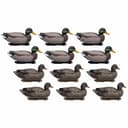 Final Approach Last Pass Mallard Floaters, 12 Pack (FA-193005) Best cheap core spread The cheapest honest dozen on the water. Twelve birds split six drakes and six hens, one-piece HDPE bodies with a weighted keel and an integrated cord lock, at a price that works out to under six dollars a decoy. It is deliberately a compact 12 inches bill to tail rather than full size, which is the trade you make for the count — and on a public marsh the count is what finishes birds. | 12 birds · 12 in | 9.2/ 10 | |
| 2 | 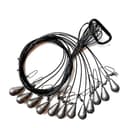 Auscamotek Tangle-Free Texas Rig, 4 oz / 36 in, 12 Pack Best way to set two dozen in the dark The cheapest thing on this page that measurably improves a hunt, and the one most new waterfowlers skip. Twelve pre-made Texas rigs at 4 oz and 36 inches turn a tangled bag of string into a dozen decoys you can throw one-handed in the dark. Nothing about it attracts a duck; everything about it buys you ten extra minutes of legal shooting light. | 4 oz · 36 in · 12 pk | 8.6/ 10 | $29.99View on Amazon Price as of November 22, 2026. #ad How we’re funded |
| 3 | 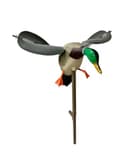 MOJO Outdoors Wind Duck (HW2400) Best motion for the money Motion without a battery, a charger or a remote. The wings spin on whatever breeze is already blowing, the support pole is in the box, and it costs less than half what the cheapest powered spinner does. On the days a budget hunter actually hunts - cold, breezy, public water - it is the highest-value single item in this roundup. | Spinning wing · wind | 8.7/ 10 | $44.99View on Amazon Price as of November 22, 2026. #ad How we’re funded |
Frequently asked questions
How many decoys do you need for a duck spread?
Far fewer than most new hunters assume. Published spreads from named hunters run two to three dozen decoys for shallow-water dabblers, no more than three dozen in green timber, two dozen on a prairie pothole roughly 30 yards wide, and as few as four mallards on a jerk string on a small backwater pond. One quoted hunter starts the season with 500 to 1,000 decoys where birds genuinely congregate and then shrinks the spread as the flocks break up - which is the real principle: imitate what you are actually seeing. For a budget public-marsh hunter, a dozen is a working spread and two dozen is plenty.
Which way should a decoy spread face?
The wind sets it, not the water. Ducks land into the wind, so the landing hole has to sit on the downwind side of the bulk of your decoys. Texas Parks and Wildlife hunter education notes that because ducks always land into the wind, many hunters deliberately set up so the wind blows from the left or right - that gives a crossing shot instead of birds dropping straight in over your head. The same course adds that many hunters face blinds north, both because newly arriving ducks tend to come from the north and because facing north at dawn keeps the sun out of your eyes.
How big should the landing hole be?
Big enough that a bird can commit to it, and wider on a windy day. The published rule is to place most decoys slightly upwind of the landing spot, keep an open hole in the center of the spread, and widen that opening in wind because birds struggle to navigate a tight pocket in a strong breeze. The hard constraint is range: the hunter-education course says to leave space in front of and to the left and right of your shooting position, and that this area must be close enough to be in effective shotgun range. A beautiful hole at 60 yards is a hole you watch birds land in.
How far from the blind should decoys be?
Inside shotgun range, and closer than beginners set them. The published guidance is to keep the whole spread within easy shooting range of the blind, with the landing hole positioned so a bird finishing in it is killable. One published spread sets the spinning-wing decoy 10 to 15 yards from the hunters; another sets two dozen decoys tight against the bank the blind sits on, across a slough roughly 30 yards wide, leaving most of the water open. If your spread is so large that one edge is out of range, you are inviting birds to land where you cannot shoot them.
Do I need a spinning-wing decoy?
No, and in some places you may not use one. Federal migratory bird regulations say nothing at all about motion decoys, which is why the restrictions that exist are state and area-level. They are real: the Arkansas Game and Fish Commission barred spinning-wing and motion decoys on its own wildlife management areas and agency-owned lakes, starting with two WMAs in 2015 and extending to all AGFC-owned WMAs the following year. Where motion is legal, place it near the blind where birds want to land, and keep a jerk string as the backup for when a battery dies in the cold. Where it is not, or where pressure is high enough that birds have learned to avoid spinners, a jerk string on four decoys does the same job for a few dollars.
What is the fastest way to set a decoy spread in the dark?
Pre-rigged lines and a headlamp. The hunter-education course notes that setting decoys is usually done in complete darkness before the morning hunt, and that headlamps give good light while keeping your hands free - which is the whole problem, because you need both hands. Beyond that, rig for your depth: Texas rigs suit shallow water of six feet or less, standard lines suit deeper water, and longlines running up to 100 yards are for deep or current-heavy water. Twelve pre-made Texas rigs turn a bag of tangled cord and twelve knots into a one-handed throw, and buy back ten minutes of the best light of the day.
Is it legal to use recorded duck calls with my spread?
No. Federal regulation prohibits taking migratory birds by the use or aid of recorded or electrically amplified bird calls or sounds, including recorded or amplified imitations, with narrow exceptions for a light-goose-only season and a September Canada and cackling goose season. Live decoys are prohibited too, and the rule treats the presence of tame or captive ducks or geese as a violation unless they have been confined for ten consecutive days in an enclosure that both muffles their calls and conceals them from wild waterfowl. Mouth-blown calls are the legal route.
Should I change my spread during the hunt?
Yes, and the hunter-education course says so directly: it is rare for everything to work perfectly, the wind may change and the decoys may drift, and hunters frequently rearrange a spread mid-hunt to adapt to the new conditions. The practical trigger is flared birds. If two flocks have swung wide at the same point, something in the spread is wrong there - a drifted decoy out of position, a hole that has closed up, or a wind shift that has moved where the landing zone should be. Wading out at 9 am feels like giving up on a setup; it is usually what saves the morning.
Sources
- Decoys — Texas Parks and Wildlife Department hunter education — The state hunter-education course's statement of the whole spread principle, in one sentence: "The basic strategy in setting a decoy spread is to leave a space in front, to the left and right of your blind or shooting position for the ducks to land in", and "The area should be close enough to be in effective range of shotguns". On wind: "Ducks will always land into the wind so many hunters like to set up so the wind is blowing from the left or right, offering a passing shot." On blind orientation: "Many hunters will also set their blinds facing north since many newly arriving ducks will be coming from the north", and because "most duck hunting is done at dawn, facing north will keep the sun out of your face". On the realities of setting: "Setting the decoys therefore is usually done in complete darkness prior to the morning hunt", headlamps "give off good light and keep your hands free", and "It is rare that everything works perfectly, the wind may change, the decoys may drift" - so "Many times hunters will rearrange their decoy spread in the middle of the hunt to adapt for changes in conditions". The page also notes that "Some decoys with battery powered wings simulate ducks that are landing". It publishes no decoy counts and no yardages (accessed November 1, 2026)
- 10 ways to improve your decoys — Ducks Unlimited — The conservation organization's practical checklist, and the source of the rigging and landing-zone rules on the spread guide. Published guidance: leave a landing zone by placing most decoys "slightly upwind of the landing spot", keep an open hole in the center, widen that opening in wind, and keep the whole spread within easy shooting range of the blind; rig for the water you hunt - Texas rigs in shallow water of "six feet or less", standard lines in deeper water, and longlines "which can run up to 100 yards" in deep or current-heavy water; mix species but set each species in its own clusters; vary posture between feeding, resting and alert decoys and use sentries sparingly; add motion near the blind where birds want to land, with a jerk string as the backup "when batteries fail"; skip spinning-wing decoys where hunting pressure is high; favor dark decoys for long-distance visibility; and store decoys in slotted bags, washing mud off with a soft brush, dish soap and a hose, then touching up paint before the season. One quoted expert starts the season with 500 to 1,000 decoys where birds congregate and shrinks the spread as flocks break up, on the principle that "The key is to imitate what you see" (accessed November 1, 2026)
- Waterfowl hunting: 5 simple decoy spreads — Ducks Unlimited — The conservation organization's collection of five real spreads from named hunters, and the source of every decoy count on the spread guide. Published counts and placements: a shallow-water dabbler spread of "two to three dozen decoys" split by species into small groups "along the edges of wetland vegetation surrounding the landing hole", with the spinning-wing decoy "10 to 15 yards away from us"; a green-timber spread of "maybe three dozen at most" with the bulk on "the upwind side of the hole" and six on the far downwind side; a prairie-pothole spread cut from four dozen to two dozen and set "tight against the bank where your blind is located" on a slough "roughly 30 yards wide", leaving most of the water open; a backwater spread of just four mallard decoys "on a jerk string placed on the far upwind side of the pond"; and a late-season goose combination of a dozen floaters, two dozen sleeper shells and one or two full bodies funnelling birds onto an ice shelf. These are hunter-reported setups rather than an experiment, and no yardage is published for three of the five (accessed November 1, 2026)
- 50 CFR § 20.21 — Hunting methods (migratory game birds), Legal Information Institute — The federal rule that governs what a waterfowl spread may and may not include. Paragraph (f) prohibits taking migratory birds "By the use or aid of live birds as decoys", and states that taking waterfowl is a violation wherever tame or captive live ducks or geese are present unless they have been confined for 10 consecutive days before the taking, in an enclosure that "substantially reduces the audibility of their calls" and "totally conceals such birds from the sight of wild migratory waterfowl". Paragraph (g) prohibits taking "By the use or aid of recorded or electrically amplified bird calls or sounds", or recorded or amplified imitations of them, with narrow exceptions for a light-goose-only season and a September 1 to September 30 Canada and cackling goose season. The section says nothing at all about motion or spinning-wing decoys, which is why that question is answered by state and area rules rather than federal ones (accessed October 25, 2026)
- Spinning-wing decoys not allowed for teal hunting on WMAs, AGFC-owned lakes — Arkansas Game and Fish Commission — A state agency notice showing how motion-decoy rules actually work: hunters "will not be allowed to use spinning-wing, or motion decoys to attract teal" on AGFC-owned wildlife management areas and AGFC-owned lakes during the special early teal hunt, with the same restriction applied to the special youth waterfowl hunt. The notice records that the ban began on Bayou Meto and Dave Donaldson Black River WMAs in 2015 and that "This ban was expanded to all AGFC-owned wildlife management areas the next year". It states no penalty. Dated September 6, 2017, so it is cited here as evidence that area-level motion-decoy restrictions exist and must be checked — not as a current statement of Arkansas law (accessed October 25, 2026)
Keep reading
Best Budget Duck Decoys
What to buy before you set anything - five cheap packs ranked on published count, size, body build and keel.
See the rankingsDuck Hunting on a Budget
The whole waterfowl season planned cheaply, from public access to the kit order that matters.
Read the guideBest Budget Hunting Waders
The one item we would not economize past a point, compared on published neoprene thickness.
See the rankingsBest Budget Headlamp
Setting decoys happens in the dark, hands-free. Cheap lamps compared on published lumens and runtime.
See the rankings