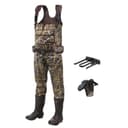
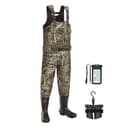
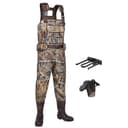
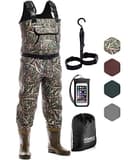
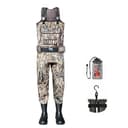
How to choose a budget wader
1. Insulation grams, and why 600 usually beats 800
The gram rating on a wader describes the insulation in the boot, and it behaves exactly the way a gram rating on a hunting boot does — which our insulated boot rankings cover in detail. More is not better. It is just warmer, and warmth you do not need becomes sweat, and sweat is what makes feet cold.
- 600 gram is the all-season answer for most waterfowl hunters. Warm enough to stand in cold water, cool enough that walking into a marsh in October does not soak your socks.
- 800 gram is right when the hunt is late and mostly still: flooded timber, a January field, a layout blind where your feet do not move for three hours.
- No insulation is right for September teal, for anyone whose wader walks more than it sits, and for crossover use with fishing.
The honest version of this is that most hunters own one wader and should buy the middle number. If you already own uninsulated waders and only need late-season warmth, buy the 800 gram and keep both.
2. Neoprene thickness, in millimetres
Neoprene thickness is the other half of warmth and all of durability. Thicker neoprene insulates the part of you that is actually underwater — your legs — and resists a snag better. Thicker is also stiffer to walk in, which matters on a long hike to a hole.
What the market publishes is thin on the ground. TIDEWE states a 3.5 mm neoprene upper on its own site. The Fiblink and Foxelli listings both state 4 mm. Neither HISEA listing publishes a thickness at all, which is the one real criticism of our top pick. If you hunt deep, cold water and want to buy on this spec, the 4 mm options are the ones that let you.
3. Seams — where cheap waders actually fail
Waders do not usually fail by wearing through the neoprene. They fail at a seam, and most often at the crotch seam, because that is where the most flex and the most water pressure meet. So seam construction is the durability spec, and it is the one almost nobody prints.
TIDEWE is the exception and the reason it earns its award here: the maker publishes triple-finished seams — stitched, glued and taped— plus a quick-drain chest hand-warmer pocket with an inner dry pocket, 3M Thinsulate named as the insulation rather than an unbranded fill, and a stated one-year warranty. One year is not generous. It is, however, the only warranty term published by any maker on this page, and a stated short warranty tells you more than an unstated one.
4. Bootfoot, which on a budget is not really a choice
Waders come as bootfoot (boots built in) or stockingfoot (a neoprene sock, with separate wading boots bought on top). Every pick on this page is bootfoot, and that is correct for this budget: a stockingfoot wader plus decent wading boots costs more than any complete wader here, and a bootfoot wader has one fewer place to leak and nothing to lace in the dark.
The trade is that when the boot fails, the wader is finished, and that you cannot tune the fit of the foot independently of the leg. Which brings us to the thing this whole category gets wrong.
Sizing: the part no maker here will help you with
We checked all five listings and the makers’ own pages. None publishes a chart relating your shoe size to a wader size, and that is a genuine gap rather than something we failed to find. Here is what to do instead:
- Size the foot first, and size it up. You will wear a heavy sock inside a wader boot, usually a merino one from our sock rankings, and a tight wader boot cannot be fixed. A roomy one can be fixed with a thicker sock.
- Then check the inseam and the chest, not the waist.Chest waders are sized by stature and girth as much as by foot. If you are tall and thin or short and broad, read the listing’s own size table rather than assuming your trouser size.
- Try them on over the clothes you will hunt in. A wader fitted over a T-shirt will not close over a fleece and a base layer in January. Our layering guide is the right reference for what is going underneath.
- Walk, squat and step up in them indoors before the tags come off. The failure you are looking for is the crotch seam pulling when you lift a knee, which is the motion that eventually splits it.
Safety, which is the reason to care about fit
Waders are the only clothing in hunting with a genuine drowning risk attached, and the mechanism is simple: step into water deeper than your waders, and the legs fill. A wader belt worn tightly at the waist is the standard mitigation — it traps air and slows the fill — and not one of these five listings mentions one, so buy a belt separately and wear it.
Cold water compounds it. The National Weather Service’s cold-weather guidance is the right background reading here: cold shock and loss of dexterity arrive long before hypothermia does, and both happen faster than people expect. Practical rules: know the bottom before you walk on it, do not wade a channel you have not probed, hunt with somebody when you can, and keep a dry layer in a bag in your pack. Our duck hunting on a budget guide covers the rest of the kit this hunt needs.
What a budget wader will not do
Being honest about the ceiling is more useful than pretending there is not one:
- Breathe. Neoprene is a wetsuit material. On a warm walk in, you will sweat inside it regardless of the gram rating, and there is no budget answer to that. Breathable waders exist and they are a different product at a different price.
- Survive briars.Neoprene punctures. A pinhole is repairable with neoprene cement, which is worth owning before you need it — our wader repair guide covers finding the hole, which is the hard part — but a budget wader pushed through thorns has a finite life.
- Come with a long warranty.One year, on one product, is the whole warranty coverage available on this page. Budget accordingly: treat a cheap wader as a three-to-five season item, store it hung and dry rather than folded, and keep it out of a hot garage — the same rules that make rubber boots last, covered in our rubber boot rankings.
- Replace a hunting boot. Waders are miserable for walking distance. If your hunt involves a mile of dry ground before any water, you want real boots and a plan to change, not waders for the whole trip.
Regulations worth checking before you buy
Two rules shape waterfowl hunting more than any gear decision. First, nontoxic shot: the federal lead-shot ban for waterfowl phased in from 1987-88 and became nationwide in 1991, and only shot types approved under the relevant federal rule may be possessed afield for ducks, geese, brant, swans and coots. Second, a Federal Duck Stamp is required for waterfowl hunters aged 16 and over, and almost all of its price funds habitat.
Neither is about waders, but both are about whether your season is legal, and both are cheaper to get right in October than in December. Public-land access rules vary on top of that — our public-land gear list is the broader checklist.
Who should buy which
- Most waterfowl hunters: HISEA 600G. The right insulation number for a whole season, at the lowest price among the established picks here.
- Anyone who wants to compare on paper:TIDEWE 600G. Published 3.5 mm neoprene, published triple-finished seams, named Thinsulate insulation, stated one-year warranty.
- Late-season and layout-blind hunters: HISEA 800G. Buy it knowing it is too much boot for an October walk-in.
- Early-season, crossover and women’s fit: Foxelli 4 mm. No insulation, 4 mm neoprene, and the only pick here listed for women.
- Tightest budget:Fiblink 600G. Publishes 4 mm neoprene and 600 gram boots for less than anything else here, and publishes nothing about seams, which is the gamble you are taking.