Blaze & Budget

Best Budget Hunting Socks

The cheapest upgrade available to a cold hunter, and the one almost everybody skips after spending two hundred dollars on boots.

By Stephen V.Last updated How we rank

Hunters will research boots for three weeks and then pull on whatever cotton athletic socks were on top of the drawer. It is the most reliably self-defeating decision in cold-weather gear, because the sock is the part of the system in contact with your skin and it decides what the boot is even able to do.

Cotton is the specific problem. It absorbs somewhere around a quarter of its own weight in water before it feels wet to you, it holds that water against your foot, and wet skin loses heat far faster than dry skin. A cotton sock inside a well-insulated boot produces cold feet in a way that a wool sock inside a cheap boot does not. The boot is not the variable.

Below are four socks that fix it, from a lifetime-guaranteed pair down to three-pairs-for-fifteen-dollars merino. We have not worn these; we compared what each maker publishes — fiber content, cushion weight, height, guarantee — ran the cost-per-season math on live prices, and flagged every spec the listing does not state. Our method is here.

How this is funded:we earn a commission if you buy through our links, at no extra cost to you. It never changes which product we recommend, and we’ll tell you plainly when we’d skip one. Full disclosure.

Quick picks

Ranked on price-per-performance — the specs that matter divided by what it costs. Select a row to jump to the full write-up. We have not field-tested these — here is exactly what we do instead.

#ProductFiber / weightScorePrice
1
Darn Tough Boot Midweight Cushion Hunting Sock (2111)

Darn Tough Boot Midweight Cushion Hunting Sock (2111)

Best buy-once sock

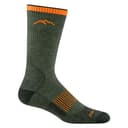
The buy-once sock. Darn Tough states 34% merino and a true seamless toe, and the brand's unconditional lifetime guarantee turns a single expensive pair into a running cost of roughly zero.

34% merino · midweight
9.1/ 10
$28.95View on Amazon

Price as of September 5, 2026. #ad How we’re funded

2
Realtree Heavyweight Merino Blend Mid-Calf (2 pair)

Realtree Heavyweight Merino Blend Mid-Calf (2 pair)

Best value for cold sits

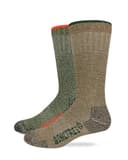
Two pairs of heavyweight full-cushion merino blend for what one premium sock costs. This is the sock most budget hunters should buy, and buying two pairs at once is the point — you rotate, one dries.

Merino blend · heavyweight
8.8/ 10
$16.98View on Amazon

Price as of September 5, 2026. #ad How we’re funded

3
Muck Boot Merino Blend Camo Tall (2 pair)

Muck Boot Merino Blend Camo Tall (2 pair)

Best for rubber boots

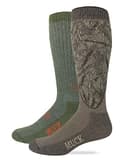
A tall sock designed by a rubber-boot company for rubber boots, which is exactly the pairing most budget hunters get wrong. Tall matters here: a mid-calf sock inside a 16-inch boot leaves bare skin against cold rubber.

Merino blend · tall
8.5/ 10
$19.99View on Amazon

Price as of September 5, 2026. #ad How we’re funded

4
Alvada Merino Wool Thermal Crew (3 pair)

Alvada Merino Wool Thermal Crew (3 pair)

Cheapest merino that works

Three pairs of merino for roughly half the price of one premium sock. Nothing about these is special, and that is the argument: they get wool on your feet at a price where you can afford enough pairs to rotate.

Merino · crew
8.2/ 10
$14.99View on Amazon

$26.9944% off

Price as of September 5, 2026. #ad How we’re funded

The picks in full

#1Best buy-once sock9.1/ 10 value

Darn Tough Boot Midweight Cushion Hunting Sock (2111)

The buy-once sock. Darn Tough states 34% merino and a true seamless toe, and the brand's unconditional lifetime guarantee turns a single expensive pair into a running cost of roughly zero.

Strengths

  • 34% merino stated on the listing, with a true seamless toe
  • Unconditional lifetime guarantee — the reason the cost-per-season math wins
  • Midweight cushion suits a leather boot on a long walk in

Trade-offs

  • Costs more per pair than three pairs of the value picks here
  • Midweight is not enough sock on its own for a static late-season sit
Merino content34% (stated)
CushionMidweight, full cushion
HeightBoot
GuaranteeDarn Tough unconditional lifetime

Specs read from the product listing, on August 19, 2026. “Not published” means the maker doesn’t state that figure. The score is our value rating, not a lab test — how we rank.

#2Best value for cold sits8.8/ 10 value

Realtree Heavyweight Merino Blend Mid-Calf (2 pair)

Two pairs of heavyweight full-cushion merino blend for what one premium sock costs. This is the sock most budget hunters should buy, and buying two pairs at once is the point — you rotate, one dries.

Strengths

  • Heavyweight full cushion — the right weight for a stationary November sit
  • Two pairs per pack, so the wet one dries while you hunt in the dry one
  • Merino blend gets you the wool warm-when-damp behavior at a low price

Trade-offs

  • The listing does not publish the merino percentage — the blend is unknown
  • Heavyweight is too much sock inside an already-tight boot
Merino contentNot published
CushionFull cushion, heavyweight
HeightMid-calf
Pack2 pair

Specs read from the product listing, on August 19, 2026. “Not published” means the maker doesn’t state that figure. The score is our value rating, not a lab test — how we rank.

#3Best for rubber boots8.5/ 10 value

Muck Boot Merino Blend Camo Tall (2 pair)

A tall sock designed by a rubber-boot company for rubber boots, which is exactly the pairing most budget hunters get wrong. Tall matters here: a mid-calf sock inside a 16-inch boot leaves bare skin against cold rubber.

Strengths

  • Tall height covers the full shaft of a rubber boot — no bare-skin gap
  • Two pairs per pack at a value price
  • Merino blend from the maker that knows what a rubber boot does to a sock

Trade-offs

  • Merino percentage is not stated on the listing
  • Tall socks are hot walking; this is a sit-still sock
Merino contentNot published
HeightTall boot
Pack2 pair
CushionNot published

Specs read from the product listing, on August 19, 2026. “Not published” means the maker doesn’t state that figure. The score is our value rating, not a lab test — how we rank.

#4Cheapest merino that works8.2/ 10 value

Alvada Merino Wool Thermal Crew (3 pair)

Three pairs of merino for roughly half the price of one premium sock. Nothing about these is special, and that is the argument: they get wool on your feet at a price where you can afford enough pairs to rotate.

Strengths

  • Three pairs per pack — a whole season's rotation in one purchase
  • Merino stated, which is the fiber that stays warm when it is damp
  • Cheap enough that wearing them out is not a financial event

Trade-offs

  • Merino percentage is not published; expect a modest blend
  • No meaningful warranty — treat them as consumables, not an investment
Merino contentNot published
HeightCrew
Pack3 pair
CushionNot published

Specs read from the product listing, on August 19, 2026. “Not published” means the maker doesn’t state that figure. The score is our value rating, not a lab test — how we rank.

Why wool, specifically

Merino is not a marketing fiber. It behaves differently from cotton and from synthetics in three ways that matter to a hunter sitting still in the cold.

It keeps insulating when damp. Wool fibers are crimped, and the crimp traps air even when the fiber itself has taken on moisture. Cotton fibers collapse and pack down when wet, which closes the air spaces that were doing the insulating. This is the entire argument, and it is why a damp wool sock is uncomfortable while a damp cotton sock is dangerous.

It moves moisture away from skin. Wool wicks perspiration outward into the sock body where it can evaporate, rather than holding it at the surface. Your feet sweat on the walk in whether it is cold or not; what happens to that sweat when you sit down is the difference between comfortable and miserable at hour three.

It does not stink as fast. Wool resists the bacterial growth that produces odor, so the same pair goes multiple days without becoming a problem. That matters for scent discipline on a multi-day hunt, and it matters more mundanely for how many pairs you need to own.

Synthetic hunting socks are not bad — they dry faster than wool and cost less — but they lose the warm-when-damp property, which is the one you are actually buying. We work through the same trade for the layer above in our merino vs synthetic base layers comparison.

How much merino do you actually need?

Almost every hunting sock is a blend, and the percentage matters more than the word on the package. Pure wool has no stretch, wears through at the heel and shrinks, so the nylon and elastane in a blend are doing real structural work. What you are looking for is enough wool to get the thermal behavior.

  • Under about 20% merino— the wool is mostly a label. Treat it as a synthetic sock.
  • Roughly 30–50% merino— the practical sweet spot. Warm-when-damp behavior with real durability. The Darn Tough here states 34%.
  • Above about 60% merino— noticeably warmer and noticeably shorter-lived. Worth it for a sock you only wear on cold sits.

Two of the four socks here do not publish their percentage, which we have marked as unpublished rather than estimated. That is a genuine gap in the buying information and you should treat an unstated blend as a modest one.

Weight and height: match the sock to the hunt

Sock weight is about how much you are moving, not how cold it is. This is counterintuitive and it is where most people go wrong.

Walking in? Midweight. A heavyweight sock on a long walk produces sweat, and the sweat is what makes you cold once you stop. The Darn Tough midweight is the right density for a boot you cover ground in, like the Irish Setter VaprTrek.

Sitting still all day?Heavyweight, and buy the boot a half size up to make room for it. A heavy sock crammed into a correctly-sized boot compresses the loft out of both the sock and the boot’s insulation and restricts circulation, which produces colder feet than a thin sock in a roomy boot. This is the most common cold-feet mistake there is, and we cover the full hierarchy in how to keep your feet warm hunting.

Wearing rubber boots? Buy tall. A 16-inch rubber boot with a mid-calf sock leaves bare skin pressed against cold rubber for six inches of your leg, and rubber conducts heat away from you enthusiastically. The Muck tall sock exists for exactly this and it is the reason it is on the list.

The cost-per-season math

This is where the expensive sock stops looking expensive, and it is worth doing the arithmetic rather than asserting it.

A pair of cheap merino socks lasts a season or two of hard hunting before the heel goes. Call it two seasons at the low price, and you are buying again. A Darn Tough pair carries an unconditional lifetime guarantee: wear a hole in them and the company replaces them, for as long as you keep wearing them out. That is not a marketing lifetime with conditions attached — it is the brand’s core promise and it is why it appears at the top of this list despite costing more than two of the multi-packs combined.

Over a ten-year hunting horizon, one guaranteed pair beats five replacement pairs on money and on annoyance. Where the cheap multi-packs win is quantity, and quantity is a genuine requirement: you need enough pairs to rotate so that a damp pair dries while you hunt in a dry one. The honest answer for most budget hunters is one guaranteed pair for the coldest sits plus a multi-pack for rotation, which is roughly the price of one premium sock set.

The liner sock question

A thin synthetic or silk liner under your wool sock does one job: it moves the friction from your skin to the sock interface, so blisters form between the two layers instead of on your heel. If you get blisters, a liner is one of the cheapest fixes available and worth trying before anything else.

It is not a warmth strategy. Two socks crammed into a boot sized for one compress everything and restrict blood flow, which makes your feet colder. If you run liners, size the boot for both layers from the start. Our break-in guide covers the lacing fixes that solve most heel movement without adding a layer at all.

What we would skip

  • Cotton, in any weight, at any price. This is not a budget compromise, it is a system failure. If all you own is cotton, a fifteen-dollar merino three-pack is the highest-return purchase in your entire kit.
  • Battery-heated socks under $60. The idea is sound and the execution at this price is not: short runtimes, bulky battery packs at the calf, and a failure mode where you are now wearing a thin sock with a dead wire in it. Fix the sock, the boot fit and the circulation first.
  • Compression socks marketed for hunting. They are designed for a different problem, and graduated compression under a tight boot is not a warmth strategy.
  • Buying one pair. Whatever you choose, you need at least two so one can dry. A single premium sock is worse than two adequate ones.
Frequently asked questions

Are merino wool socks worth it for hunting?

Yes, and they are the cheapest meaningful warmth upgrade you can make. Wool fibers are crimped, so they keep trapping air even when they have taken on moisture, while cotton collapses when wet and holds water against your skin. Wool also wicks sweat outward and resists odor bacteria, so the same pair works over multiple days. The percentage matters more than the label — roughly 30 to 50% merino in a blend is the practical sweet spot for warmth and durability together.

How thick should hunting socks be?

Match the weight to how much you are moving, not to the temperature. Midweight for walking, because a heavyweight sock makes you sweat on the way in and the sweat is what makes you cold once you sit. Heavyweight for stationary sits, but only if the boot has room for it. A thick sock crammed into a correctly-sized boot compresses the loft out of both the sock and the insulation and restricts circulation, which is the single most common cause of cold feet in expensive boots.

Should hunting socks be tall or crew height?

It depends on the boot. With a tall rubber boot, buy tall socks: a mid-calf sock inside a 16-inch rubber boot leaves six inches of bare skin pressed against cold rubber, and rubber pulls heat out of you efficiently. With an 8-inch leather boot, a boot-height or crew sock is enough, and a tall sock is just hot on the walk in. The height that matters is the one that reaches past the top of the boot shaft.

Are expensive hunting socks actually better?

Sometimes, and the honest reason is usually the guarantee rather than the fiber. A sock with an unconditional lifetime replacement policy costs three times as much once and then never again, which beats replacing a cheap pair every two seasons on both money and hassle over a hunting lifetime. Where cheap multi-packs genuinely win is quantity, and quantity matters — you need enough pairs to rotate so a damp pair dries while you hunt in a dry one.

Should I wear two pairs of socks hunting?

Only for blisters, and only if the boot has room. A thin liner sock under a wool sock moves the friction to the interface between the two layers so blisters form there instead of on your heel, which is a cheap and effective fix. It is not a warmth strategy: two socks in a boot sized for one compress the insulation and restrict blood flow, and cold feet follow. If you run liners, size the boot for both layers.

How many pairs of hunting socks do I need?

At least two, and three is better for a multi-day hunt. The reason is drying rather than cleanliness — a sock that has absorbed a morning of sweat insulates worse than a dry one, and it will not dry inside a boot. Rotating gives each pair a full day to dry out. This is also the argument for pairing one premium sock for cold sits with a cheap multi-pack for rotation rather than buying a single expensive pair.

Sources

Keep reading