What Irish Setter publishes
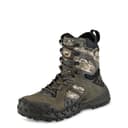
The VaprTrek in this configuration is an 8-inch boot in waterproof full-grain leather and nylon, with Irish Setter’s UltraDry waterproofing system, a scent-control lining, an aggressive lugged outsole, and no insulation. Those five facts decide almost everything about whether it suits your hunting, and the rest of this review is an argument about what each one means in the woods.
The weight, and why it is the whole point
Boot weight is the most under-rated specification in hunting gear, because the cost of carrying it is cumulative rather than immediate. A boot does not feel heavy when you put it on in the dark at the truck. It feels heavy at the end of the second mile, and it feels heavy in a way that changes decisions.
The reason is that weight on your foot is not equivalent to weight on your back. Your foot travels through a full arc on every step and you accelerate and decelerate that mass thousands of times an hour. The practical consequence is straightforward: heavy boots make you less willing to walk the extra half mile past where everybody else parked.
On public land, that half mile is the entire game. Hunting pressure drops off sharply with distance from access points, and the boot that makes you willing to go further is doing more for your season than almost anything you could buy. That is the VaprTrek’s actual argument, and it holds.
Uninsulated: read this before you buy
This is the specification people misread most often, and it is where most VaprTrek disappointment comes from.
An uninsulated boot is the correct choice for any hunting where you are moving: early season, spooking-and-stalking, scouting, walking in to a stand, turkey hunting in spring. Insulation in a moving boot makes your feet sweat, and sweat inside a waterproof boot has nowhere to go, so you finish the walk with wet feet in a boot that cannot dry. That is a colder outcome than no insulation at all.
An uninsulated boot is the wrong choice for a stationary November or December sit. Sitting still in a treestand at 25°F, you are generating almost no heat and the boot has nothing to hold. No sock fully compensates for that, though a heavyweight merino sock and a boot with room for it get you further than most people expect.
The honest way to read this: the VaprTrek is a walking boot that happens to be waterproof, not a cold-weather boot that happens to be light. If your season is mostly cold sits, buy an insulated boot instead and accept the weight. If your season is a mix, most budget hunters end up with this boot for October and a cheap insulated rubber boot for December, which together cost less than one premium do-everything boot and work better.
UltraDry waterproofing, and what waterproof means over time
Every waterproof hunting boot works the same way: a membrane between the leather and the lining lets water vapor out and blocks liquid water coming in. UltraDry is Irish Setter’s implementation of that idea, and while the maker does not publish the membrane’s technical specification, the concept and its failure modes are well-understood.
The failure is almost never the membrane. It is the leather outside it. Leather that has dried out, cracked, or filled with mud stops shedding water and starts holding it, and a saturated upper feels exactly like a leaking boot from the inside even though the membrane is intact. The fix is cheap and takes twenty minutes, and it is the single highest-return piece of boot maintenance there is — we walk through it in how to waterproof hunting boots.
A membrane boot also has a hard ceiling: it is waterproof to the top of the shaft and no further. Eight inches is enough for wet grass, dew, light snow and a shallow creek crossing. It is not enough for a flooded timber hole or a marsh edge, and no amount of treatment changes that. For those, you want rubber boots, which is a different tool rather than a better one.
The scent-control lining: our honest read
Irish Setter states a scent-control lining. We are not going to tell you it is worthless and we are not going to tell you it kills deer, because neither claim is supportable from published information.
What we can say is where it sits in the hierarchy. A whitetail carries roughly 297 million olfactory receptors against a dog’s 220 million. You are not defeating that with a boot lining. What a boot lining plausibly does is reduce the bacterial odor your own footwear accumulates over a season, which is a real and modest thing.
Treat it as a small bonus on a boot you are buying for its weight, and put your actual scent effort into wind discipline, which is free and works. Our scent control guide ranks the whole stack honestly, and boot linings are not near the top.
Break-in, and the thing to do in week one
Full-grain leather needs a break-in period and the VaprTrek is no exception, though it is milder than a traditional heavy leather boot because the nylon panels flex from the start.
Do not skip it. The classic failure is buying boots in September, wearing them once, and then walking two miles into public land on opening morning with a fresh pair on. The blisters that produces will end your hunt more reliably than the weather will. Four weeks of increasing wear before the season costs nothing and prevents it entirely; the schedule is in our break-in guide.
Who should skip the VaprTrek
- The late-season stand hunter. Uninsulated is simply the wrong tool for sitting still in the cold, and buying it anyway and hoping socks fix it is how people end up hating a good boot.
- The waterfowl or marsh hunter. Eight inches of waterproofing ends at eight inches. Buy rubber.
- The hunter who needs one boot for everything and hunts a real winter. There is no such boot at this price. Two cheaper specialized pairs beat one compromised pair, and cost less.
- Anyone shopping purely on price.This is a mid-tier boot, not a bargain one. If the budget is genuinely tight, an insulated rubber boot delivers more weatherproofing per dollar and needs no break-in at all — it just walks worse.
The verdict
The VaprTrek earns its position because it solves the problem most public-land hunters actually have, which is covering ground to get away from other hunters without wrecking their feet. It is light, it is genuinely waterproof to the top of the shaft, and it walks like a hiking boot with better traction.
What it is not is a cold-weather boot, and the maker does not claim it is. Buy it as the boot you walk in, pair it with a proper merino sock, treat the leather twice a season, and add a cheap insulated rubber boot when the temperature drops. That two-boot system is the budget answer, and it is better than the single-boot answer at any price we would recommend.