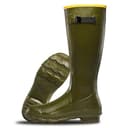
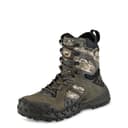
The four differences that actually decide it
Strip away the marketing and there are four real distinctions. Everything else — camo pattern, brand heritage, tread name — is noise.
1. Scent
A rubber boot is a sealed, non-porous barrier. Your boot is the one piece of gear in constant contact with the ground a deer will put its nose on, so the difference between a material that holds and releases human odor and one that does not is more than marketing. Purpose-made hunting rubber — the natural rubber compounds LaCrosse and others use — is also relatively neutral in its own right, rather than off-gassing the way some synthetics do. The clearest example of a boot built around that claim is examined in our LaCrosse Grange 18-inch review.
Leather is porous. It absorbs sweat, holds it, and releases it along your entire walk in. Treatments and sprays reduce this; they do not eliminate it. If you hunt a small property where deer regularly cross your entry route, or you are working close to a bedding area, this is the single strongest argument for rubber and it is why so many whitetail hunters own a pair regardless of what else is in the closet.
Keep it in proportion, though. Boot scent is one input among many, and it is dominated by wind. A rubber boot on a bad wind is still a hunter a deer smells — see scent control on a budget for where boots sit in the actual hierarchy.
2. Water
A knee-high rubber boot is waterproof in a way no leather boot can match, because there is no membrane to fail and no seam to wet out. You can stand in six inches of creek and think about something else. An 18-inch upper crosses flooded timber, marsh edge and beaver slough without a decision.
A waterproof leather boot is waterproof in a different, weaker sense: a membrane keeps liquid water out until the leather saturates and the boot stops breathing, or until the membrane is damaged by grit, flex and age. Two or three seasons of hard use is a realistic life for a budget membrane. That is not a defect; it is the trade you make for a boot you can walk in.
3. Miles and support
This is where leather wins outright. A leather hunting boot has a structured heel counter, a lasted shape that can be fitted to your foot, a shank that resists twisting on side-hill ground, and an ankle that supports rather than just covers. It flexes where your foot flexes.
A rubber boot is a straight-sided tube. Your heel lifts inside it with every step, which is the mechanism that produces blisters, and the lack of torsional stiffness means every uneven step is absorbed by your ankle instead of the sole. Some rubber boots add a steel shank to address exactly this, and it helps meaningfully — but it narrows the gap rather than closing it.
The practical threshold: most hunters are comfortable in rubber up to about a mile of easy ground. Past that, or on anything steep, the boot starts costing you.
4. Warmth and how you actually hunt
Rubber does not breathe. On a cold sit that is an advantage; on a warm walk in it means your foot arrives wet with its own sweat, and a wet foot loses heat many times faster than a dry one. That is why hunters in rubber boots often report cold feet in conditions that should be comfortable — the insulation is fine and the moisture is the problem. Our guide to keeping your feet warm covers the fix, and it is rarely more insulation.
Leather breathes, so it manages a walk-in far better, but it also loses heat faster on a static sit at the same insulation rating. Neither material is warmer in the abstract. The right question is whether the cold part of your hunt is the walking or the sitting.
Side by side
- Scent control: rubber, clearly.
- Standing in water: rubber, no contest.
- Walking more than a mile: leather, no contest.
- Steep or side-hill ground: leather.
- Sitting still in the cold:insulated rubber, narrowly — provided you got there dry.
- Long-term durability: leather, if you maintain it. Rubber eventually cracks at the flex point and cannot be repaired.
- Fit precision: leather. Rubber comes in whole sizes and generous shapes; you fit around it with socks.
- Price at the bottom of the market: rubber. The cheapest usable hunting boot is almost always rubber.
So which do you buy first?
Answer the question about distance honestly, because hunters consistently overestimate how far they walk and then buy boots for the hunt they imagine.
Buy rubber first if you hunt a stand or blind within about half a mile of where you park, hunt wet ground, flooded timber or marsh edge, or hunt pressured whitetail on a small property where your entry route matters. This covers a large share of eastern and midwestern deer hunting, and it is why an uninsulated-to-lightly-insulated rubber boot is the most sensible single first boot for many hunters. Add insulated rubber later for the late season.
Buy leather first if you cover real distance, hunt hills or mountains, still-hunt or spot-and-stalk, hunt western public land, or plan to use the boot for scouting and shed hunting as well. A leather boot you can walk in is also the more versatile purchase overall, which matters when it has to be the only pair.
Most hunters who do this for a few seasons end up owning both, and that is not a failure of planning — it is the correct answer, arrived at slowly. If you can only fund one now, buy the one that matches the hunting you will actually do this season and add the other when the season shows you the gap. Our full budget boot rankings cover both camps, and the dedicated rubber and insulated roundups go deeper on each.
Two things that change the answer
Snake country. If you hunt the southern or southwestern US in early season, snake protection is a separate requirement that both materials can meet, but it is bought specifically rather than assumed. Do not infer it from boot height.
Sizing. Rubber boots are sold in whole sizes and fitted with socks; leather boots are lasted and should be fitted precisely, ideally in the afternoon when your feet have swollen and in the socks you actually hunt in. A rubber boot that is slightly large is workable. A leather boot that is slightly large will blister you, and no amount of break-in fixes a size error.