What the gram rating actually means
The number on an insulated boot — 400g, 800g, 1,000g — is the weight of insulation per square meter of material, not the weight of the boot and not a temperature rating. There is no industry-standard temperature conversion, which is why two 800-gram boots from different makers can feel different. What the number does give you is a reliable way to compare boots within the same construction type.
The working rule most hunters land on:
- 200–400 g— early season, active hunting, walking, scouting. Anything more and you sweat.
- 600–800 g— the do-everything band. Cold-weather sits with a moderate walk-in, most of October through early December for most of the country.
- 1,000 g and up— stationary late-season hunting in genuine cold. Excellent in a stand at 20 degrees, miserable on any real walk.
- Unrated “insulated”— treat as mid-season and no warmer. If the maker will not publish a number, we will not invent one for them.
Movement matters more than temperature
This is the part budget hunters get wrong most often, and it costs them a whole boot purchase. Insulation does not create heat; it traps the heat your body makes. When you walk, your feet generate a lot of heat and also a lot of moisture. Heavy insulation traps both. The sweat then soaks the insulation, insulation stops working when it is wet, and you arrive at the stand with damp feet that get genuinely cold within the hour.
So the correct question is not “how cold does it get here?” It is “how far do I walk and how still do I sit?” A hunter with a mile walk-in to a stand at 25 degrees is better served by 400 grams plus a good sock and a pair of boot blankets than by 1,000 grams. A hunter who drives to a ladder stand 100 yards from the truck should buy the 1,000-gram boot.
Rubber or leather?
Both appear on this page, and they solve different problems.
Insulated rubber
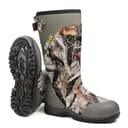
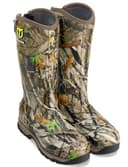
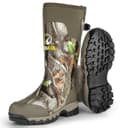
A neoprene-lined rubber boot is the standard whitetail answer. It is waterproof with no membrane to fail, holds very little human scent, and pulls on and off without laces in the dark. It walks poorly and supports the ankle badly. For a stand hunter on wet ground with a short walk-in, it is the correct boot and it is usually the cheaper one too.
Insulated leather
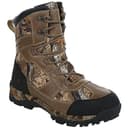
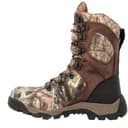
A lace-up insulated leather boot supports the ankle on uneven public ground, walks far better, and lasts longer if you care for it. It holds scent in a way rubber does not, and its waterproofing depends on a membrane and treated leather rather than on being a solid piece of rubber. For a hunter covering ground, it is worth the scent penalty.
If you can only own one and you hunt whitetail, buy the rubber. If you can only own one and you cover distance, buy the leather. If you can own both, our rubber boot roundup covers the wet-ground half of the kit.
Sizing an insulated boot
An insulated boot must be sized with room for a thick sock and for your toes to move. Circulation is most of foot warmth: a boot laced tight over a compressed sock cuts blood flow and will be colder than a looser boot with less insulation. Most hunters go up a half to a full size for insulated boots. If your toes touch the end when standing, the boot is too small no matter what the label says.
Wear one pair of good wool or wool-blend socks, not two pairs of thin cotton ones. Two socks compress and cut circulation. Cotton holds sweat against your skin and is the single worst material you can put in a hunting boot. A $15 pair of merino socks does more for foot warmth than a $50 step up in insulation rating.
The cheap fixes that beat buying a warmer boot
Before you spend $150 on more insulation, spend $40 on the following and see if the problem goes away — and read our cold-weather hunting gear picks, which put boots, socks, hands and layers in the order cold actually beats you:
- A wool sock and a boot one size larger. Fixes circulation, which is most of the problem.
- An insulated insole. Most of the cold comes up through the sole from the stand platform, and the factory insole is a flat piece of foam.
- Boot blankets or an insulated muff. These slip over your boots once you are settled in the stand and are far more effective per dollar than any boot upgrade.
- Change socks at the stand. Walk in with a thin pair, swap to dry wool once you are up. This costs nothing and works better than almost anything else.
The full cold-weather playbook is in how to keep your feet warm hunting, and it is worth reading before you buy anything on this page.