How we picked
Every pick on this page had to clear four gates before it was eligible, in this order. The order matters, because it is the opposite of how these boots are usually sold.
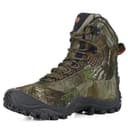
- It is sold as a women’s boot, on a women’s size run.Not a unisex boot with a women’s size chart bolted on. Four of the five here are built and sized for women; the fifth is a women’s hiking boot, and we say so in its write-up rather than pretending otherwise.
- The maker publishes the numbers that decide the purchase.Insulation in grams, shell construction, shaft height. Where a maker will not publish one, we mark it “Not published” on the spec table instead of guessing. Two boots here have real gaps, and those gaps cost them score.
- It is genuinely waterproof, not water resistant.Cold feet are almost always wet feet first. A boot that fails this gate is a shoe with a pattern printed on it.
- It is currently in stock in a real size run.The women’s hunting-boot market is thin enough that plenty of well-reviewed models exist only as a single orphaned size. Those are not recommendations, they are archaeology.
What did notget a gate: brand, camo pattern, and how the boot photographs. All three drive the price of women’s hunting gear and none of them keeps your feet dry.
What “women’s” means on a boot box — and when it means nothing
There are three different things a maker can mean by a women’s boot, and they are worth an extra thirty seconds on the listing before you buy.
A women’s-specific last.The last is the form the boot is built around, and a women’s last is generally narrower through the heel relative to the forefoot, with a different instep height and arch position. This is the version that fixes heel slip, which is the complaint that ruins more boots than anything except leaks. It is also the version that costs the most to tool, so it is the one budget lines skip.
A women’s size run on a shared last.The boot is the same shape as the men’s, offered in smaller numeric sizes. Length will be right. Whether the rest fits depends entirely on your foot, and you will not know until it arrives.
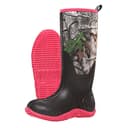
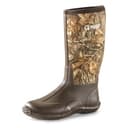
A camo pattern and a lower price.No construction change at all. This is most of the cheap end of the category, and it is not automatically disqualifying — the Guide Gear boot on this page is a straightforward rubber pull-on and it works — but you should know which one you are buying.
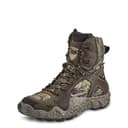
The width question is where this stops being abstract. Irish Setter publishes the women’s VaprTrek in sizes 5 through 11 in both a regular (B) and a wide (D) width. Every rubber boot on this page is sold in one width only. If you have a wide foot, that single line on a spec sheet is the entire decision, and it is why the VaprTrek sits at the top of the list despite costing more than three of the others.
Insulation: match the grams to how much you move
Insulation is measured in grams per square meter of the insulating layer, and the number is a warmth rating, not a temperature rating. Boots do not have honest temperature ratings, because how warm a boot keeps you depends on your circulation, your sock, how long you sit and how wet you got on the walk in. Any listing that promises you a degree number is marketing. One of the boots on this page does exactly that and we called it out in the write-up.
The rule that actually works is to pick grams by activity level rather than by forecast:
- Uninsulated to 200 grams— early season, and any hunt where you are walking most of the day. The XPETI here sits at 200. If you are moving, your own body is the heat source and extra insulation just makes you sweat, which is what makes you cold later.
- 400 grams— the do-everything middle, and the reason the VaprTrek is our top pick. Warm enough for a morning sit into the thirties, cool enough that a mile of walking does not soak the boot from the inside.
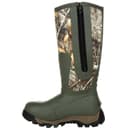
- 800 to 1,200 grams— stationary, cold, late season. The Rocky here is 1,200, which is a lot of boot. It is the right answer if you sit a stand from dark to noon in December and the wrong answer for essentially everything else.
If you can only buy one pair this season and you mostly sit, buy insulated rubber and accept it is heavy. If you mostly walk, buy the leather boot and put the difference into wool socks. We work through the full trade in our hunting boot buying guide, and the same grams-by-activity logic drives the picks on our insulated boot roundup.
The calf-fit problem nobody puts on the spec sheet
Here is the failure mode specific to this category: a 16-inch rubber boot is a fixed cylinder. It has no laces, no gusset and no adjustment. The shaft circumference is decided at the factory and makers almost never publish it — none of the three rubber boots here does.
That cuts both ways, and both ways end in a returned boot. A shaft that is too narrow will not go over a calf, full stop. A shaft that is too wide flops, which means the boot pivots on your foot every step, which means blisters and a boot that pulls off in deep mud. Neither is a size problem you can fix by ordering a different number, because the number only changes the foot.
The practical answers are unglamorous and they work. Measure your calf at its widest point before ordering and ask the seller for the shaft measurement if it is not listed. Order from somewhere with free returns and treat the first pair as a fitting, not a purchase. Try the boot on over the sock you will actually hunt in — a heavy merino sock adds real circumference, and it is the sock you should be sizing around anyway, which is the argument we make at length in our budget hunting sock picks. And if the calf is genuinely the problem rather than the foot, a lace-up leather boot solves it in a way that no rubber boot can.
Should you just buy a men’s boot in a smaller size?
Sometimes, and it is a legitimate budget move rather than a compromise you should feel bad about. The men’s and unisex lines are deeper, they discount harder, and a hunting boot is not a dress shoe. Plenty of women hunt in unisex rubber boots and are perfectly happy.
Two cautions, though. First, the conversion is not universal. Makers publish their own unisex-to-women’s size guidance and it varies by brand and by boot, so use the size chart on the specific model rather than a rule of thumb you read somewhere. Second, going down in length does not go down in width or heel volume proportionally. A smaller men’s boot is a shorter men’s boot, and if your complaint is heel slip or a sloppy midfoot, a smaller size makes the length wrong without fixing the shape.
The honest decision rule: if you are buying a pull-on rubber boot with a thick sock and your main variable is length, a unisex boot is fine and often cheaper. If you are buying a lace-up leather boot you intend to walk in for six seasons, pay for the women’s last and the width option. That is the same conclusion we reach comparing rubber against leather generally: the boot you walk in deserves the fit money, and the boot you stand in does not.
What we would skip
- Fashion rain boots with a camo print. Tall rubber boots from lifestyle brands cost as much as the Rocky here, weigh more, have no insulation rating, and use a hard rubber compound that is loud against brush. They are not built for the woods and they are priced like they are.
- Anything advertised with a temperature rating and no gram figure.A degree number with nothing behind it is a substitute for the spec, not a summary of it. Grams are comparable; “good to -20” is not.
- Buying up in insulation to be safe. The most common cold-feet mistake is a heavily insulated boot crammed with a thick sock, which compresses the loft and restricts circulation and leaves you colder than a thinner boot with room in it. Start with the actual hierarchy of cold feet before you buy warmer.
- A single orphaned size at a great price.The women’s hunting-boot market is full of one-size-left listings on discontinued models. If it is not your size, a good price on it is not a deal.
- Skipping the sock budget. The gap between a $36 boot and a $90 boot is smaller than the gap between a cotton sock and a merino one. If money is tight, buy the cheaper boot and the better sock, in that order.
Where to learn the rest of it
Gear is the easy part of entering hunting and the part the internet over-weights. If you are among the third of new hunters this page opened with, the highest-return thing you can do is not a boot purchase — it is a weekend with instructors and loaner equipment. Most state wildlife agencies run a Becoming an Outdoors-Woman program: Minnesota’s DNR, for one, runs fall, winter and spring workshops plus dedicated archery deer, firearm deer and firearm upland bird hunts, with the gear and the instruction provided. Check your own state agency’s education page; nearly all of them have a version of this.
When you are ready to assemble the rest of the kit around these boots, our public-land gear list is the cheapest complete setup we can defend, and what it costs to start hunting puts real numbers on the whole first season.