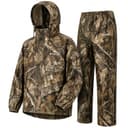
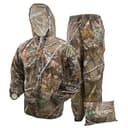
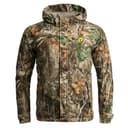
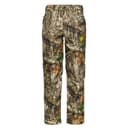
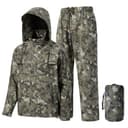
How we picked
Four gates, applied in this order. The order matters, because it is almost the reverse of how budget rain gear is sold — which is on the camo pattern first, the word “breathable” second, and everything that actually keeps water out somewhere below the fold.
- The listing states how the seams are treated. This is the single most useful sentence on a rain-gear listing and the one most often missing. Fabric can be perfectly waterproof and the garment can still leak, because every seam is a line of needle holes. Taped or welded seams close them. Three of our five picks state a seam treatment; two do not, and their spec tables say so.
- A named brand with a model number. Search “hunting rain suit” and most of the first page is unbranded, sold under a name that will not exist next season, with a specification you cannot check against anything. Every pick here has a brand, a model number on the listing, and a product line that has been sold for more than one year.
- A camo pattern, not a color. Not because deer are studying the print — they are not — but because a plain glossy shell is the single most visible thing you can wear in the woods, and because a rain shell goes on over everything else you own. Whatever is on the outside is what gets seen.
- Described closures. Hood, cuffs, waist, hem, leg openings. Water does not usually come through a rain jacket. It runs down your neck, up your sleeves and in around your waist. A listing that describes its closures has thought about that; a listing that does not, has not.
What did not earn a gate: the specific camo pattern, the word “breathable” used without a figure, and any claim about being “silent.” Pattern names are marketing. Breathability without a number is a hope. And quiet is worth paying for, but only one listing here describes its own fabric that way, so it is a tiebreaker on this page rather than a gate.
The rating almost nobody publishes
Waterproofing is measured as a hydrostatic head: how tall a column of water the fabric holds back before it starts to leak, stated in millimeters. It is not a marketing invention. Frogg Toggs publishes the interpretation on its own website — 5,000 mm for light conditions, 10,000 mm for mild conditions, and 20,000 mm and up for extreme conditions — alongside a matching breathability scale running from 5,000 grams per square meter for low activity to 20,000 and up for high-intensity work.
Here is the awkward part. That same manufacturer publishes no millimeter figure for the DriPore Gen 2 fabric in the suit we rank first, and neither of the ScentBlocker Drencher pieces states one either. The only product on this page that publishes a number at all is the Bassdash suit, at 5,000 mm — which, read against the scale above, is the entry point rather than a headline. We ranked it fifth anyway, and we still think publishing a modest number is more useful to a buyer than publishing nothing.
So what should you take from that? Two things. First, at this budget you are not choosing between a 10,000 mm shell and a 20,000 mm shell; you are choosing between garments that mostly will not tell you. Second, the number matters less for hunting than it does for hiking, because hydrostatic head is largely a measure of resistance to pressure— a pack strap pressing on a wet shoulder, or your own backside on a wet seat. A stand hunter sitting still under light rain is asking far less of a fabric than a backpacker under a loaded pack. Sealed seams and a hood that actually stays put will do more for you than a rating you cannot read.
Suit or separates?
This is the real buying decision on this page, and it is worth more thought than the pattern. A complete suit — jacket and pants in one purchase — is significantly cheaper per piece and is the right call if you are starting from nothing. Both Frogg Toggs picks and the Bassdash are suits, and each of them costs less than the two ScentBlocker separates cost together.
Separates win on three counts. You can size the top and the bottom independently, which matters because a rain shell has to fit over insulation the pants do not need. You can buy only the half you are missing, and for most hunters that half is the pants — the piece almost everyone skips and then regrets on a wet walk in. And when something tears, you replace one piece instead of two.
Our honest advice for a first purchase: if you own nothing, buy a suit. If you already own a shell of some kind and keep hunting in wet jeans, buy the pants. If you are trying to decide how the whole wardrobe fits together before you spend anything, read our guide to layering hunting clothing first — rain gear is the outer layer of that system, and it works badly over the wrong mid layer.
Waterproof is the easy half. Staying dry is the hard half
Almost everybody who reports that their cheap rain gear “leaked” got wet from the inside. Walking a mile to a stand in a sealed shell will soak you as thoroughly as the weather will, and once you sit down that moisture is exactly as cold as rain. This is not a budget problem — it happens in expensive shells too — but budget shells have fewer tools to fight it.
Three practical fixes, none of which cost anything. Walk in unzipped, or better, walk in without the shell on at all and put it on when you reach the tree; the shell is for sitting, not for hiking. Use the vents if the garment has them — only the Bassdash on this page publishes chest and back ventilation openings, and that is a genuine argument for it. And treat your base layer as part of the rain system rather than as a separate purchase, because a wet cotton shirt under a perfect shell still leaves you cold. Our budget base layer picks cover the layer that actually moves that moisture off your skin.
The other thing worth knowing: rain gear does nothing for your feet. The NIOSH figures at the top of this page are about feet specifically, and a rain suit ends at the ankle. If you hunt wet ground, the rain layer that matters most is a rubber boot, and it is a better first purchase than any jacket here.
The blaze orange problem with rain gear
This one catches people every firearm season, and it is worth reading before you buy. Blaze requirements are usually written against your outer clothing — in Minnesota, for example, hunters in the field during the open firearms and muzzleloader deer seasons must display blaze orange or blaze pink on the visible portion of the cap and outer clothing above the waist, with sleeves and gloves excluded, and blaze camo patterns must be at least 50 percent blaze within each square foot.
A rain jacket becomes your outer clothing the moment you put it on. Pull a camo shell over a blaze vest and, in a state written that way, you have just stopped complying. There are three honest answers: wear the blaze vest over the rain jacket and accept that it gets wet; buy a blaze-orange rain jacket rather than a camo one; or hunt the camo shell during archery season and swap for gun season. Which of those you need depends entirely on your state, and the rules change year to year, so confirm with your own wildlife agency rather than with us. Worth knowing while you are deciding: deer see blues and greens well and cannot distinguish orange from red, so wearing the orange on the outside costs you far less concealment than it feels like it should — the longer version of that is in what colors deer can see.
Is it even worth hunting in the rain?
The research does not agree with itself, and it is more honest to say so than to pick the answer that sells rain gear. The National Deer Association’s summary of the work reports an Auburn study finding a slight increase in buck movement during drizzle and roughly average movement during steady rain — while the Deer-Forest Study found bucks reduced their movement by as much as half on rainy days. Both, interestingly, found the least movement in dead calm conditions, with activity rising as wind speed increased.
What is not in dispute is the part that concerns your gear. Wet leaves are close to silent underfoot, which makes a slow stalk possible on a day when a dry woods would give you away at eighty yards. Parking lots at public access points empty out in the rain. And the hunter who owns rain gear gets to make the decision on the morning, rather than having it made for him by the forecast. That is the entire budget argument for this category: forty to seventy dollars buys you the option on every wet day of the season.
What we would skip
- Anything sold as “water-resistant.” It is a different product with a similar word. Water-resistant means a coating that sheds a shower for a while. If the listing will not say waterproof, and will not say what it does to the seams, it is a wind layer.
- Cheap PVC and vinyl rain suits. They are genuinely waterproof and genuinely cheap, and they are also stiff, loud and completely non-breathable, which means you sweat through and get cold anyway. For yard work they are fine. For sitting in a tree next to a deer, the crinkle alone rules them out.
- A poncho, as your only rain layer. It packs small and it will keep the rain off in camp, but it flaps in wind, it catches on everything on the walk in, and it is impossible to shoot a bow in. Carry one as a pack cover if you like; do not count on it as rain gear.
- Insulated rain gear, at this budget. Waterproof and insulated in one garment sounds efficient and locks you into a single temperature range. Buy the shell and put the warmth underneath it, where you can add and remove it.
- Buying your normal size. A rain shell goes over a base layer, a mid layer and sometimes a jacket. Sized to your chest, it will not close over any of them. Size up, and check the maker’s chart rather than assuming — one of the listings on this page states plainly that its sizing runs large, and none of the others state anything at all.
Where rain gear fits in a budget setup
Rain gear is not a first purchase. Boots, a base layer and glass all change more hunts than a rain suit does, and our deer hunting on a budget guide sets out the order we would actually spend in. But it is a purchase with an unusual property: it is the only piece of clothing on this site that determines whether you hunt at all on a given day, rather than how comfortable you are once you are out there.
The cheapest sensible version of this is the one most people miss. Buy the lightest suit here, leave it in the bottom of your pack in its stuff sack, and forget about it until the sky opens. It weighs less than a bottle of water and costs less than a tank of gas, and it belongs on the same short list as a headlamp and a knife — our public-land day pack checklist covers the rest of what lives in there permanently. If you want the whole outfit rather than just the shell, our budget hunting clothes roundup handles the layers that go underneath it. And if the water you hunt is deeper than your boots, a rain shell is the wrong tool entirely — our budget wader rankings cover the neoprene chest waders that waterfowl hunting actually needs.