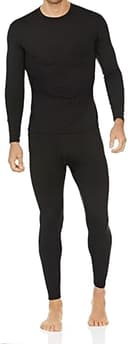
Merino wool vs synthetic: the honest comparison
This is the whole decision, and both answers are defensible. The marketing on both sides overstates the case, so here is the plain version.
What merino actually does better
Odor. This is the real reason to buy merino for hunting, and it is not a small thing. Wool resists bacterial growth, which is what makes worn clothing smell. A merino base layer worn three days in a row still smells like almost nothing; a synthetic one worn a day and a half smells like a gym bag. On a multi-day hunt, or on any hunt where a deer will be downwind of you at 20 yards, that matters more than any single fabric property.
Warmth when damp. Wool retains a meaningful amount of its insulating value when wet. Synthetic does too, but wool does it better, and it feels warmer against the skin when damp rather than clammy.
What synthetic does better
Price. A synthetic set costs roughly a third of a merino set. For a budget hunter, that gap can be the difference between owning a base layer and not owning one, and a synthetic layer you own beats a merino layer you were saving for.
Durability. Merino wears through at elbows, knees and heels faster than synthetic. A synthetic set survives being thrown in a hot dryer, which merino does not.
Drying speed. Synthetic dries faster, which matters if you are hunting out of a truck or a tent with no way to dry gear properly.
The budget verdict
Buy synthetic first. It is cheap, it works, and it fixes the cotton problem immediately. Add merino when you start hunting multi-day, or when you have moved close enough to deer that scent is the thing costing you opportunities. Owning one synthetic set and one merino top is a very good place for a budget hunter to end up.
Understanding fabric weight
Base layers are sold in lightweight, midweight and heavyweight, and merino is often given a number in grams per square meter.
- Lightweight (roughly 150 g/m² merino)— early season, active hunting, or as the first layer under heavier layers in real cold. Moves moisture, adds almost no warmth.
- Midweight (roughly 200–250 g/m²)— the do-everything weight. If you buy one base layer, buy this.
- Heavyweight (roughly 400 g/m²)— late-season stationary sits only. Too warm for any walking, and it becomes a mid layer rather than a base layer in practice.
The common budget mistake is buying heavyweight because it sounds warmer. A heavyweight base layer on a walk-in produces the exact sweat problem the base layer exists to prevent. Midweight, plus a fleece you can remove, is the more flexible and cheaper system.
Where the base layer fits in the system
A working cold-weather hunting system has three parts and each has one job:
- Base layer— moves sweat off your skin. Never cotton. Fits close to the body, because a loose base layer cannot wick anything.
- Mid layer— traps warm air. Fleece, wool or a light puffy. This is where warmth comes from.
- Outer layer— blocks wind and rain. This is also your camo and your quiet fabric.
Get all three and you can hunt anything down to serious cold on budget gear. Skip the base layer and the other two will not save you. Our layering guide walks through the whole system, and the budget hunting clothes roundup covers the mid and outer layers.
Fit, and the mistake that ruins a good base layer
A base layer has to sit against your skin. Wicking works by capillary action from skin contact; a baggy base layer is just a thin shirt and wicks nothing. Buy your true size, not a size up. If you can pinch more than a little fabric at your chest, it is too loose.
Length matters more than most people expect. A base layer top that rides up when you draw a bow or shoulder a rifle exposes your lower back on every shot; look for a longer cut. Bottoms should reach past the ankle so they stay tucked into your boots and do not ride up your calf when you climb.
Care: how to not ruin merino in one wash
Merino is the one item in your hunting kit that will genuinely be destroyed by careless laundry. Wash cold on a gentle cycle, use a wool-safe or scent-free detergent with no fabric softener, and hang it to dry. A hot dryer will shrink merino permanently and there is no recovering it.
Skip fabric softener entirely on all hunting clothing, wool or synthetic. It coats fibers, kills the wicking that you paid for, and leaves a strong scent that defeats the entire point of buying merino for odor control. Use a scent-free detergent for everything you hunt in.