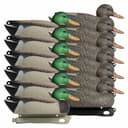
The four criteria, and why realism is not one of them
Decoy marketing is almost entirely about paint. Feather detail, UV coatings, hand-carved masters. Some of that is real — Higdon publishes a UV painting process it says minimizes glare when the decoy is wet, and glare is a genuine problem on bright water. But none of it is the first thing that decides whether a budget spread works. These four are.
- Cost per bird. The only number that lets you compare a six-pack against a twelve-pack honestly. The top pick here works out to under six dollars a decoy; the teal pack is closer to eleven. Both are reasonable buys, for different jobs.
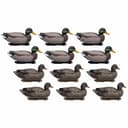
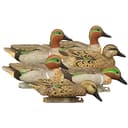
- Pack composition. A dozen drakes looks wrong. You want hens in the spread, and you want more than one head position so the group does not read as twelve identical birds facing the same way. The Final Approach pack publishes six and six; the Higdon teal pack publishes three head postures across six bodies.
- Body construction and fill. Foam filled is the single most useful durability spec in this category, because a decoy that takes a stray pellet and keeps floating is a decoy you still own next season. One-piece bodies matter for the same reason: a seam is where a cheap decoy splits.
- Keel and rigging. A weighted self-righting keel means a decoy that lands upside down rights itself instead of needing a wade. A cord lock or a short-string clip means you can change depth without re-tying. These details decide how long setup takes, and setup time in the dark is the real cost of a big spread.
Size matters too, but not in the direction most buyers assume. The Final Approach pack is deliberately 12 inches bill to tail, smaller than a full-size floater, and Higdon states outright that its standard-size decoys are “slightly undersized from an average live duck.” Compact bodies are how you get twelve birds into a bag you can carry a half-mile. If your hunting involves a walk, that trade is the right one. Once you own a dozen, the placement matters more than the brand — how to set a duck decoy spread collects the counts and landing-hole rules that named hunters and state hunter-education courses actually publish.
What the federal rules actually say about a spread
Two things are prohibited outright for migratory birds, and they are worth knowing before you spend anything. Federal regulation bans taking migratory birds “by the use or aid of live birds as decoys,” and it treats the mere presence of tame or captive ducks or geese as a violation unless they have been confined for ten consecutive days in an enclosure that both muffles their calls and hides them from wild birds. Separately, the same section bans taking migratory birds “by the use or aid of recorded or electrically amplified bird calls or sounds,” with narrow exceptions for a light-goose-only season and a September Canada and cackling goose season.
What that section does notmention is motion. There is no federal rule about spinning-wing decoys at all, which is why the answer is local rather than national. Arkansas is the clearest published example: the Game and Fish Commission barred spinning-wing and motion decoys on its own wildlife management areas and agency-owned lakes, starting with two WMAs in 2015 and then, in its own words, “expanded to all AGFC-owned wildlife management areas the next year.” That notice is from 2017 and we cite it as proof that area-level motion rules exist, not as a current statement of Arkansas law.
The practical consequence for a budget hunter: buy the static decoys first. Motion is the item most likely to be restricted on the public ground you actually hunt, and it is the item you can add later once you have read your own state’s regulations and the rules for the specific area. Our guide to finding public land to hunt covers where to look those rules up.
Twelve mallards or six teal? The spread question
This is the real decision on this page, and the honest answer depends on the water you hunt and the month you hunt it.
Twelve mallards is the default. Mallards are the species a budget hunter encounters nearly everywhere, the decoys are cheapest per body, and a dozen reads as a group from the air. If you buy one pack this season, buy this one. It also scales: a second mixed dozen later makes the spread look less uniform, which is exactly what you want.
Six teal is the September and October answer.Early season, small water, flooded fields and creek bends — teal decoys are smaller, lighter, and the Higdon pack’s short-stringing keel clip is built for water measured in inches rather than feet. Six teal on a half-acre pothole is a complete spread. Twelve full-size mallards on the same pothole is a billboard.
One documentation note on the teal pack, because it is the sort of thing that gets a buyer annoyed on arrival: the Amazon title says four drakes and two hens, while Higdon’s own product page lists two upright drakes, one rester drake, one skimmer drake, one rester hen and one skimmer hen — three and three. We use the maker count, and you should expect the maker count.
Motion on a budget: wind beats batteries
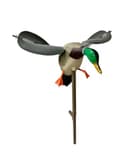
Movement is what a dozen static decoys are missing, and the cheapest way to buy it is to stop paying for electricity. The MOJO Wind Duck spins on whatever breeze is already blowing, includes its support pole, and publishes a real weight — 2.8 lb — and real dimensions. A powered spinner costs more, needs charging the night before, and flattens its battery in the cold at the worst possible hour.
The obvious catch is that a wind-powered decoy needs wind. On a dead-calm morning it is a static mallard drake on a stick. Our read on that trade: a budget hunter is mostly out on cold, breezy days anyway, because those are the days ducks move. If you hunt exclusively calm timber, skip motion entirely and spend the money on a second dozen floaters instead.
And check your area rules before you buy either kind. Several public areas restrict spinning-wing motion regardless of whether it is powered by a battery or by the wind.
The purchase nobody budgets for
Here is the thing that separates a hunter who enjoys a twelve-decoy spread from one who resents it. Cheap decoy packs ship with a keel and a tie-off point and no line. Which means your first morning involves a bag of tangled cord, a headlamp, numb fingers and twelve knots, at the exact moment legal shooting light is arriving.
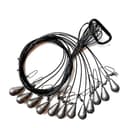
Twelve pre-made Texas rigs at 4 oz and 36 inches fixes it for the price of a sandwich lunch. Decoys stack along the line instead of knotting, you throw them one-handed, and you pick the whole spread up in about a tenth of the time. It attracts exactly zero additional ducks. It buys back ten minutes of the best light of the day, every single hunt.
The limit worth knowing: 4 oz and 36 inches suits flooded timber, creeks and shallow marsh. Deep or fast water needs heavier weights and longer lines, and the listing publishes no line material or breaking strain, so big-river hunters should buy the heavier rig instead. For everyone wading knee-deep, this is the right spec.
What the rest of a budget duck hunt costs
Decoys are rarely the expensive part. Waders are, and they are the one place we would not economize past a point — our budget hunting waders roundup covers what the published neoprene thickness actually buys you, and how to repair waders covers keeping the pair you already own alive for another season. Hearing protection is the other one: a shotgun under a blind roof is louder than most hunters realize, and cheap electronic muffs cost less than a box of steel.
For the whole season planned out, our duck hunting on a budget guide sets the order we would buy in, and the hunting on a budget pillar guide puts waterfowl in context against the other ways to spend a limited gear budget.
What we would actually buy
- Final Approach Last Pass dozen. Twelve birds, six and six, published size and build. The spread.
- Twelve Texas rigs. In the same order. Do not wait for the first tangled morning to learn this one.
- The MOJO Wind Duckif your area allows motion and you hunt breezy days — or a second dozen floaters if it does not.
- Six Higdon teal before next September, if you hunt small water in the early season.
The first two items together come in under a hundred dollars at the prices in the ledger above, and they are the difference between owning decoys and owning a spread. The one combination we would not buy is two unbranded dozens with no published specs — at the same money, buy the pack that tells you what it is.