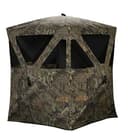
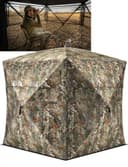
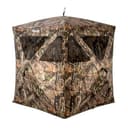
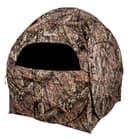
How we picked
Four gates, in this order. The order matters, because it is the reverse of how ground blinds are sold — which is on camo pattern first and everything else afterward.
- The maker publishes real dimensions. Not “2-3 person.” A height, a width and, ideally, a floor space. Two of the five blinds here publish a floor space; the other three publish only a footprint or an overall dimension, and their spec tables say so.
- A named brand with a model number. Search “hunting blind” and most of the first page is unbranded, with a model name that will not exist next season and a specification you cannot check against anything. Every pick here has a brand, a model and a warranty statement.
- Quiet windows. The loudest object in a cheap blind is its own hook-and-loop window flaps, and they are loudest at exactly the wrong moment, which is when a deer is close enough to shoot. Silent toggles, sliding windows, zipperless windows or an adjustable 270-degree system — every blind here has one of the four.
- A blacked-out interior. A blind conceals you by being darker inside than out. That is a coating, not a camo pattern, and a blind without it turns you into a silhouette in a lit box the moment the sun gets behind you.
What did not earn a gate: camo pattern, “person” rating, and window count. A deer does not resolve a pattern at the distances a blind is used at — it resolves the shape of a box and the movement inside it, which is what brushing in and a dark interior are for. Person ratings are marketing arithmetic. Window count is worse than useless, because the honest answer is that you should be shooting out of exactly one of them.
The number that decides it is floor space, not the one on the box
Here is the trap in this whole category, laid out with published figures. The see-through blind ranked second here states a hub-to-hub measurement of 75 by 75 inches and a floor space of 58.5 by 58.5. Those are both true, and they describe the same blind. Hub-to-hub is measured across the widest part of the frame, roughly at shoulder height where the walls bow outward; floor space is the square of fabric on the ground. Sixteen and a half inches separate the two numbers.
That difference is exactly where the buying mistake happens. A blind advertised at 75 inches sounds enormous and sits on a floor closer to 58. A blind advertised at 55 sounds cramped and might have a floor very close to that, because the maker measured the footprint rather than the frame. Comparing one maker’s hub-to-hub number against another maker’s footprint number tells you nothing at all, and three of the five listings here never publish a floor space to compare in the first place.
The practical test, before you buy anything: sit in a chair at home, hold whatever you hunt with, and measure the square you need. A rifle or a crossbow on a rest wants something in the region of four feet. A compound bow drawn from a seated position wants closer to five, and that is the single most common reason a bowhunter buys a blind twice. If you shoot a bow, treat any blind with a floor under about 55 inches as a gun blind and stop there.
Center height is the second number and the easier one. Sixty inches is enough to sit comfortably. Sixty-five to sixty-seven lets a tall hunter sit upright without brushing the roof and lets you stand partly upright to stretch a cold leg at hour four, which matters more than it sounds on a December sit.
Hub or spring steel — the frame decides how you carry it
Two frame types dominate the budget end, and they fail in opposite directions.
Hub blinds use rigid poles that you push out to locking hub joints. They are the stiffer structure, they hold their shape in wind, and they fold into a long, narrow bundle that leans in a truck bed or straps along the side of a pack. They take a minute or two to put up until you have done it a dozen times. Four of the five picks here are hub blinds.
Spring-steel blinds are the ones that pop open in one motion, like a car sunshade. Nothing is faster when legal light is arriving and you are still walking. The trade is that a sprung frame is less rigid in wind, and it folds into a large flat disc rather than a bundle — awkward against a pack frame even when it is genuinely light. Our run-and-gun pick is this kind, and it is the only blind here that publishes what it weighs.
That last point deserves its own sentence, because it is the clearest example of how thin the published data is in this category. Of five current listings from four established brands, exactly one states a packed weight. On public land, where the blind has to walk in and walk back out the same day, weight is arguably the most important number there is — and four of five makers do not print it.
Read the public-land rules before you buy, not after
This is the part that turns a good purchase into a wasted one, and it is state law rather than an opinion. Ground blinds on public land are regulated far more tightly than most first-time buyers expect, and the rules are written specifically around leaving them out.
Michigan’s deer regulations are a good example of the shape of it. Only three types of ground blind are legal on public land there. A Type 1 portable blind must be clearly portable and removed at the end of each day’s hunt, and if you do that, no identification is required. Leave the same blind out overnight and it is no longer a Type 1 — it becomes a Type 3 constructed blind, which must permanently carry your name and address or license number, and which is not legal at all on state game areas, state parks or state recreation areas in Zone 3. Nothing may be placed before September 1, and anything found out there before that date or after the season is treated as abandoned.
Wisconsin adds a second requirement that catches people out. On DNR-managed land, a ground blind used during any open firearm deer season must display at least 144 square inches of solid blaze orange or fluorescent pink, visible from all directions. An unoccupied blind has to carry the owner’s DNR customer ID or name and address. South of State Highway 64, the blind may only remain placed from one hour before to one hour after shooting hours — a daily-removal rule in everything but name.
Wisconsin also states plainly what a lot of hunters assume the opposite of: placing a blind on public land does not reserve the spot. It does not restrict anyone else from using your blind or from hunting where you put it. If you were planning to stake a claim on a funnel with a hundred dollars of fabric, that is not what you are buying.
Put together, these rules push a public-land buyer toward the light end of this page rather than the roomy end, and toward budgeting for a blaze orange panel set on top of the blind itself — none of the five blinds here ships one in the box, and a panel set costs a fraction of a citation. They are also why our guide to treestand rules on public land exists — the same daily-removal logic governs stands, and the details differ by state every single year. Check your own agency before you buy, not after.
Blaze orange on a blind does not cost you deer
Hunters resist the orange-panel requirement because it looks like it undoes the entire point of camo. The published research on deer vision says otherwise. Whitetails have two cone photopigments rather than our three and no red cone at all, which means they cannot distinguish orange from red; a blaze panel does not glow at a deer the way it glows at another hunter. What deer do see well is blue, and they lack the ultraviolet filter our eyes have — which is why a fabric treated with an optical brightener is a bigger liability than an orange square, and why the detergent you wash your camo in matters more than most people think. We go into the full picture in what colors deer can see.
The concealment that a blind actually provides is not color. It is a dark interior that stops your silhouette from reading against a lit wall, plus enough brush stuffed into the loops on the outside to break up a shape that is otherwise a black rectangle in a place where nature does not make rectangles. Both of those are free or nearly free. Neither is affected by a legally required orange panel.
A blind solves movement. It does not solve wind
The one thing a ground blind cannot do is beat a deer’s nose. A whitetail carries something like 297 million olfactory receptors against a dog’s 220 million, and a blind is a fabric box with open windows, not a sealed room. What research on scent behavior does suggest is that your scent forms a reasonably consistent cone downwind above roughly 8 to 10 miles per hour, and eddies unpredictably below that — which means a still, calm morning is the hardest condition to beat from any setup, blind included.
Practically: set the blind so the wind carries your scent to the least likely approach, not to the prettiest shooting lane, and accept that at ground level you have less margin than you would at twenty feet up a tree. Everything in our budget scent-control guide still applies inside a blind, and the cheapest item on that list — hunting the right wind — applies more.
What we would skip
- Any listing that will not publish dimensions. A “4-person” rating with no floor space and no height is not a specification, it is a hope. There are dozens of these, they are often the cheapest results, and you cannot tell them apart.
- Buying on person count. Person ratings assume people sitting still with their hands in their laps. Two hunters plus two chairs plus a bow needs the floor of a “3-person” blind at minimum.
- Shooting a firearm through shoot-through mesh. At least one maker on this page states plainly that its mesh is for broadhead use only. Take the panel out for a gun. Nobody has ever regretted opening a window.
- An elevated or box blind, at this budget. They start at several times the price of everything here, they are not portable, and on most public land they are not legal to leave out at all. If height is what you want, a budget hang-on stand costs less and comes home with you.
- Skipping the stakes and tie-downs. Every blind here includes them and every blind here is, structurally, a kite. Ten seconds of staking is what stops you from chasing your purchase across a field.
Where a blind fits in a budget setup
A ground blind is the right first “where do I sit” purchase for three specific hunters: anyone who does not want to climb, anyone hunting with a child or a second person, and anyone who hunts terrain with no climbable trees. It is also, by a comfortable margin, the best turkey setup on this site — a blind lets you get away with the fidgeting that a spring gobbler hunt demands, which is why it appears in our turkey hunting on a budget guide.
It is the wrong first purchase if you hunt public-land whitetails and want to be mobile. There, the daily-removal rules and the bulk both work against you, and a lightweight stand or a saddle moves faster for similar money. The comparison we would actually read before deciding is saddle hunting versus a treestand, which lays out the same trade — weight, setup time, mobility — from the elevated side of it.
Whichever you land on, the blind is a fraction of the season’s cost, and the money that changes your results most is still boots, glass and time. Our deer hunting on a budget guide sets out the whole order we would spend in, and a blind sits comfortably in the middle of it rather than at the top.