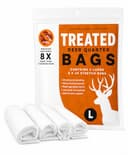
What a game bag is actually for
It is not a shopping bag for meat. It does three specific jobs, and understanding them is how you avoid buying the wrong thing:
- It keeps dirt, bark, hair and insects off the meat.Texas Parks and Wildlife’s hunter-education guidance names the enemies precisely: “The three factors that can spoil meat through the spread of bacteria are: heat, moisture and dirt.” A bag handles the third directly.
- It lets the meat breathe so it can cool.This is why a plastic bag is actively worse than no bag at all. Plastic traps heat and moisture against the meat, and the same state guidance is explicit that moisture is one of the factors that contributes to bacteria growth — the reason you dry an animal off rather than leave it wet.
- It makes the load carryable. Four discrete, closed bundles strap to a pack frame. A loose quarter does not. That is the practical connection to our meat-hauling frame page, where the entire argument is about lashing an irregular load.
Note what is not on that list: refrigeration. A game bag does not cool meat, it only allows meat to cool. Cooling is still your job, and the state guidance is clear that it starts the moment the animal is opened or quartered.
How to choose: the four published specs
1. Size, which is the only spec that really varies
Bag size is the one thing worth reading carefully, and the range across this page is enormous:
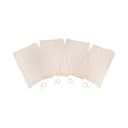
- 20 by 12 inches (Allen): sized specifically for deer quarters. Right for whitetail, too small for an elk quarter or a big bone-in hindquarter.
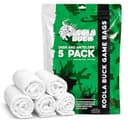
- 16 by 50 inches (Koola Buck Standard): long enough for a bone-in hindquarter, a whole boned-out side, or loins without folding them. The most versatile published size here.
- 40 inch large (Koola Buck Treated): takes a bone-in quarter without forcing it.
- Not published (MARRASSA, GearOZ): two of the five listings give no dimensions at all. The GearOZ set is at least described as elk, caribou and moose sized, which tells you it errs large. The MARRASSA listing tells you nothing about size, and that is the main reason it is not ranked higher despite having the best feature list.
If you only hunt whitetail, deer-sized bags are better than oversized ones — excess fabric means folding and tying slack around a quarter in the dark, which is more annoying than it sounds.
2. Count — how many bags one deer actually needs
A quartered whitetail is four pieces: two front shoulders, two hindquarters. Add the backstraps, the tenderloins and the neck and rib trim, and the real answer is five to six bags per deer if you want everything kept separate.
So a four-pack covers the quarters and nothing else, and a five-pack covers the quarters plus one bag for everything else. That is the whole count argument: the Allen and treated Koola Buck sets are four-packs, the other three are five-packs. Buy two packs of the Allen bags if you want a spare — it is still the cheapest option on the page by a wide margin.
3. Treatment, and what the listing does not say about it
One pick here — the Koola Buck Treated set — states on its listing that the bags are treated, which in this category means an antimicrobial finish aimed at the early-season problem: a deer shot in September heat going sour before it reaches a cooler.
It is the only pick here that claims any treatment, and it is the most expensive. It is also worth being precise about the limits of the claim: the listing does not state what the treatment is, how long it lasts, or whether it survives washing. If your opener is hot, that is still the right bag on this page. If you hunt November, you are paying for something you do not need.
4. Closures and the small stuff
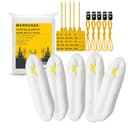
The MARRASSA set is the one that reads like it was designed by somebody who had done a pack-out. It publishes drawstring closures, so a bag seals without improvising with paracord; reflective strips, which is the only answer on this page to finding a bag you set down in the dark; and five tags for labelling which bag holds what across a multi-trip carry. None of those is a protection spec. All of them are things you discover you wanted at 11 p.m. on the second trip.
The specification table, including the gaps
| Spec | Allen | Koola Buck Std | MARRASSA | GearOZ | KB Treated |
|---|
| Published bag size | 20 x 12 in | 16 x 50 in | Not published | Not published | 40 in |
| Bags per pack | 4 | 5 | 5 | 5 | 4 |
| Treatment stated | No | No | No | No | Yes (agent not stated) |
| Closure stated | Not published | Not published | Drawstring | Not published | Not published |
| Reflective / tags | No | No | Both | No | No |
| Fabric weight | Not published | Not published | Not published | Not published | Not published |
| Stated origin | Made in America | Not published | Not published | Not published | Not published |
Two rows deserve attention. Fabric weight is blank all the way across— nobody in this category publishes the spec that would actually tell you how breathable or how tough a bag is, so treat any claim of “heavy duty” as marketing. And the originrow has exactly one entry, which is a point in the Allen set’s favor at the lowest price here.
How to use them properly
Buying bags is the easy half. The cooling discipline is what actually saves the meat, and the full warm-weather sequence is in how to cool a deer in warm weather:
- Have them out before the first cut. Fumbling for a bag with bloody hands is how meat ends up on the dirt. This is step one of our quartering guide for a reason.
- Never plastic, ever. Plastic traps heat and moisture against the meat, and moisture is one of the three spoilage factors the state guidance names.
- Spread the bags out, do not pile them. Lay them in shade or on cool ground with air able to reach each one while you make the first trip out.
- Hang them if you can. Off the ground beats on it, for air circulation and for keeping scavengers honest.
- Dry the meat before bagging. The same guidance that says to wash off excess blood says to dry the animal well afterwards, because moisture feeds bacteria.
- Keep meat above the ice, not in the water. Once you reach a cooler, drain it regularly so the meat is not sitting in melt.
- Wash and dry them for next year. These are reusable, and a bag put away damp is a bag you throw out in October.
What else goes with this
Game bags are one line of a three-item kit, and the other two are already covered on this site. You need a knife you can quarter with — one four-inch blade is enough for the gutless method, since you never cut bone — and you need something to carry the result, which is a frame if a cart cannot reach you. Add paracord for tie-down points no pack ships with, and a second light source, because every pack-out finishes in the dark.
Check your tagging rules first
This is the only part of the process that can cost you a citation rather than a bad steak. Many states require the tag to be attached before the animal is moved or butchered, and several require evidence of sex or species to remain naturally attached to a portion of the meat — which changes how you cut and which bag something goes into. A growing number of states also regulate carcass transport and disposalfor disease management, which is one of the reasons boning out at the kill site has become the normal practice. Read your own agency’s big-game regulations before the season, not at the carcass.
Who should buy which
- Everyone who owns none: the Allen Company four-pack. Cheapest item on this site, correct size for deer, stated origin, established brand. Buy two packs if you want a spare bag.
- Anyone wanting one set for everything: Koola Buck Standard Series. The 16 by 50 inch published size handles deer and elk, and five bags covers a whole animal.
- Anyone who has done a multi-trip pack-out: MARRASSA. Drawstrings, reflective strips and tags are features you only value once you have needed them — accepting that the listing publishes no size.
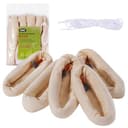
- Elk, moose or caribou hunters: GearOZ. Cut for bigger animals, five bags, cheaper than the treated set.
- September and early-October openers: Koola Buck Treated. The only treatment claim here, aimed squarely at heat.