How we ranked these, in order
A decoy has no measurable performance spec. There is no NRR, no lumens, no load rating — nothing a lab could check. So the ranking runs on the four things a listing will actually tell you, weighted for a hunter who walks in:
- Decoys in the box, then packed weight. This is the real spec in the category and the one nobody leads with. A turkey spread is a weight problem: you are carrying it in the dark, usually with a vest, a gun and a seat, often a mile or more off a gate. The spread here runs from 0.9 lb for a pair of hens to 3.6 lb for one hen, which is a four-fold difference in what ends up on your back for the same number of birds on the ground.
- Pose, because pose is the tactic. A lone upright hen, two feeding hens, a submissive laydown hen and a half-strut jake are four different messages to a gobbler, and two of them can backfire. We rank on which message is most likely to be the one you want, not on which decoy looks best in a photo.
- What the maker publishes. One pick here publishes dimensions, weight, material and a warranty in one place. One publishes a warranty term. Two publish neither a body material nor a warranty term. A figure a maker will not state is a figure you cannot plan around, and in a category with no performance specs documentation is most of what separates the brands.
- Cost against the three above. Our score is a value-per-dollar judgment on compiled specs, disclosed in full at how we rank. It is not a test result. We do not own these decoys.
The decoy rule that is about other hunters, not turkeys
Read this before you buy anything on this page, because it is the one genuinely dangerous thing about turkey decoys and it is not about whether a gobbler believes them.
The Wisconsin DNR’s turkey-hunting page states it in four words: “Never carry or move an uncovered decoy.” A decoy is a convincing turkey. That is the entire product claim. A convincing turkey being carried through the woods by a person in camo is exactly what another hunter is hoping to see, and the same DNR page notes that “Most shooting accidents occur because one hunter mistakes another hunter for the game.” Put the decoy in a bag — which is one practical reason the two Avian-X picks, which ship with a carry bag, are worth more than their listings suggest.
The Pennsylvania Game Commission adds the clothing half of the same problem. Hunters “should not wear clothing that contains black, like the color found on a turkey’s body,” “or red, white or blue, like those on a turkey’s head,” and there is “no requirement to wear fluorescent orange during the spring turkey season.” If you are setting decoys at a spot you cannot see all the way around, the Commission is specific about the fix: “Sit against a large stump, tree trunk or boulder that is wider than your shoulders and higher than your head.” The DNR puts a number on the same idea — a calling site with at least 40 yards of visibility in every direction. A decoy pulls other hunters’ eyes toward you on purpose. Set up so their shot cannot reach you, and never move the decoy uncovered. More of that in our budget turkey calls roundup, which covers the calling-side safety rules in full.
Which pose, and when each one costs you a bird
This is where the money actually goes in a turkey spread, and all five picks here are legitimate — for different hunts.
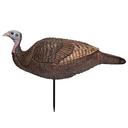
- A single hen is the safest spread and the one to start with. A hen says “a bird worth walking to” without saying anything about rank. The weakness is that one bird alone can read as a bird the other turkeys have already passed over, and on pressured public land where every hunter is running one hen it is also the most familiar silhouette in the woods.
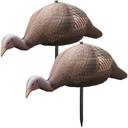
- Two hens read as company, which is the cheapest upgrade in the category. A feeding pair says the ground is safe, and safety is what a gobbler is actually evaluating when he hangs up at 70 yards. This is why the Thenshop 2-pack earns a place on a page it would otherwise lose on build quality.
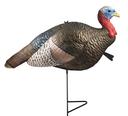
- A half-strut jake is the decoy that changes behavior rather than holding attention. A young bird acting cocky is a provocation a dominant tom often comes to settle in person. It is also the pick most capable of emptying a field: a subordinate tom who has already been beaten this spring will leave rather than fight, and on heavily hunted public ground a lot of the toms still alive in late season are subordinate ones.
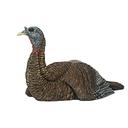
- A laydown breeding hen is the submissive answer to that problem. It raises the stakes for a gobbler without threatening him, which is why Avian-X says it “Pairs well with jake or as dusting hen.” Its cost is visibility: a bird on the ground disappears in grass that a lookout hen clears easily.
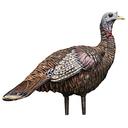
- A lookout hen is the long-distance option. Avian-X raises the head specifically so “passing gobblers can spot her even in tall grass and dense vegetation.” The trade is that an alert, head-up posture is also how a turkey tells every other turkey something is wrong, so it works better as the tall bird in a spread than as the only bird in a field.
If you are buying one decoy and you hunt timber and field edges on public land, buy a hen. If you are buying two, buy a hen and a jake and be willing to pull the jake when the woods go quiet. That is a two-decoy spread for less than the price of one premium strutter, and it is the spread we would carry.
What the premium decoys actually buy you
Nobody on this page is being ripped off, and we are not going to pretend the price gap is all badge. Here is what the Avian-X bodies genuinely give you over a bargain-bin hen, in the maker’s own terms.
A body that does not crease. Avian-X states that its LCD decoys use a “collapsible dura-rubber body that won’t crease or dent and stays quiet in the field.” Both halves of that matter. A creased decoy catches light wrong at the fold, and a hard plastic shell knocking against a stake in the wind is noise you did not plan for. The Thenshop listing shows the other end of that scale in its own words: “If the product appears flattened upon arrival, simply inflate it from the bottom to quickly restore its shape.”
Realistic movement rather than spin. Avian-X publishes that its LCD decoys are 15% smaller than a real turkey and ties that to “realistic movement without unnatural spin.” A decoy that pirouettes on its stake in a crosswind is a decoy that reads as wrong to a bird that watches turkeys for a living.
A bag and a stake that are not an afterthought. Both Avian-X picks ship with a collapsible carbon stake, a compression strap and a carry bag. Given the DNR rule above, the bag is not a nicety. The cheaper picks include a stake and nothing else.
And here is the honest limit on all of it: neither Avian-X listing nor the Primos listing publishes a body material and warranty term together. The Laydown Breeding Hen does — 11.5 x 5.2 x 11.1 in, 3.6 lb, durable rubber, 1-year limited — and it is the only one of the five that does. The Lookout Hen, at the highest price on the page, publishes no warranty term at all. The cheapest pick with a stated warranty term is the jake, at one year. If documentation is what you think you are paying extra for in this category, the price order and the documentation order do not match.
How many decoys, and when to leave them in the truck
Two is plenty on public land. Three is a field setup. More than three is a private-land or a managed-property answer, and it is not what this site is for — our whole approach to turkey hunting on a budget is built around gear you can carry to a spot other people did not want to walk to.
There are two situations where the right number is zero. The first is timber with less than 40 yards of visibility, where a decoy is doing nothing a gobbler can see and is adding the only real hazard on this page. The second is pressured late-season birds: by the back half of the season on public ground, a decoy is a shape those toms have walked away from several times, and your call plus a good setback against a wide tree is a better bet than a plastic bird.
The National Wild Turkey Federation’s own beginner primer puts the priority order plainly: pattern your gun before the season, a box call is the easiest first call, and camo matters because turkeys see extremely well. Notice what is not on that list. Decoys are the fourth purchase in turkey hunting, not the first — and if you have not patterned your shotgun yet, spend the decoy money on shells and a target instead. Our budget hunting shotgun guide is where that decision starts.
The blind the decoys sit in front of
A spring setup is usually a decoy spread and a blind, because a turkey picks a moving hunter apart in open timber. If the budget for the blind is under a hundred dollars, four of the blinds we track clear it — ranked on published floor space and window noise in our ground blind under $100 page, which also covers the blaze-orange rule several states apply to blinds in a firearm season.