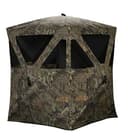
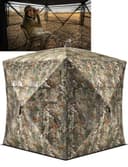
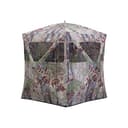
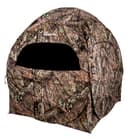
The blind the ceiling just removed
Worth stating plainly, because it is the most useful thing on this page. The Ameristep Care Taker — the pick our main budget ground blind roundup calls the cheapest hub blind worth owning — no longer clears a hundred dollars on the live price layer. It is a good blind and a 55-inch footprint that tucks into thick cover better than anything here, and it is now a hundred-and-teens purchase rather than a double-digit one.
That is what a hard ceiling does: it is not a quality line, it is a line that moves. If the Care Taker drops back under while you are reading this, the ledger on the roundup page will show it.
What a sub-$100 blind actually publishes
Three specs matter and the listings are wildly inconsistent about them.
- Floor space. Published by the Rhino (49.5 x 49.5 in) and the TIDEWE (58.5 x 58.5 in). The Barronett publishes a 71 x 71 in hub-to-hub frame and never the floor inside it; the Doghouse publishes a 60 x 60 in footprint and no floor space either. If you bowhunt, buy one of the two that tells you.
- Center height. All four publish it: 65 in Rhino, 66.5 in TIDEWE, 67 in Barronett, 66 in Doghouse. That is enough to sit in a chair and raise a gun without hunching in every case.
- Packed weight.Published by exactly one — the Doghouse, at 12 lb. Nobody else states a figure, which means carry-burden comparisons across these blinds are not available and we do not make them up.
Windows are the noise, not the fabric
The loudest thing on a cheap blind is the window system, and this is where the four genuinely separate.
The Barronett Radar runs a zipperless system — not a quieter zipper, no zipper at all — plus a rear peek window so you can check your back trail without opening the shooting side. The Rhino uses silent hook-and-loop attachments with shoot-through mesh sewn in. The TIDEWE uses noise-free sliding windows on three sides and adds one-way see-through panels, so you can watch behind you with nothing open at all. The Doghouse is the plain one here, and its argument is weight rather than windows.
One safety note the Barronett listing publishes and others do not: its shoot-through mesh is stated to be for broadhead use only. Do not fire a bullet or a slug through mesh.
Two rules the blind does not tell you about
Both come from the agencies rather than the box, and both can end a hunt.
- Blaze orange on the blind.Several states require a blaze panel visible from all sides on a ground blind during a firearm deer season. None of these four includes one. Budget for a separate panel set — our blaze orange roundup covers the cheap end, and check your own regulations, because the requirement varies by state and by season.
- Leaving a blind on public land. Many units treat an unattended blind as a prohibited structure or require it to come out daily. That is the real argument for the Doghouse: it is the only blind on this page the listing says you can carry on your back. Our public-land stand and blind rules guide collects the published agency guidance.
What the hundred-dollar ceiling costs you
Less than you would guess, and the gaps are mostly on paper. You still get hub or spring-steel frames, shoot-through mesh, silent window systems and a carry bag. What you do not get is a published fabric denier on three of the four (only the Barronett states one: water-resistant, tightly woven HD 150 denier with a black interior coating), a warranty term on any of them, or a packed weight on three of four.
And one real-world gap: rigidity in wind. The Doghouse’s spring-steel frame pops open faster than any hub blind, which is worth a lot when legal light is coming, and it is less rigid in wind than a hub frame. Stake every one of these blinds and use the tie-downs, every time. A blind that blows over with you in it is the cheap-blind failure that actually happens.
If you want the full field with no ceiling, including the Care Taker that just rose above it, read our budget ground blind roundup. If you are deciding between a blind and sitting a tree, our saddle versus treestand comparison covers the other half of that argument.