Blaze & Budget

CRISPI Alternatives

A CRISPI is a mountain boot sold on a published stiffness number. Three cheaper boots against that, ranked on the structure they actually publish - and an honest account of the one spec the budget end simply does not state.

By Stephen V.Last updated How we rank

If you want the closest thing to a CRISPI at a fraction of the money, buy the Irish Setter VaprTrek: a light, waterproof, uninsulated 8-inch leather boot you lace down and walk miles in, which is the job a CRISPI mountain boot is built for before insulation ever enters the conversation. If your steep country is also cold country, the Northside Renegade 800 Thinsulate is the lace-up leather boot with 800 grams published and real ankle support. And if the thing you actually want is underfoot stiffness — the reason people buy CRISPI in the first place — the TIDEWE Steel Shank is the one boot on this whole site whose listing publishes a structural spec, and it costs less than a sixth of the cheapest CRISPI.

Give CRISPI its due, because the case for it is specific and it is published. The brand describes itself as “Handcrafted Hunting Tradition Since 1975” and says that “For 50 years, CRISPI has crafted mountain boots with cutting-edge technology and time-tested craftsmanship”, handcrafted in Italy. More usefully for a buyer, it publishes a flex rating: the Nevada Legend lists a “3 Flex Rating” and the Briksdal Pro a “4 Flex Rating”, alongside an “ABSS Ankle Bone Support System”, “Board Lasting Mechanical Construction”, a “CRISPI Crossbow Frame”, a “CRISPI x Vibram Megagrip outsole with polyurethane CCF midsole”, and a per-boot weight — 1 lb 13 oz for the Nevada Legend in a size 9, 1 lb 15 oz for the taller Briksdal Pro. Nothing on this page publishes a stiffness number, and we are not going to invent one.

What a CRISPI costs is also published. On the brand’s own men’s insulated listing on the date below, the Shimek was $340.00, the Nevada Legend $368.00, the Guide $404.00, the Briksdal Pro and the Hunter $416.00 each, and the Briksdal Pro SF $432.00 — against comparison figures running up to $540.00. That is the gap this page exists to deal with. Every price in the ledger below is read live, with the date it was read, rather than quoted in prose. We own none of these boots and have hunted in none of them. Here is how we rank instead.

How this is funded: we earn a commission if you buy through our links, at no extra cost to you. It never changes which product we recommend, and we’ll tell you plainly when we’d skip one. Full disclosure.

Three cheaper boots, ranked on published structure

Ranked on price-per-performance — the specs that matter divided by what it costs. Select a row to jump to the full write-up. We have not field-tested these — here is exactly what we do instead.

#ProductType / insulationScorePrice
1
Irish Setter VaprTrek 8" Waterproof

Irish Setter VaprTrek 8" Waterproof

Closest in purpose: the boot you walk in

A genuinely light, waterproof leather boot you can walk miles in — the do-everything early-season pick. If you only own one pair of hunting boots and you cover ground, this is the smart budget buy.

8" leather, uninsulated
9.1/ 10
$189.95View on Amazon

Price as of November 22, 2026. #ad How we’re funded

2
Northside Renegade 800 Thinsulate

Northside Renegade 800 Thinsulate

Best support plus warmth for the money

The insulated boot you can actually cover ground in. Waterproof leather with 800 grams of Thinsulate is the classic mid-season formula, and lace-up leather supports an ankle in a way no rubber knee boot does.

Leather, 800g
8.7/ 10
$110.00View on Amazon

Price as of November 22, 2026. #ad How we’re funded

3
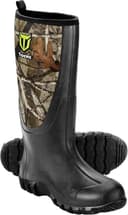
TIDEWE Steel Shank Rubber Boot

TIDEWE Steel Shank Rubber Boot

Cheapest boot that publishes any structure

The rubber boot for hunters who actually walk in. A steel shank is the single spec that separates a boot you can hike a mile in from a boot that folds under your arch on the second ridge.

Rubber, steel shank
8.6/ 10
$56.52View on Amazon

$69.9919% off

Price as of November 22, 2026. #ad How we’re funded

The picks in full

#1Closest in purpose: the boot you walk in9.1/ 10 value

Irish Setter VaprTrek 8" Waterproof

A genuinely light, waterproof leather boot you can walk miles in — the do-everything early-season pick. If you only own one pair of hunting boots and you cover ground, this is the smart budget buy.

Strengths

  • Very light for a full leather 8-inch boot — easy on all-day hikes
  • UltraDry waterproofing keeps feet dry through wet grass and creeks
  • Scent-control lining and an aggressive lugged outsole

Trade-offs

  • Uninsulated — you will want a rubber or insulated boot for late season
  • Leather needs a break-in period before long miles
Height / material8 in, waterproof leather + nylon
InsulationNone (early-season)
WaterproofYes (UltraDry)

Specs read from the product listing, on September 7, 2026. “Not published” means the maker doesn’t state that figure. The score is our value rating, not a lab test — how we rank.

#2Best support plus warmth for the money8.7/ 10 value

Northside Renegade 800 Thinsulate

The insulated boot you can actually cover ground in. Waterproof leather with 800 grams of Thinsulate is the classic mid-season formula, and lace-up leather supports an ankle in a way no rubber knee boot does.

Strengths

  • Waterproof leather laces down for real ankle support on uneven public ground
  • 800 g Thinsulate is warm without being a late-season-only boot
  • Rubber traction outsole grips wet leaves better than a smooth rubber boot

Trade-offs

  • Leather holds scent in a way rubber does not — a real cost on a pressured deer
  • Needs a break-in period before a long walk-in
Insulation800 g Thinsulate
UpperWaterproof leather
OutsoleRubber traction

Specs read from the product listing, on August 11, 2026. “Not published” means the maker doesn’t state that figure. The score is our value rating, not a lab test — how we rank.

#3Cheapest boot that publishes any structure8.6/ 10 value

TIDEWE Steel Shank Rubber Boot

The rubber boot for hunters who actually walk in. A steel shank is the single spec that separates a boot you can hike a mile in from a boot that folds under your arch on the second ridge.

Strengths

  • Built-in steel shank gives the underfoot support that most cheap rubber boots simply lack
  • Camo pattern doubles as a turkey and waterfowl boot
  • 6 mm neoprene upper inside a natural rubber shell — stated 100% waterproof, and rubber holds far less scent than leather

Trade-offs

  • The maker publishes a -4°F to 68°F comfort range but no insulation gram rating, so there is no number to compare against an insulated boot
  • The shank adds weight you feel on a long walk out
Construction6 mm neoprene upper, natural rubber shell, steel shank
WaterproofYes — stated 100% waterproof
Comfort range-4°F to 68°F (stated)
Insulation ratingNot published

Specs read from the product listing, on September 22, 2026. “Not published” means the maker doesn’t state that figure. The score is our value rating, not a lab test — how we rank.

What you are actually buying when you buy a CRISPI

Strip the marketing out and a premium mountain boot is four things, three of which CRISPI puts a label on:

  • Stiffness.The flex rating — 3 on the Nevada Legend, 4 on the Briksdal Pro. A stiffer boot holds an edge on a side-hill and stops your arch folding over a rock at mile four. It is also miserable on flat ground, which is why the number exists at all: it is a fit decision, not a quality score.
  • Ankle structure. The ABSS ankle bone support system plus board-lasted construction, which is a stiffer, more-structured way of joining the upper to the sole than a cemented budget boot uses.
  • Outsole. A Vibram Megagrip compound, co-developed and named on the listing. Named rubber is not a small thing on wet rock and frozen duff.
  • Weight, published per boot. 1 lb 13 oz for the 8-inch Nevada Legend in a size 9. Published weight is the single most useful number a boot maker can give you and almost nobody at the budget end gives it.

Two honest notes about what CRISPI does notpublish on the pages we read. Insulation is stated as an approximation — “Insulated: Yes - GORE (~200 g)” — not an exact figure, and there is no warranty term, no resole term and no last name on the product page itself, though the site links out to warranty and resole-and-repair pages. Both pages we read also carry a published “MADE WITH PFAS CHEMICALS” disclosure, which is a waterproof-membrane fact across the industry rather than anything specific to this brand.

The spec the budget market refuses to publish

Here is the finding, and it is the reason this page is three boots rather than six. We track sixteen hunting boots. Not one of their listings publishes a flex rating, a shank material, a last, or a per-boot weight — with exactly one exception. The TIDEWE Steel Shank publishes a steel shank, and that single word is the only structural claim in the entire category.

That is why it is on a CRISPI page at all. It is a rubber boot, it looks nothing like an Italian mountain boot, and on the one axis that makes a CRISPI worth $368 — something rigid between your foot and the ground — it is the only budget boot that will put a word in writing. It also publishes a stated comfort range of -4°F to 68°F and 6 mm of neoprene inside a natural rubber shell, while publishing no insulation gram figure, so there is no number to set against a CRISPI’s ~200 g.

For everything else, the budget market publishes insulation grams and waterproofing and stops. That is a real information gap, not a quality verdict, and the honest way to shop it is to buy on the numbers that are published and accept that stiffness is something you will find out in your own boots on your own hill. Our hunting boot buying guide walks through the specs that do get stated.

Match the boot to the ground, not to the brand

CRISPI’s whole line is built around one kind of hunting: steep, open, walk-a-lot western country where you are on your feet all day and the terrain punishes a soft boot. If that is your hunting, the VaprTrek is the closest substitute here — a light waterproof leather 8-inch boot with an aggressive lugged outsole that laces down for ankle support, uninsulated so it breathes on the climb.

If your hunting is a cold sit after a walk in, a 1,000-gram pac boot beats any mountain boot on earth and costs a third of one. That is a different purchase, and it lives on our insulated hunting boot picks. And if you mostly hunt whitetail from a stand on public ground near home, rubber is the right answer for scent reasons that have nothing to do with construction — start with the rubber boot roundup instead. The rubber versus leather comparison is the shortest route through that decision.

Three things that close most of the gap for free

None of these is a boot, and all three do more for a budget boot than another fifty dollars of boot would.

  • A real sock. A merino or merino-blend sock is the cheapest upgrade in hunting and the one that most changes how a boot feels at hour eight. Our budget hunting sock picks cover it, and the Darn Tough alternatives page covers the same ground from the premium side.
  • An aftermarket footbed. CRISPI ships a removable Air Mesh footbed; budget boots ship a flat die-cut insole. Swapping it is the nearest thing to buying arch support you can do for twenty dollars, and it is the single change that most mimics a stiffer boot underfoot.
  • Break-in before the season, not during it. Leather boots at any price need miles before they need a mountain. Our break-in guide is the version of this that costs nothing at all.

When a CRISPI is genuinely the cheaper boot

We will say this plainly because it is true and because a page that cannot say it is not worth reading. If you hunt steep country forty or more days a year, a resoleable, board-lasted mountain boot with a named outsole is a boot with a service life measured in rebuilds rather than seasons, and the cost per day lands below a stack of cheaper boots replaced every two or three years. Nothing on this page is resoleable. CRISPI publishes warranty and resole-and-repair pages we did not read on this visit, so we are not quoting terms we have not seen — check them yourself before you treat a rebuild as part of the math.

The budget case is for the hunter who gets out fifteen or twenty days a season, mostly within a few hours of home, who would rather own a leather walker and a rubber boot for the price of one premium boot than own one boot that is wrong half the season. That is most of us, and it is the whole premise of this site. If you want the full field with no brand framing, the budget hunting boot roundup ranks every boot we track. Hunting western country on a budget? The elk hunting on a budget guide is where the rest of that kit list lives.
Frequently asked questions

Why are CRISPI boots so expensive?

You are paying for published structure and Italian manufacture. CRISPI states a flex rating (3 on the Nevada Legend, 4 on the Briksdal Pro), an ankle bone support system, board-lasted mechanical construction, a co-developed Vibram Megagrip outsole with a polyurethane midsole, and a per-boot weight - and it makes the boots in Italy. On the brand's own insulated listing the range ran from $340.00 to $432.00 as displayed, against comparison figures up to $540.00.

What is the closest budget alternative to a CRISPI?

For the job a CRISPI does - covering ground in rough country - the closest thing we track is a light, waterproof, uninsulated 8-inch leather boot you can lace down for ankle support. If you need the same thing with warmth, a waterproof leather boot with 800 grams of published Thinsulate is the next step. Neither publishes a stiffness rating, because no budget hunting boot listing we have found does.

What does a boot flex rating actually mean?

It is a stiffness scale, and a higher number is not automatically better. A stiff boot supports your arch on side-hills and over rock and resists twisting under a loaded pack; it is also heavier and less comfortable on flat, soft ground. It is a fit-to-terrain decision, which is exactly why the makers that publish it treat it as a spec rather than a selling point.

Do any budget hunting boots publish a shank or a stiffness spec?

Almost none. Of the sixteen hunting boots we track, exactly one listing publishes a structural spec of any kind: a steel shank in a rubber boot. Everything else publishes insulation grams and waterproofing and stops there. If underfoot stiffness is your deciding factor, that information gap is the real cost of shopping the budget end.

Is a cheaper boot plus good socks and a footbed as good as a CRISPI?

No, and anyone saying otherwise is selling you something. A merino sock and an aftermarket footbed genuinely close part of the comfort gap for about thirty dollars, and break-in miles close more of it for nothing. What they cannot replicate is a board-lasted upper, a named outsole compound or a resole program. They make a budget boot noticeably better; they do not make it a mountain boot.

Can you resole a budget hunting boot?

Generally not. Cemented budget boots are built to be replaced rather than rebuilt, and none of the boots on this page offers a resole program. CRISPI publishes warranty and resole-and-repair pages on its own site - read those directly if a rebuild is part of how you are costing the purchase, because that is the one part of the premium argument a cheaper boot cannot answer.

Sources

  • Nevada Legend Boot - Crispi USA — The premium original's own product page, and the source of every CRISPI figure and price quoted on this site. Published overview rows on the visit: "Insulated: Yes - GORE (~200 g)", "Upper: Water-repellent Nubuck", "Removable Footbed: CRISPI(R) Air Mesh", "Protection: Rubber rand", "Height: 8\"", "Weight (one boot, size 9): 1lbs 13oz", and a "MADE WITH PFAS CHEMICALS" disclosure. Published technology labels, verbatim: "GORE-TEX(R) Insulated Comfort Lining", "CRISPI(R) x Vibram(R) Megagrip outsole with polyurethane CCF midsole", "3 Flex Rating", "ABSS Ankle Bone Support System", "Board Lasting Mechanical Construction", "CRISPI(R) Crossbow Frame" and "Dual Tech Lining" (a label the page does not explain). The description states the boot is built "With 200 grams of GORE-TEX(R) insulation and a waterproof membrane", and a size note adds "Size 15 are a special build and come with a standard Vibram(R) outsole." The page's own price on the visit was $368.00 against a $460.00 comparison figure. CRISPI publishes NO warranty term, NO resole term, NO last name and no exact insulation gram figure on this page - insulation is given as an approximation (accessed November 22, 2026)
  • Men's Insulated Hunting Boots - Crispi USA — The brand's own insulated-boot listing, and the source of the CRISPI price range this site quotes. Prices as displayed on the visit, each shown as a pair of figures the page does not label: Shimek $340.00 / $425.00, Nevada Legend $368.00 / $460.00, Guide $404.00 / $505.00, Briksdal Pro $416.00 / $520.00, Hunter $416.00 / $520.00, Wild Rock 400 EFX $416.00 / $520.00, Wild Rock 800 EFX $424.00 / $530.00, Briksdal Pro SF $432.00 / $540.00 - a range running from $340.00 at the low end to $540.00 at the high end. The Briksdal Pro page published a "4 Flex Rating" against the Nevada Legend's "3 Flex Rating", a 10-inch height and a "Weight (one boot, size 9): 1lb 15oz", and states the boot "is 100% waterproof thanks to the full surround GORE-TEX(R) lining". The brand describes itself on the storefront as "Handcrafted Hunting Tradition Since 1975" and says "For 50 years, CRISPI(R) has crafted mountain boots with cutting-edge technology and time-tested craftsmanship", "Handcrafted in Italy" (accessed November 22, 2026)
  • Cold Weather Safety — National Weather Service — Federal cold-weather hazard overview — frostbite, hypothermia and wind chill (accessed July 22, 2026)
  • Hunting — US Forest Service — USFS rules for hunting on National Forest System land — state-law compliance and area restrictions (accessed July 22, 2026)

Keep reading