What Darn Tough is genuinely known for
Two things, and they are not the two things most buyers think they are paying for.
- The guarantee, in writing, with no receipt.This is the real product. Darn Tough's published terms say “If these aren't the longest lasting socks you've ever owned, you can return them to us for another pair,” that a worn hole is replaced free of charge, and that the socks are covered “no matter how damaged they are” provided enough remains to identify them. No registration. No receipt. That is a stronger written promise than anything else in the category at any price.
- Knitting in Vermont, family owned.The brand states “Still family owned, our company still knits every pair of socks here in VT,” and its guarantee page names “Our Mills in VT, USA.” If domestic manufacture matters to you as a purchase, no sock on this page replaces it. None of the three is made in the United States.
What Darn Tough is notuniquely known for is merino content. The hunting sock we track states 34% merino on its listing — a blend, not full wool — and the guarantee page publishes no merino percentage for any sock in the line. It links to a separate page about merino and leaves it there. Hold that thought, because it cuts both ways in a moment.
What the guarantee actually costs you to use
This is the part the cost-per-season math usually skips, and it is the honest reason a cheaper sock can win.
Reading Darn Tough's own published process: you fill in an online claim form, then you ship the socks back at your own expense— the company suggests the cheapest method, typically USPS Ground Advantage. It then emails a credit code for the full replacement value to spend on its own website. It states plainly that it “will not issue credit before receiving the socks.” Processing runs 7 to 10 business days, or up to two weeks, longer in peak season. The email on the claim has to match the email you checked out with. Replacement shipping is free.
So the true shape of the promise is: postage, a form, and two to three weeks, in exchange for store credit rather than a sock in the mail. For a hunter whose season is six weekends long, a hole worn in late October is not replaced in time to hunt in, regardless of how generous the terms are. That is not a knock on the policy — it is a working constraint, and it is precisely the constraint that two pairs in a pack solves.
There are two real exclusions, and they matter to bargain hunters specifically. Socks “purchased as seconds or irregulars are not covered,” which rules out the discount bins where budget buyers find these socks cheap in the first place. And altering a sock by resizing or dyeing voids the warranty. Outside the US you claim through a local distributor or pay to ship to Vermont yourself.
The one number none of the cheap socks publishes
Here is the finding of this page, and it is not flattering to the budget picks.
Not one of the three alternatives publishes its merino percentage. Realtree says “merino blend” and stops. Muck Boot says “merino blend” and stops. Alvada says merino and stops. The Darn Tough hunting sock we track states 34% on its listing. That means the only sock in this comparison that tells you what you are actually buying is the expensive one — and “merino blend” could be 40% wool or it could be 10%.
We are not going to invent a figure to fill that gap, and you should distrust any page that does. What we can tell you is what the word is doing: merino's value to a hunter is that wool keeps insulating when it is damp, which is the condition your feet are actually in after a mile of walking in. A blend gets you some of that behavior. A blend with very little wool in it gets you very little of it. Buy on the assumption that these are modest blends, and judge them on what they dopublish instead — cushion weight, height and pairs per pack.
Which of the three you actually want
These are not interchangeable, and the deciding factor is your boot rather than your budget.
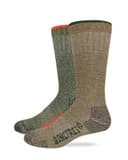
- Leather boots, walking in, then sitting:the Realtree Heavyweight. Full cushion and heavyweight is the right build for a stationary November sit, and two pairs per pack is the whole argument — you hunt in the dry pair while the wet one dries. The catches are real: no published merino percentage, and heavyweight is too much sock inside a boot that already fits snugly. If your boots are tight, size up the boot, not down the sock.
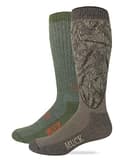
- Rubber or neoprene boots: the Muck Boot Merino Blend Camo Tall. Tall is not a style choice here. A mid-calf sock inside a 16-inch pull-on boot leaves a band of bare skin pressed against cold rubber, and that band is where a cold sit starts going wrong. It also comes two pairs to a pack. It is hot walking, and it publishes neither a merino percentage nor a cushion weight.
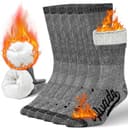
- Cheapest route to wool: the Alvada Merino Wool Thermal Crew, three pairs per pack. Treat these as consumables rather than an investment: there is no meaningful warranty, crew height is wrong for a tall rubber boot, and the blend is unpublished. At the price, wearing them out is not a financial event, which is a legitimate strategy and the opposite of the Darn Tough one.
The honest case for buying the Darn Tough anyway
We will make it properly, because a page that cannot is not worth reading.
If you hunt hard and often — every weekend, all season, year after year — you will wear holes in socks, and the only company in this comparison that has promised in writing to replace them is Darn Tough. Three pairs of unpublished-blend socks that thin out in two seasons cost more than one pair that gets replaced for the price of a stamp. That math is the brand's entire argument and it is a good one.
It is also the better buy if you have exactly one pair of boots that fit and you need the sock inside them to be the same thickness every time. A sock that is reliably 34% merino at a stated cushion weight is a known quantity; “merino blend” from two different production runs may not be.
Where the cheaper socks win is not durability. It is count. The thing that keeps feet warm on a public-land sit is a dry sock, and the reliable way to have a dry sock at 2 p.m. is to have carried a second one. Two pairs of Realtree or three of Alvada put rotation inside your budget in a single purchase. One premium pair does not, no matter how good the guarantee behind it is. We work the rest of that problem — vapor barriers, boot fit, when wool stops helping — in how to keep your feet warm hunting.
Where a cheap sock genuinely loses
Fit over distance, and it is the same failure as a cheap boot. A sock that bunches or slides is what starts a blister on mile three, and a seamless toe and a performance fit are exactly the things a spec sheet cannot show you. Darn Tough's hunting sock states a true seamless toe; none of the three cheaper listings states one.
The second thing you lose is recourse. If a cheap sock fails in week two, you have bought a disposable item and it is gone. That is a defensible trade at the price, but it is a trade, and the people who tell you otherwise are usually selling something. It is the same calculation one category up, where the stakes are higher and the published numbers are thinner — see Mystery Ranch alternatives on a budget for what happens when the cheap option publishes no spec at all. If you want the full field rather than the three cheapest, our budget hunting sock roundup ranks all four we track, Darn Tough included, and explains where the cost-per-season line actually crosses. The boot matters more than the sock either way, which is the argument in how to choose hunting boots.