What Mystery Ranch is genuinely known for
One thing, mostly, and it is not the fabric.
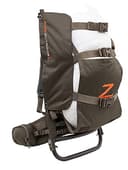
- Load carriage — the frame and the yoke.The brand's own description of the METCALF 75 puts it plainly: the pack is “built on the ULTRA LIGHT MT™ frame to minimize weight while maximizing the load bearing capacity that MYSTERY RANCH is known for.” That is the product. A pack that transfers 70 lb of boned-out elk onto your hips without folding is a mechanical achievement, and it is the reason people pay $575.
- Hunting-specific details that are not decoration. The same page lists external blaze orange frame tabs for attachments, a roll-top closure with a side zip so you can reach big items, a detachable lid, and multiple compression straps to hold gear and meat secure. Those are solutions to real pack-out problems rather than features in a list.
- It publishes its numbers. Weight, volume, dimensions, frame name, fabric denier, zipper brand. Hold onto that, because it turns out to be the sharpest difference on this page.
Two things worth knowing before you shop. The METCALF 75 was out of stockon the brand's own site when we read it — “we're not currently able to estimate when this item will be available again” — which is a practical reason a hunter ends up on a page like this one in the first place. And the linked Warranty and Repair page renders no terms at all without JavaScript, so we are not quoting a Mystery Ranch warranty figure anywhere here. We will not put a number on a page we could not read.
The documentation gap, which is the real finding
Against that spec sheet, the budget shelf is close to silent.
Not one of the three picks on this page publishes a capacity figure, a weight, a fabric denier or a warranty term. The ALPS Commander Lite publishes a frame weight (a listed 4.7 lb) and a torso range (17 to 23 in), and that is the most complete data on the page — it publishes no bag volume for the honest reason that there is no bag: the pack bag is a separate purchase, and the listing says so. The North Mountain Gear daypack states waterproof fabric and bow and rifle carry, with no volume. The Fieldline states that it is a hunting daypack, with no volume.
Two packs we track do publish a capacity and would make the comparison direct, and neither carried a live price when this page was built, so neither is a pick here: the ALPS OutdoorZ Pursuit at roughly 2,700 cubic inches and the TIDEWE 5500cu frame pack at 5,500 cubic inches. Both sit in the full budget hunting backpack roundup, and the TIDEWE is the one number in our registry that beats the Mystery Ranch on paper — 5,500 cubic inches against the METCALF's 4,575. Volume is the easiest spec in the category to win and the least useful one to win on, which is worth saying out loud before anyone reads that as a verdict.
Because a frame pack's whole value is in how it carries, not how much it swallows. A 5,500 cubic inch bag on a soft suspension is a sack of meat hanging off your shoulders. The spec that would tell you the difference — a rated load capacity — is published by nobody in this comparison, premium brand included. So we rank on what is published: frame material and weight, torso adjustment, and whether the lashing system was designed to strap a quarter to a frame or just happens to have straps on it.
If that pattern sounds familiar, it is the same one that decides the sock aisle: the premium brand publishes a number and the budget shelf publishes an adjective. We work that version of the problem, including what the premium guarantee actually costs you to use, in Darn Tough alternatives on a budget.
Which of the three you actually want
These three are not a good, better, best ladder. They are three different packs for three different hunts, and picking wrong costs more than the money saved.
- You will be carrying meat: the ALPS OutdoorZ Commander Lite Frame. This is the only pick that replaces the actual Mystery Ranch job. Its lashing system with three extension straps exists to strap quartered game to a frame; the frame is high-strength aluminum at a listed 4.7 lb; the torso adjusts 17 to 23 in, which matters more on a loaded frame than on a daypack. Full-length zippered pockets in the lashing panels and Hypalon lashing points mean it is not bagless in practice. The catch is explicit and you should price it in: the main pack bag is a separate purchase, and a frame is far too much pack for a two-hour whitetail sit.
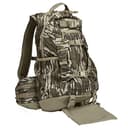
- You sit over a field with a bow or a rifle: the North Mountain Gear Camo Hunting Backpack. Waterproof fabric, a quiet exterior and dedicated bow and rifle carry straps, at a price where knocking it around is not a problem. It is day-hunt sized and the basic straps get uncomfortable under a heavy load, so do not buy it expecting to haul with it.
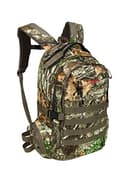
- You are new and want to stop spending:the Fieldline Pro Series Ridge Tracker. Water, snacks, calls, a knife, a headlamp — that is the pack's entire job and it does it. Small capacity, thin straps, basic materials. At the price, those are fair trades, and a cheap pack that gets you hunting beats an expensive one you are saving up for.
The honest case for buying the Mystery Ranch anyway
There is a real one, and it is about consequences rather than comfort.
A pack failure on a day hunt is an inconvenience. A pack failure four miles into a wilderness unit with 70 lb of elk on the frame is a genuinely bad day, and possibly two trips instead of one. If you hunt that way — backcountry, solo, heavy loads, repeatedly — you are not buying fabric, you are buying the probability that the frame holds. Mystery Ranch publishes what its frame is and what the pack weighs; none of the cheap packs publish either, which means you cannot even estimate the risk you are taking. That is a legitimate reason to spend the money.
It is also the better buy if your torso is at either end of the range. Fit on a loaded frame is the whole ballgame, and a premium pack sold in four sizes with an adjustable yoke will fit a 5'6" hunter and a 6'4" hunter properly. A one-size budget pack fits the middle of the bell curve and nobody else.
Where the budget route genuinely wins is the shape of the spend. A frame and a cheap daypack together cost a fraction of one premium pack and cover both hunts, which one pack cannot. If you hunt whitetails from a stand nine days out of ten and pack an animal out once a season, buying two cheap purpose-built packs is the better allocation, and it is the argument behind our pack frame roundup.
Where a cheap pack genuinely loses
Three places, and only one of them is obvious.
Suspension under load. A cheap pack carries 20 lb as well as an expensive one. At 50 lb the difference is the whole purchase: shoulder straps that compress to nothing, a belt that rolls, and a frame sheet that lets the load sag away from your back. There is no spec for this and no cheap pack publishes one.
Noise. Budget packs use stiffer, louder fabrics and more plastic hardware than the quiet brushed shells on premium hunting packs. On a stalk, that is a real cost, and it is why the North Mountain Gear pick earns its place on a quiet exterior rather than on a feature.
Recourse.If a $50 pack tears in week two, it is gone. That is the trade at the price, and it is a defensible one — but it is a trade. If you are not sure which size of pack your hunting actually needs, work that out before you spend anything: what size hunting pack do I need sizes it by hunt length rather than by brand, and how to pack a hunting backpack covers the load order that makes a cheap suspension carry better than it should.