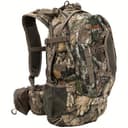
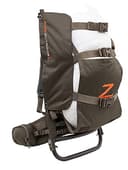
The spec sheets, side by side
Read from each tracked listing. The Commander Lite publishes no bag volume because there is no bag to publish one for, which is a finding rather than a gap — and it is the single most important row in the table.
| Spec | Pursuit Pack | Commander Lite Frame | TIDEWE 5500cu |
|---|
| Main bag volume | ~2,700 cu in | None — bag sold separately | 5,500 cu in |
| Frame | No frame | Aluminium, listed 4.7 lb | Internal frame |
| Meat-hauling provision | None | Lashing system with three extension straps | Volume and frame, no dedicated lashing panel |
| Torso adjustment | Not published | 17–23 in | Not published |
| Weapon carry | Bow / rifle pocket | Not published | Bow / rifle / pistol |
| Rain cover | Built in, blaze orange | Not published | Included |
| Storage without buying a bag | Full pack | Full-length zippered lashing-panel pockets only | Full pack |
| Our value score | 9.0 | 8.6 | 8.6 |
Question 1: are you carrying gear in, or meat out?
Almost every hunting pack decision collapses to this. Carrying gear in is a volume and organization problem: you need somewhere for water, layers, a knife, calls, a rangefinder and a tag, and you need to find them in the dark. Carrying meat out is a structural problem: you need a frame that transfers eighty or a hundred pounds onto your hips without folding.
A pack that is good at the first is usually mediocre at the second, and the Pursuit is honest about that — it has no frame and does not pretend to. For a whitetail hunter who drags or carts a deer to a truck on a two-track, that is not a limitation, it is the correct design. The Commander Lite is the opposite: it solves the structural problem completely and solves the storage problem not at all.
If you cannot say which of the two jobs is yours, you are a day-pack hunter and should buy the Pursuit. People who need a meat frame know they need one, usually because they have already done the carry once without one. Our public-land day pack checklist works through what actually goes inside, which is a better way to size a pack than guessing at cubic inches.
Question 2: how far from the truck do you actually hunt?
Distance is what turns a meat frame from a luxury into a requirement. Within a few hundred yards of a road, a deer gets dragged and a cart is cheaper than any pack. A mile in on national forest, with a blowdown-choked drainage between you and the truck, a frame is the difference between two trips and five.
Public land pushes hunters further in than private does, because the easy ground near the parking area is where everyone else is. That is the context in which the Commander Lite makes sense: deep public land, elk country, or anywhere quartering an animal and carrying it out in loads is the normal end of a successful hunt.
The Commander’s published 17 to 23 inch torso adjustment is the spec to notice here, and it is the one the Pursuit does not publish at all. Under a heavy load, a pack that does not match your torso length puts the weight on your shoulders instead of your hips, and that is how a two-mile carry becomes a one-mile carry and a long sit on a log.
Question 3: are you willing to buy twice?
The Commander Lite is sold as a frame, and the matching pack bag is a separate product. ALPS does not hide this — the listing says so — but it is easy to miss when you are comparing prices in a search results page. In practice the Commander is a two-purchase system, and the right way to price it is frame plus bag.
It is not entirely bagless: the lashing panels carry full-length zippered pockets and Hypalon lashing points, so a hunter who already owns a daypack can strap it to the frame and run the combination. That is a legitimate and genuinely cheap way to end up with both tools, and it is what we would do before buying the matching bag at full price.
If buying twice is not acceptable, the TIDEWE frame pack is the honest third answer: 5,500 cubic inches on an internal frame with a rain cover and weapon carry, in one purchase, for daypack money. The trade is a less refined suspension than the ALPS on a long haul and a pack that is far too big for a morning sit. It is on our budget hunting backpack rankings for exactly that reason.
What each one is actually like to own
The Pursuit
Roughly 2,700 cubic inches is the sweet spot for a full-day sit with layers, food, water and a kill kit, with room left for a packable rain shell. The bow and rifle carry pocket matters more than it sounds: a weapon on your back with both hands free is the difference between climbing sticks safely and climbing them badly.
The built-in blaze-orange rain cover is the quiet detail we rate most. It is two pieces of required kit in one — weather protection for your gear and, in firearm season, a large orange surface on the side of you that another hunter is most likely to see first. Several states mandate a minimum area of blaze orange, so check yours and count the cover as part of the plan rather than all of it.
The Commander Lite
A listed 4.7 pound aluminum frame is genuinely light for something meant to carry a quartered animal, and the three extension straps exist specifically to strap meat to the frame rather than into a bag. The padded waist belt is stated to accept a clip-style holster, which is a small thing that tells you who the pack was designed for.
For a short whitetail sit it is the wrong tool entirely — heavier, bulkier and with nowhere convenient to put a thermos. Own it alongside a day pack, not instead of one.
The short answer
- Whitetail hunter, truck within half a mile: Pursuit. Nothing in the Commander’s design helps you, and the Pursuit does the job you have.
- Elk, mule deer, or deep public-land whitetail: Commander Lite, plus a bag or a strapped-on daypack. Buy the frame, keep a cheap day pack for the walk in.
- One pack, one purchase, big loads: TIDEWE 5500cu. Volume and a frame for daypack money, with a suspension that is not ALPS-grade.
- Not sure: Pursuit, and revisit after your first long carry. A frame bought in advance of needing one is money sitting in a garage.