The spec gap is documentation, not just glass
Start here, because it reframes the whole comparison. A MONARCH M7 comes with a published spec sheet: field of view, eye relief, exit pupil, relative brightness, close focus, weight. A sub-$150 binocular usually comes with the magnification, the objective diameter and some adjectives.
That means part of what you pay for at the step-up price is knowing what you bought. You can compare two MONARCHs against each other on paper. You cannot compare the four picks on this page against each other on field of view, because none of them publishes one, and we are not going to invent figures to fill the table. What we can compare is what each listing does state, which is why the awards above are glass type, warranty and waterproof rating rather than optical numbers.
One number we can put next to Nikon’s: 10x42 means a 4.2 mm exit pupil (42 divided by 10), and that is true of every binocular on this page as well as of the M7 — it is arithmetic, not a feature. Exit pupil is the width of the light column reaching your eye, and at dusk your pupil opens wider than 4.2 mm, which is why every 10x42 on earth gets dimmer at last light. Paying more does not change the arithmetic; it changes how much of the available light survives the glass.
What the step down actually costs you
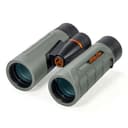
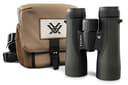
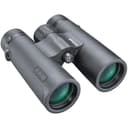
- The last ten minutes of light.This is the real one, and it is where every binocular comparison is actually decided, because it is when deer move. HD or ED glass holds contrast into dim light better than plain multi-coated glass does. The Athlon is HD and the Vortex Crossfire is HD; the Bushnell Engage X is neither and its own listing says so — it gives up snap in the last ten minutes. That honesty is why it ranks fourth rather than being left off.
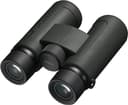
- Eye relief, if you wear glasses. Nikon publishes 16.5 mm for the M7, which is comfortable for spectacle wearers. Neither the Athlon nor the Nikon PROSTAFF publishes a figure, though both listings describe their eye relief as generous or long. If you wear glasses and need a guaranteed number, that is a legitimate reason to buy the binocular that publishes one.
- Weight, which nobody cheap will tell you.The M7 is about 24 oz. None of these four states a weight. The Bushnell Engage X is the lightest full-size 10x42 we track, which we know from the listing’s own description rather than from a figure — and if you hang glass on your chest for ten hours, weight is a spec that matters more than the brochure admits.
- Mechanical feel.Focus wheels are where cheap binoculars feel cheap. The Athlon’s is stiffer out of the box than the Vortex pair; the PROSTAFF’s is smooth but quick to overshoot. Neither is a defect and both are things you notice.
What the step down does not cost you
Two things, and they are bigger than the list above suggests.
Weather sealing.All four picks are waterproof, and one of them publishes a tested rating — the Bushnell Engage X states IPX7, which is a defined standard rather than the word waterproof. A rained-on binocular is not a crisis at any price on this page.
Warranty.Here the budget side wins outright. The Vortex Crossfire HD carries the full VIP warranty — unlimited, lifetime, transferable, no receipt required. Nikon’s own PROSTAFF carries a limited lifetime warranty, which is good but is not no-fault. If the thing you fear is dropping a binocular out of a treestand, the cheapest route to peace of mind on this page is the Vortex, not the Nikon.
8x42 is the upgrade nobody suggests
If you are unhappy with a cheap 10x42, the fix may not be a dearer 10x42. Nikon’s own binocular guidance makes the point: the higher the magnification, the more unstable the image is from hand movement, and higher magnification brings a narrower field of view and lower brightness.
Nikon’s own figures show the cost precisely. The M7 8x42 publishes 435 feet of view at 1,000 yards against the 10x42’s 362 — roughly 20% more woods in the picture — and an 8x42 gives a 5.25 mm exit pupil against the 10x42’s 4.2. For timber hunting, where you are finding movement rather than judging antlers across a canyon, eight power is arguably the better instrument at every price point. Our 8x42 versus 10x42 comparison works through why eleven of the twelve budget pairs we track are 10x42 anyway, which is a marketing answer rather than an optical one.
Buy the harness before you buy better glass
Here is the cheapest upgrade on this page and it is not a binocular. A binocular on a neck strap bounces, swings into a bow riser and ends up in your pack, where it glasses nothing. A chest harness keeps it flat against you and accessible one-handed, and the cheapest one we track costs a fraction of the gap between the Bushnell and the Athlon.
A hunter who actually glasses with cheap binoculars finds more deer than a hunter whose expensive binoculars are in the pack. Our budget bino harness roundup ranks six, and how to glass for deer covers the grid-search method that does more for your results than any glass upgrade.
If what you want is simply the cheapest binocular that works, our under-$100 binocular page is the right page, and the full roundup covers the step-up pairs worth stretching for.
And if the pair you are really comparing against is a flagship rather than a step-up, the same exercise gets more lopsided and more interesting: Swarovski binocular alternatives on a budget measures four budget 10x42s against the NL Pure’s published 7.6 degrees, 91% light transmission and 18 mm of exit-pupil distance — and finds one spec where the cheap glass has the longer published promise.