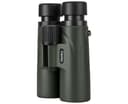
What $100 actually buys in a binocular
Four things separate a usable cheap binocular from a bad one, and three of them are printed on the listing if you know what to read for. None of them is magnification.
1. Prism material: BaK-4 or nothing
Roof and porro prisms are cut from one of two glasses. BaK-4 is barium crown glass; BK-7 is borosilicate. BaK-4 has a higher refractive index, which means the cone of light leaving the eyepiece stays round instead of getting clipped at the edges. In practice a BK-7 pair shows you a circle of image with gray, squared-off shoulders, and those shoulders eat the parts of the frame where you catch movement.
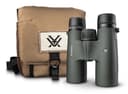
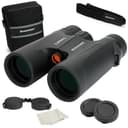
Two of the pairs here state BaK-4 in writing. One states nothing at all about its prisms, which we have marked as unpublished rather than assumed. At this price, a maker that will not name its prism glass is telling you something.
2. Coatings, and the difference one word makes
Every air-to-glass surface in a binocular reflects a few percent of the light hitting it, and there are ten or more of them in the optical path. Coatings recover that light. The terms are a ladder and they are not interchangeable:
- Coated— at least one surface has a single layer. Nearly meaningless.
- Fully coated— every air-to-glass surface has a single layer.
- Multi-coated— at least one surface has multiple layers.
- Fully multi-coated— every surface has multiple layers. This is the one worth paying for.
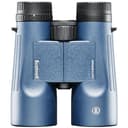
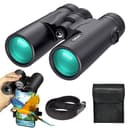
Under $100 you will mostly find “multi-coated”. Two pairs here — the Bushnell and the Gosky — state fully multi-coated, which is genuinely unusual in this bracket, and for the Bushnell it is most of why it ranks where it does. The same ladder is explained in our guide to choosing hunting binoculars, which is worth reading before you spend anything at all.
3. A waterproof rating you can hold them to
“Waterproof” on a listing is marketing. IPX6 and IPX7 are test standards: IPX6 covers powerful water jets from any direction, IPX7 covers immersion. A maker printing an IP number has committed to something checkable. A maker printing the word alone has not.
This matters more on cheap glass than expensive glass, because the failure is permanent and invisible until it happens. Water gets past a bad seal, condenses inside the barrels on the first cold morning, and the pair is finished. You cannot dry it out from the outside.
4. The warranty, which is the only real insurance down here
Under $100 the odds of something failing are not small. What decides whether that is annoying or expensive is who stands behind it. Vortex will repair or replace a Triumph under its VIP terms with no receipt and no fault question. Celestron and Bushnell are established optics companies with real service departments. A marketplace seller offers a return window and then nothing.
That is the entire argument for spending the full hundred rather than sixty. Two sixty-dollar pairs cost more than one hundred-dollar pair you never have to replace.
8x or 10x under $100? Take the 8x
At every price above this bracket we would tell a whitetail hunter that 10x42 is the better default. Down here the advice inverts, for a reason that has nothing to do with the optics and everything to do with your hands.
Ten power magnifies image shake as much as it magnifies the deer. A heavy, well-balanced binocular damps that shake; a light one made to a price does not. Add cold fingers, a bulky glove and no rest, and a cheap 10x can genuinely deliver less usable detail than a cheap 8x, because you cannot hold it still enough to use the magnification you paid for.
Eight power also gives you a wider field of view, which is what you want in the timber where most public-land whitetail hunting happens. If you glass long open country — a cut cornfield, a river bottom, a western slope — take the 10x and find something to brace against. Otherwise the 8x is the honest recommendation at this price.
What we would skip entirely
- Anything advertised as 20x, 30x or “high power” at this price. The magnification is real and the image quality behind it is not. Handheld 20x is unusable without a tripod, and a maker leading with the biggest number is telling you which spec it wants you looking at.
- Zoom binoculars. A variable-magnification pair under $100 has compromised every part of the optical path to make the zoom mechanism fit and work. It is the single worst value in the category.
- Compact 25 mm and 32 mm pairs for low light. Objective diameter is how much light gets in, and dawn and dusk are when deer move. A 42 mm objective at this price beats a 25 mm one at the same price every single morning.
- Rangefinding binoculars. They are excellent and they start at many times this budget. If you need a range number, buy a separate budget rangefinder and keep your glass money in glass.
Should you spend $100 or save for $200?
Here is the honest version of the answer, because it depends on a question only you can answer: are you buying your first binocular, or replacing one?
If this is your first pair, buy in this bracket now. A hundred-dollar binocular used all season beats a two-hundred-dollar binocular you buy next year, and you will learn what you actually want from glass by using some. The step from nothing to competent glass is far larger than the step from competent to good.
If you already own a pair and you are shopping because you were disappointed at last light, do not buy here. That specific disappointment — detail collapsing in the final twenty minutes — is exactly what more money fixes, and it is not fixable inside this budget. Save for the under-$200 bracket, where fully multi-coated glass and better prisms become the rule rather than the exception.
And whatever you buy, get a harness before you buy anything else for it. A binocular on a neck strap swings, bangs and eventually gets left in the pack. One on a chest harness gets used forty times a day, and using cheap glass often beats owning good glass rarely.