What actually changes between 8x and 10x
Magnification is not a free upgrade. It is a set of trades, and every one of them moves in the same direction when you go up a power. Here is the spec sheet of the decision, with the rows that matter to a hunter rather than to a spec comparison.
| What changes | 8x42 | 10x42 |
|---|
| Exit pupil (objective ÷ magnification) | 5.25 mm | 4.2 mm |
| Field of view | Wider | Narrower |
| Hand shake, magnified | 8x | 10x |
| Detail at long range | Less | More |
| Choice on the budget shelf | 1 of the 12 pairs we track | 11 of the 12 pairs we track |
| Published eye relief on our budget 8x pick | Not published | Not published on most; Athlon states generous eye relief |
Exit pupil: the number that decides last light
Divide the objective by the magnification and you get the exit pupil— the width of the cone of light the binocular hands to your eye, in millimetres. An 8x42 gives 5.25 mm. A 10x42 gives 4.2 mm. In daylight neither matters, because your own pupil is constricted to 2 or 3 mm and is the bottleneck. In the last twenty legal minutes your pupil opens wide, and now the binocular is the bottleneck.
That is the real argument for 8x, and it is the one most often stated backwards. The 8x42 is not brighter because it has better glass. It is brighter at dusk because it spreads the same light across less magnification. If the only time you glass is first and last light — which, for whitetail hunters, is most of the hunting day — a cheap 8x42 can genuinely show you more than a cheap 10x42 of the same build quality.
The catch is that “of the same build quality” is doing a lot of work in that sentence. At this end of the market, coatings and prism glass vary far more between products than exit pupil does between powers, which is why our binocular buying guide puts coatings ahead of magnification in the order of things to check.
Shake: the reason 8x looks better to more people
A binocular magnifies the image and it magnifies your hands. At 10x, a tremor that is invisible at 1x becomes a visible wobble, and at the end of a cold morning sit with no rest, that wobble is what stops you resolving antler tines against brush. This is the single most underrated reason a beginner prefers 8x the first time they compare them honestly.
It is also the reason the shake argument has a cheap solution. Set a 10x42 on a rest — a pack, a stand rail, a tripod — and the advantage of 8x largely evaporates while the extra reach stays. That is the entire premise of our budget hunting tripod rankings: a tripod makes glass you already own behave like glass costing three times as much, and it costs less than the difference between two binoculars.
Field of view: how much woods you see at once
Lower magnification shows a wider slice of the world. In open country that is a nice-to-have. In timber it is the whole game, because what you are doing is sweeping thick cover for an ear flick or a horizontal line, and a wider view means fewer passes and faster re-acquisition when a deer moves. Vortex’s own budget-binocular education makes the same point: lower magnification buys a wider field and more forgiving handling.
Neither of the budget listings we track publishes a field-of-view figure in degrees or feet at 1,000 yards. That is a finding about the cheap end of this category, not a gap in our research — when a maker omits field of view, prism material and coatings, treat all three as unknown and buy on what is stated. The one pair we track that does publish a field of view is the Celestron Nature DX at 5.8 degrees, and it is a 10x42.
Why the budget shelf is almost all 10x42
Of the twelve budget hunting binoculars we track, eleven are 10x42 and one is 8x42. That is not a coincidence and it is worth understanding before you go hunting for an 8x bargain. Ten power sells, so that is where makers put their money, their coatings and their warranty support. The practical consequence for a value hunter is blunt:
- At the same price, the 10x42 is usually the better instrument, because it is the volume product in the category and the 8x42 at that price is frequently a rebadged no-name.
- The 8x advantage is real but small, and it is smaller than the gap between plain multi-coated and fully multi-coated glass, which is the thing we would spend the money on first.
- If you want a genuinely good 8x42, you are shopping higher up. That is a legitimate choice, but it is not a budget choice, and this site is not the place we will pretend otherwise.
Our full field, with coatings and warranty on every pair, is in the budget binocular rankings, and the two hard price ceilings are at under $100 and under $200.
How to pick in one minute
Answer these in order and stop at your first yes.
- Do you hunt mostly inside 150 yards, in timber, thickets or swamp edge? Buy 8x42. The wider view and the steadier image are worth more than reach you will never use.
- Do you glass from a saddle, a stand or any position where you cannot brace your elbows? Buy 8x42, or buy 10x42 and commit to a rest.
- Do you spend real time picking apart distant hillsides, CRP, cut agriculture or open public land? Buy 10x42. This is what the extra power is for.
- Are you buying your first pair and genuinely unsure? Buy 10x42. It is the deeper market at this budget, it covers the widest range of hunting, and the shake problem has a cheap fix while the reach problem does not.
One thing that is not on this list: 10x50 and 12x50. Bigger objectives do restore exit pupil at higher power, and they are also heavier, bulkier and worse on a chest harness all day. A heavy binocular is a binocular that stays in the pack, which is why the accessory that most improves cheap glass is not more glass but a bino harness that keeps the pair on your chest and in your hands.
The verdict
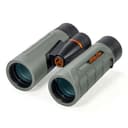
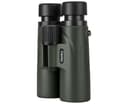
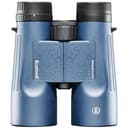
Most budget hunters should buy a 10x42, and the Athlon Talos G2 HD is the pair we would buy: HD glass and stated generous eye relief at a price where rivals ship plain multi-coated. If you hunt close cover, or you know your hands are not steady, the Hontry 8x42 is the cheapest pair here we would still hang on a hunter, and 8x is the more forgiving power. If your season is spent in rain and marsh, the Bushnell H2O states fully multi-coated lenses plus anti-fog construction, which is the combination that fails first on cheap glass in November.