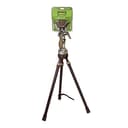
One leg, two legs or three: what you are actually choosing
Every stick in this category is one of three shapes, and the shape decides more than the brand does.
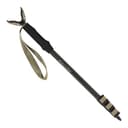
- Monopod. One pole. It removes vertical wobble and most of the fore-and-aft sway, and leaves side-to-side movement to your body. It is the lightest, fastest and cheapest shape, and the only one you will reliably carry on a mobile public-land hunt. It is not hands free: you hold the rifle and the pole.
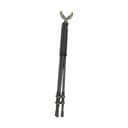
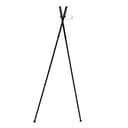
- Bipod. Two legs. It kills the side-to-side sway a monopod leaves in, which is the main reason a cheap rest feels useless. Still not hands free, and still needs your body as a third point of contact on uneven ground. The sitting-height versions are the cheapest real rests available.
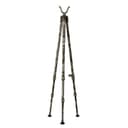
- Tripod.Three legs, and the only shape that stands on its own. That is the real ergonomic difference: you set the rifle down, it stays pointed where you left it, and both your hands are free for binoculars or a rangefinder. The cost is weight, price and deployment time — three legs to set is three legs of noise and movement.
Our order of preference for a budget hunter is not the order of technical merit. It is monopod first, because the stick you carry beats the stick you own. A convertible like the Allen Axial sidesteps the question by being all three, which is the right answer for anyone still learning which position they shoot from most.
The spec that decides it, and the one nobody publishes
Height range is the only spec on this page that can make a stick worthless. A sitting bipod does not reach a kneeling shot. A short tripod does not reach a standing one. And the Primos Trigger Stick sold as a “Gen3 tripod” comes in several height ranges that look identical in a thumbnail — the one in this roundup is the short model at 18 to 38 inches, which covers sitting and low kneeling and nothing above it.
Here is how thinly this category documents itself. Of five picks, two publish a usable height range in the listing (the Allen monopod at 22 to 61 inches, the Allen Axial at a 61 inch maximum with no stated minimum). One has a complete retailer spec sheet: the Primos, at “18-38in” and “approximately 2.5lbs,” model 65812. The two BOG DeadShot picks publish neither a height nor a weight on their listings — which is odd, because BOG’s own DeadShot monopod and bipod listings both state 25 to 64 inches. We looked for a maker spec page for the DeadShot tripod and could not reach one; retailer figures for its weight disagree with each other, so we publish none rather than pick a number.
That is why the Allen monopod is the top pick. It is not the most capable rest here. It is the one where a buyer can confirm, before paying, that it reaches the position they shoot from and weighs what they are willing to carry.
Measure your own height range before you buy
Do this with a tape measure and your actual rifle, in the actual position, in about two minutes. It is the single most useful thing on this page.
- Sit on the ground as you would hunt, shoulder the rifle, and have someone measure from the ground to the forestock. For most adults this lands somewhere in the high teens to low twenties of inches.
- Repeat kneeling. Repeat standing. Standing is usually somewhere around the low-to-mid forties for a rifle held naturally, which is why a 38 inch maximum does not reach it.
- Buy a stick whose published range brackets the positions you actually hunt from — with the minimum below your lowest number, not equal to it, because a stick at full collapse has no adjustment left.
If you hunt a box blind or a chair, you only need the sitting number and the cheapest bipod on this page is enough. If you hunt a field edge or a western slope where you may have to stand, you need a stick that reaches into the fifties or sixties, and that rules out three of the five picks here.
Forestock, not barrel — and why the yoke material matters
The TPWD course is explicit on the one setup mistake that costs accuracy: “Always support the forestock of the rifle, not the barrel,” and avoid placing the forestock directly on a hard surface. A barrel resting on anything changes where it points as it heats and as pressure changes. That is why a rubber or padded yoke is not a comfort feature — it is the part that stops a hard aluminum V from becoming the hard surface the course warns about.
All five picks publish something here. The BOG sitting bipod states a rubber shooting yoke, the BOG tripod a universal shooting rest head, the Allen monopod a removable cradle with a padded grip, the Allen Axial a Quick-Snap rubber grip cradle, and the Primos a quick-detach yoke with an integrated lock. The two that detach are worth a note: a removable head means the same pole runs a spotting scope or a camera, which is how a shooting stick quietly becomes the glassing support you were going to buy separately. If you have already decided three legs are what you want under the rifle, our shooting tripod rankings cut this field down to the tripods alone and add the clamping head that holds a gun hands-free.
The same hunter-education page is worth reading alongside our guide to sighting in a rifle scope, because a rest changes your zero confirmation: sight in from the support you will hunt from, not from a bench you will never use again.
When the expensive one is worth it
The Primos Trigger Stick costs roughly four times the cheapest bipod here, and the thing you are buying is one specific capability: you change the height with one hand, by squeezing a trigger, with the rifle still shouldered. Every other stick on this page requires you to break position, find a twist lock or a lever, adjust, and re-establish. In a treeline where a deer steps from forty yards to seventy and from behind cover to open ground, that difference is real.
It is also the only pick with a complete published spec sheet, which we weight heavily. So why is it last? Because this is a budget site and the Primos costs more than the other four picks combined, the short model will not reach a standing shot, it is the heaviest documented stick here at about 2.5 lb, and the trigger mechanism is one more thing to freeze or clog. It loses on value, not on merit. If you shoot from a tripod regularly and the money is not the constraint, it is the correct stick.
For the hunter whose budget has one slot left this season, our public-land gear list puts a shooting rest roughly where we would buy it: after boots, optics and a knife, at about the same priority as a rangefinder— because a steady rifle and a known distance solve the same problem from two directions.
What we would actually buy
- Allen monopod, 22–61 in. Publishes its range and its weight, reaches every position, costs almost nothing. Start here.
- BOG DeadShot Compact Sitting Bipod if you hunt a blind or a chair and will never stand. Cheapest real rest on the page.
- Allen Axialif you genuinely do not know which position you shoot from yet — it is all three, once.
- Then a tripod only if you sit still for long stretches and want your hands free: the BOG for value, the Primos for the one-handed trigger.
The one purchase we would avoid is a sitting-height bipod bought by someone who hunts standing, which is the single most common mistake in this category and the reason this page leads with height range instead of price. Measure first. Then buy the cheapest stick whose published numbers cover you.