What hunter education actually says about shooting off a rest
This is worth getting from the authority rather than from a product page. Texas Parks and Wildlife’s hunter-education course ranks the four field positions and is blunt about the one most hunters actually shoot from: standing, “With no support other than muscle strength, this is the most difficult position for accurate shooting” and it “should only be used for short range shots”. Prone is “the most accurate of the four”, though its low angle can put grass and brush in your line. In the sitting position “both arms are supported”.
Two instructions from the same course apply to every tripod on this page. First: “Always support the forestock of the rifle, not the barrel.” A yoke or cradle under the barrel changes where the shot goes. Second: do not set the forestock directly on a hard surface — which is why a rubber cradle or a padded yoke is not a luxury feature on these products. The course recommends bipods, shooting sticks or natural rests such as a limb or a tree fork, and it publishes no accuracy figures for any of them, so neither do we.
That is the honest case for a tripod over the cheaper shapes. A bipod or a monopod steadies a position you are holding. A tripod stands unsupported: you set the rifle in it and it stays pointed where you left it, which is what makes a two-hour field-edge sit bearable and what lets you glass with both hands without breaking the setup.
Match the height to the position you actually shoot from
Work out your position first and buy to it. Vortex’s own tripod-selection guidance is the clearest maker version of this: match maximum load, maximum height, weight and head type to the job, with its published line running from 22 lb loads for optics work up to 55 lb for rifle work and heights up to 73.8 inches for stand-up glassing. Against that, here is what these four will actually reach:
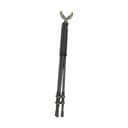
- Sitting or a blind chair — 18 to 38 in is plenty. The Primos Short covers it with room to spare, and the published one-handed trigger adjustment is worth more here than anywhere else, because a seated shooter cannot reset legs without standing up.
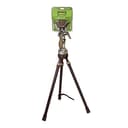
- Kneeling — the awkward middle. The Primos Short reaches a low kneeling shot. The DeathGrip publishes three leg-angle locks at 20, 45 and 85 degrees across a 7 to 59 inch range, which is the only pick here that genuinely spans prone to standing.
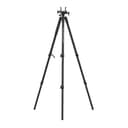
- Standing — only two of these four get there. The Allen Axial publishes a 61-inch maximum, the DeathGrip 59 inches. Neither of the other two publishes a figure that reaches a standing shot, and one publishes no figure at all.
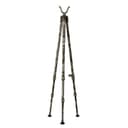
If you do not yet know which position you shoot from most — which describes most hunters in their first two seasons — the Allen Axial is the pick that defers the decision: it runs as a tripod from a chair, drops a leg for a bipod in timber, and collapses to a monopod when you are moving.
A clamp is not a rest
The BOG DeathGrip is on this page because people search for it as a shooting tripod and because it is genuinely the best answer to one specific problem: it clamps the rifle instead of resting it, holding guns, shotguns or crossbows up to 40 lb, with 25 degrees of cant and 360-degree panning under tension adjustment. Hands off, the gun stays on target. For a long watch over a cut cornfield or a prairie dog flat, nothing else here is close.
Two honest costs. It weighs 8.5 lb, which is nearly three times the documented weight of the Primos and a figure you feel on every step of a public-land walk-in. And it is a shooting rest first: mounting binoculars means working around the clamp head rather than a standard optics plate, so it does not replace a glassing tripod. If you can only buy one tripod and you spend more time looking than shooting, buy from the budget glassing tripod roundup instead and put a cheaper stick under the rifle.
Weight is the spec that gets a tripod left in the truck
Three legs of aluminum is the heaviest shape in the rest category, and only two of these four publish a weight: the Primos at approximately 2.5 lb and the DeathGrip at 8.5 lb. The Allen Axial publishes none, and a convertible mechanism is always heavier than a fixed one. The BOG DeadShot tripod publishes none either, and retailer figures for it disagree with each other, which is exactly why we publish no number for it rather than picking the one we like.
The practical version: a tripod is a sit-still tool. If your hunting is a mile-in walk and a spot-and-stalk, the honest recommendation is not on this page — it is the plain Allen monopod on our budget shooting sticks roundup, which publishes 22 to 61 inches and 2 lb and costs a fraction of anything here. Buying the right shape beats buying the expensive shape, every time. That page ranks all five rest shapes together if you want the wider comparison.
What a shooting tripod will not fix
A rest removes wobble. It does not remove the three things that actually miss deer, and it is worth saying so on a page that is trying to sell you one.
- A rifle that is not zeroed. A tripod makes a bad zero more precisely wrong. Our sighting-in guide is the free version of this upgrade.
- Range you guessed at. Past about 200 yards, estimating distance is the dominant error for most hunters. A rangefinder under $100 fixes more shots than a tripod does.
- Not knowing where to aim. Steady on the wrong spot is still the wrong spot.
- Noise and movement. Nothing here is coated for silence, and three legs are three legs of setup. Set up before legal light, not when the animal is in front of you.
And one buying note that applies to all four: not one of them publishes a warranty term, and only one publishes a material beyond “aluminum”. In this class you are buying a mechanism and a published height, and the makers are consistent about telling you very little else.