Three gloves, three different jobs
A hunting glove is not one product. These three are not better and worse versions of each other; they fail at different things, and picking by price alone is how you end up with the wrong one.
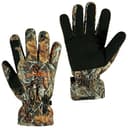
- Wet-weather and waterfowl work. Handling wet decoys, wet rope, a wet gun. The Bassdash is the only pick that states a waterproof shell, and that is worth more in November than any insulation claim. Its honest cost is noise: a waterproof shell is louder against a bow riser or a gun stock than fleece is.
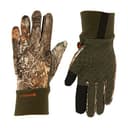
- Bowhunting and anything with a trigger feel.The Manzella. Stretch fleece fits close, so a release strap does not shift on the draw and the string stays clear of bunched fabric. Its honest cost is warmth — thin means cold, so this is a mobile-hunting glove rather than a sit-still glove.
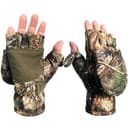
- Everything else, for almost nothing. The Favuit. A convertible fingerless mitten with a stated windproof face and an anti-slip palm, at the lowest price in the category. Its honest cost is that it states no insulation at all: this is a wind layer, not a cold-weather glove, and the build quality is the compromise you are accepting.
The convertible design is worth more than insulation
If you take one thing from this page, take this. The single most useful feature in a cheap hunting glove is not warmth — it is the ability to get a bare fingertip out without taking the glove off.
The reason is that the moment you need dexterity is the moment you cannot afford movement. Nocking an arrow, finding a safety, adjusting a rangefinder, working a call: each of those is a two-second job that becomes a thirty-second job of pulling a glove off, holding it in your teeth and putting it back on afterwards. Deer notice thirty-second jobs.
A flip-mitten or fingerless design solves it for nothing, which is why the cheapest glove on this page is worth buying and why the flip-mitten in our full budget glove roundup ranks as high as it does despite sitting over this ceiling.
Why cold hands are usually not a glove problem
This is the part that saves you money. Your body protects its core first and your extremities last. NIOSH’s cold-stress guidance describes the mechanism plainly: the body narrows the blood vessels in the skin and extremities to hold heat in the core, which is why your fingers go numb long before you feel cold in your chest.
The practical consequence is counter-intuitive and it is the whole argument of this section: if your hands are cold, the cheapest fix is usually a warmer torso, not warmer gloves. A fleece-lined base layer under your camo costs about the same as the glove at the top of this page and will do more for your fingers than doubling your glove budget, because a warm core lets your body send blood back out to your hands.
The second-cheapest fix is a disposable warmer in each glove or, far better, a hand muff at your waist where both hands can go at once. The National Weather Service’s cold-safety guidance makes the other half of the point: wet clothing accelerates heat loss sharply, so a waterproof glove is doing warmth work even when it claims no insulation. Our budget hand-warmer roundup ranks five warmers on the two figures those makers do publish — hours of heat and average temperature — which is more comparable data than any glove in this bracket offers.
What the twenty-five dollar ceiling actually costs you
- Published numbers, entirely. No insulation weight, no temperature rating, no hydrostatic-head figure on any of the three. You are buying on construction and materials, which is workable but means you cannot compare them on warmth and neither can we.
- Hard-weather durability. Cheap gloves fail at the fingertips and the seam between thumb and palm. Expect a season or two, and buy the spare pair the price makes realistic rather than one better pair.
- Touchscreen compatibility and tailored fit. Neither is stated on any of the three. If you need a glove that works a phone screen, that is a reason to go over this ceiling.
- A genuinely warm sit-still glove. This is the real gap. Nothing under $25 is a hard-freeze, sit-motionless glove. The Carhartt fleece glove and flip mitten that lead our main glove page both sit just over this line, and if late-season stand hunting is what you do, that is where to spend.
Buy two pairs, not one better pair
At these prices the strategy that actually works is redundancy. Wet gloves are useless gloves, and gloves get wet from the inside — from sweat on the walk in — as often as from the weather. A second pair in a pack pocket means the walk-in pair comes off at the tree and a dry pair goes on for the sit.
That is the same reasoning behind the layering argument in how to layer hunting clothing and the reason our cold-weather kit page spends its money on the torso first. Two cheap pairs of gloves and a warm base layer beat one expensive pair of gloves on a cold morning, and it costs less.