Start with what you are shooting
The glove decision is downstream of the weapon, not the temperature. Get this order wrong and no amount of insulation helps.
Bow or crossbow: dexterity wins
A release aid is a small mechanical device with a trigger and a wrist strap, and both are calibrated to your bare hand. Add three millimeters of fabric and the strap sits looser, the trigger feels further away, and your anchor point moves. Archers who practice all summer bare-handed and then hunt in thick gloves are shooting a bow they have not shot before.
Buy thin, buy stretch, and practice in the glove you will hunt in. Then solve the cold separately with a hand muff or a pocket warmer rather than with more glove — our budget hand warmer rankings cover both, including which warmers publish an actual temperature.
Rifle or shotgun: you have more room
A trigger guard is bigger than a release trigger and the movement is simpler, so a moderately insulated glove is workable. The specific thing to check is that your gloved finger fits inside the trigger guard without touching the guard on the way in. If it does not, you will end up stripping the glove at the worst moment.
Sitting still: warmth wins, and mittens are the answer
Fingers stay warm by sharing heat. Separate them into individual fabric tubes and each one radiates on its own, which is why a mitten of a given thickness is meaningfully warmer than a glove of the same thickness. That is the physics, and it is why the flip mitten exists.
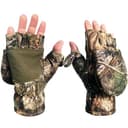
The flip mitten: the only design that gets both
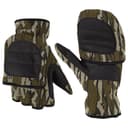
A flip mitten is a fingerless glove with a mitten hood that folds back and secures out of the way. You sit with your fingers together and warm; when it is time to shoot, you flip the top back and you have bare or lightly-covered fingers on the trigger.
It is the correct answer for stand hunting and it is a slightly awkward object the rest of the time — bulkier on the walk in, with a flap that can catch on a bowstring or a climbing stick if you are careless. The trade is worth it for anyone who sits still in the cold, which is most whitetail hunters for most of the season.
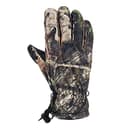
Two of the five gloves here use this design, at opposite ends of the price range. Buy the flip mitten if your hunting is mostly stationary and buy a thin glove if it is mostly moving; if you can only afford one and you hunt both ways, the plain fleece glove is the better compromise because you can add a hand muff over it.
Fleece, insulation and waterproofing
Fleece
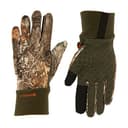
Fleece is the default for a reason. It is quiet against a bow riser or a rifle stock, where a shell fabric rasps audibly at exactly the wrong moment. It keeps some insulating value when damp. It is cheap. And it is thin enough to preserve most of your feel.
What it will not do is stop wind or rain. A fleece glove in a twenty-mile-an-hour wind is a cold glove, and this is the single biggest limitation of the category.
Insulated and waterproof
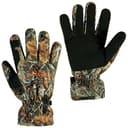
An insulated waterproof glove solves the wind and wet problem completely and costs you noise and feel. If you hunt waterfowl, handle wet decoys, hunt in genuine rain, or hunt the late season on open ground, this is what you need and the trade is correct.
The catch worth knowing: waterproof gloves keep sweat in as well as rain out. Walk in wearing them and you will arrive with damp hands inside a shell that cannot dry, which is colder than arriving with cold dry hands. Carry them and put them on when you stop.
What the listings do not tell you
Almost no glove in this price bracket publishes an insulation weight in grams or a temperature rating, and where that figure is missing we have printed “Not published” rather than inventing one. That is a genuine gap in the buying information for this category and it applies to nearly every budget glove on the market, not just these.
The things that beat gloves
Three cheap fixes do more for cold hands than upgrading the glove, and all three are worth doing before you spend more on the glove itself.
- A hand muff. A fleece-lined tube on a belt that both hands go into. It is warmer than any glove because it holds both hands together in one air space, it takes zero dexterity to use, and your hands come out ready. For stand hunting this is the highest-return cold-hands purchase there is.
- Warm your core, not your hands.When your body gets cold it shuts down blood flow to the extremities to protect your core temperature. Cold hands are frequently a symptom of an under-dressed torso, and the fix is another layer under your jacket — the hierarchy is in how to layer hunting clothing.
- Disposable hand warmers. A few cents each, they last most of a sit, and one in each glove or one in a muff transforms a marginal glove into a warm one. Buy them by the box in the off-season.
What we would skip
- Heated gloves under about $60. Runtimes are short, the battery packs are bulky at the wrist, and when the charge goes you are wearing a thin glove with a dead wire in it. The idea works at higher prices; it does not work at this one.
- Leather shooting gloves for cold weather. Superb feel, close to zero insulation, and they stiffen when wet. Fine for early season, wrong for November.
- Anything with a hard logo patch or shiny shell. A deer that catches a glint of movement at twenty yards is a deer you do not shoot. Matte and soft, always.
- Touchscreen-only marketing. Useful, but it tells you nothing about warmth. Do not let it decide the purchase.
The budget answer
For most public-land whitetail hunters: a plain fleece glove for the walk in and the early season, a hand muff with disposable warmers for the sit, and a flip mitten if you hunt hard into December. That set costs less than one premium glove and covers every condition a budget hunter will meet.
If you bowhunt, invert the order — buy the thinnest glove that keeps your fingers functional, practice in it, and put the warmth budget into the muff. And whatever you buy, spend the leftover money on a proper pair of socks, because cold feet and cold hands are usually the same circulation problem in two different places.