Blaze & Budget

Best Hunting Waders Under $100

A hard ceiling, checked against live prices. Four chest waders that come in under a hundred dollars, ranked on the two numbers their listings actually publish - and an honest account of the one thing you lose.

By Stephen V.Last updated How we rank

Under a hundred dollars, the HISEA Chest Waders 800G are the pair to buy: 800 grams of published boot insulation is the warmest rating under this ceiling, and waders get cold while you stand still in water, which is most of what waterfowl hunting is. If your season starts in warm weather or you walk to your spot, buy the HISEA 600G instead — the same bootfoot neoprene build with an insulation number that will not cook you in October. The cheapest pair here that still publishes its numbers is the Fiblink, at 4 mm neoprene and 600 gram boots.

Now the thing the ceiling actually costs you, and it is a single specific item: the only hunting wader we track with a published warranty sits above this line. The TIDEWE NE11 publishes a 3.5 mm neoprene upper, 3M Thinsulate insulation, triple-finished seams — stitched, glued and taped — and a one-year warranty term. Not one wader under a hundred dollars publishes a seam construction, and not one publishes a warranty at all. If a leak in year two would ruin your season, that gap is the reason to go over.

Every wader here was under $100 on the live price layer when this page was published, and the ledger below shows today’s number with the date it was read rather than a frozen claim. We own none of these waders and have stood in none of them. Here is how we rank instead.

How this is funded: we earn a commission if you buy through our links, at no extra cost to you. It never changes which product we recommend, and we’ll tell you plainly when we’d skip one. Full disclosure.

The four that clear the ceiling

Ranked on price-per-performance — the specs that matter divided by what it costs. Select a row to jump to the full write-up. We have not field-tested these — here is exactly what we do instead.

#ProductInsulationScorePrice
1
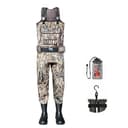
HISEA Chest Waders 800G Insulated

HISEA Chest Waders 800G Insulated

Best under $100: warmest published rating

The same wader with more insulation, and the question is whether you need it. 800 gram is the right call if your season is mostly late and mostly still — flooded timber, a late-January field, a layout blind. If you walk into a marsh in October, the extra 200 grams is a liability, not a feature.

800g · bootfoot
8.7/ 10
$91.19View on Amazon

$122.9926% off

Price as of November 22, 2026. #ad How we’re funded

2
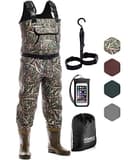
HISEA Chest Waders 600G Insulated Boot

HISEA Chest Waders 600G Insulated Boot

Best all-season insulation number

The best-balanced budget wader and the one most duck hunters should buy. 600 gram insulation in the boot is the right number for a season that runs from an early-October marsh to a January field, and HISEA is already the brand behind two of the rubber boots we rank — same build language, same honest price.

600g · bootfoot
9.0/ 10
$83.49View on Amazon

$118.9930% off

Price as of November 22, 2026. #ad How we’re funded

3
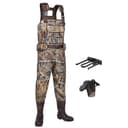
Fiblink Hunting Waders 4mm / 600G

Fiblink Hunting Waders 4mm / 600G

Cheapest with published numbers

The cheapest wader here that still publishes its two important numbers: 4 mm neoprene and 600 gram insulated boots. Thicker neoprene than the TIDEWE for less money is a real argument, and the honest counterweight is that nobody can tell you how long a no-name wader lasts — nor will the listing.

600g · 4 mm
8.4/ 10
$83.99View on Amazon

$119.9930% off

Price as of November 22, 2026. #ad How we’re funded

4
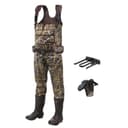
Foxelli Chest Waders 4mm (uninsulated)

Foxelli Chest Waders 4mm (uninsulated)

Best early season, and the only women's fit

The early-season and crossover pick, and the only one on this page that lists a women's fit. 4 mm neoprene with no insulation rating is exactly right for September teal, for fishing, and for anyone whose wader spends more time walking than sitting — insulation you do not need is just heat you have to carry.

None · 4 mm
8.5/ 10
$84.97View on Amazon

$99.9715% off

Price as of November 22, 2026. #ad How we’re funded

The picks in full

#1Best under $100: warmest published rating8.7/ 10 value

HISEA Chest Waders 800G Insulated

The same wader with more insulation, and the question is whether you need it. 800 gram is the right call if your season is mostly late and mostly still — flooded timber, a late-January field, a layout blind. If you walk into a marsh in October, the extra 200 grams is a liability, not a feature.

Strengths

  • 800 gram insulation published — the warmest rating on this page
  • Same bootfoot neoprene construction as our top pick, at close to the same price
  • The right wader for sitting still in cold water, which is where waders actually get cold

Trade-offs

  • 800 gram is too much boot for early-season walking — you will sweat and then freeze
  • The listing publishes no neoprene thickness and no warranty term
  • No published size chart relating boot size to wader size
Insulation800 gram
StyleChest-high bootfoot
Neoprene thicknessNot published
Warranty termNot published

Specs read from the product listing, on October 11, 2026. “Not published” means the maker doesn’t state that figure. The score is our value rating, not a lab test — how we rank.

#2Best all-season insulation number9.0/ 10 value

HISEA Chest Waders 600G Insulated Boot

The best-balanced budget wader and the one most duck hunters should buy. 600 gram insulation in the boot is the right number for a season that runs from an early-October marsh to a January field, and HISEA is already the brand behind two of the rubber boots we rank — same build language, same honest price.

Strengths

  • 600 gram insulated boot — enough for most of the waterfowl season without cooking your feet in October
  • Neoprene bootfoot build, so there is no separate wading boot to buy or to leak
  • Camo pattern and a chest-high cut, which is the standard waterfowl configuration

Trade-offs

  • The listing publishes no neoprene thickness in millimetres
  • No published warranty term
  • No boot-size-to-wader-size chart is published, and neoprene waders are the hardest garment in hunting to size by guess
Insulation600 gram (boot)
StyleChest-high bootfoot
Neoprene thicknessNot published
Warranty termNot published

Specs read from the product listing, on October 11, 2026. “Not published” means the maker doesn’t state that figure. The score is our value rating, not a lab test — how we rank.

#4Best early season, and the only women's fit8.5/ 10 value

Foxelli Chest Waders 4mm (uninsulated)

The early-season and crossover pick, and the only one on this page that lists a women's fit. 4 mm neoprene with no insulation rating is exactly right for September teal, for fishing, and for anyone whose wader spends more time walking than sitting — insulation you do not need is just heat you have to carry.

Strengths

  • 4 mm neoprene published, with no insulation to overheat in early season
  • Listed for men and women, the only pick here that says so
  • Doubles as a fishing wader, which spreads the cost across two seasons

Trade-offs

  • No insulation rating at all — this is not a late-season wader and we would not pretend otherwise
  • No seam construction and no warranty term published
  • No published size chart
InsulationNone published
Neoprene thickness4 mm (listing published)
FitMen's and women's (listing published)
SeamsNot published
Warranty termNot published

Specs read from the product listing, on October 11, 2026. “Not published” means the maker doesn’t state that figure. The score is our value rating, not a lab test — how we rank.

Two numbers decide a sub-$100 wader

Camo pattern and pocket count are what the listing photographs. These two are what you feel at hour four in the marsh.

  • Boot insulation, in grams.Published by three of these four: 800 g on the HISEA 800G, 600 g on the HISEA 600G and 600 g on the Fiblink. The Foxelli publishes none at all, by design — it is an uninsulated wader. Grams is the only comparable warmth figure in footwear and it is the right spec to shop on, because waders are a sitting-still garment and your feet are the part standing in cold water.
  • Neoprene thickness, in millimetres.Published by two: 4 mm on both the Fiblink and the Foxelli. The two HISEA pairs publish no thickness at all, which renders as “Not published” below. Thicker neoprene is warmer and more buoyant and also stiffer to walk in — 4 mm is a standing wader, not a hiking one.

Notice the odd shape of that: the two cheapest waders here publish the thickness and the two best-balanced ones publish the insulation. Nobody under a hundred dollars publishes both.

What 800 grams is for, and when it is a liability

Insulation you do not need is heat you have to carry. The HISEA 800G is the right wader for flooded timber, a late-January field or a layout blind — anywhere you are still and the water is cold. Walk half a mile into an October marsh in them and you will sweat, and then you will freeze, which is the actual mechanism behind most cold-weather misery. The National Weather Service’s own cold-safety guidance is blunt about it: wet clothing accelerates heat loss, and the extremities are where you notice first.

The 600 gram pairs are the all-season answer and the Foxelli is the early-season one. If you hunt one season and one marsh, buy to that; if you hunt all of it, buy 600 and wear better socks. Our budget hunting sock roundup covers the layer that does more for cold feet than two hundred extra grams does.

Seams are where cheap waders actually fail

Not the fabric. The seams. A neoprene wader leaks at a stitch line first, and the construction that prevents it — stitched, then glued, then taped — is the single spec that separates a wader that lasts four seasons from one that lasts one.

None of the four waders under this ceiling publishes a seam construction.Their spec rows read “Not published” and that is a finding, not a gap in our research: if a maker had triple-finished the seams, the listing would say so, because the one wader we track that does say so is also the one that charges for it.

The practical answer is to budget for repair rather than for replacement. A tube of neoprene cement costs a few dollars and fixes a pinhole in an evening — our wader repair guide walks through finding the leak, which is the harder half.

Sizing is the thing that ruins a cheap wader purchase

Read this before you order. None of these four publishes a chart relating boot size to wader size, and a bootfoot neoprene wader is the hardest garment in hunting to size by guess: the boot is moulded on, so a boot that is a half-size off cannot be fixed by lacing, and a wader that is too short in the inseam pulls the boot off your heel every step.

Order to your boot size, not your shoe size, and leave room for the heavy sock you will actually wear. Expect one exchange. At these prices that is a defensible cost; at three hundred dollars it would not be.

Should you go over the ceiling?

Yes, if any of these three is true: you hunt more than a dozen days a year, a mid-season leak would cost you a trip you cannot repeat, or you want a specification you can actually compare on paper. That is precisely what the money buys above this line — published seam construction, a named insulation, a stated warranty.

No, for almost everyone else. A first pair of waders is a bet on whether you will hunt ducks enough to need good ones, and a hundred-dollar bet is the right size. Read our full budget hunting wader roundup for the field with no ceiling, and duck hunting on a budget for where waders sit in the order of things worth buying first.
Frequently asked questions

Are hunting waders under $100 any good?

For a first pair, genuinely yes - you get chest-high bootfoot neoprene with published insulation or published thickness, which is the same construction more expensive waders use. What the ceiling costs you is a published seam construction and a warranty: not one wader under a hundred dollars publishes either.

How much insulation do hunting waders need?

600 gram for a season that runs from early marsh to late field, 800 gram if you mostly sit still in cold water, and none at all for September teal or crossover fishing use. Insulation you do not need is heat you carry, and sweating on the walk in is how people get cold while hunting.

What neoprene thickness is best for hunting waders?

4 mm is the standard budget figure and it is warm and buoyant, at the cost of being stiffer to walk in. Thinner uppers around 3.5 mm walk better. Only two of the four waders under this ceiling publish a thickness at all - the other two publish insulation instead, and nobody under a hundred dollars publishes both.

Where do cheap waders leak first?

At the seams, not through the fabric. The construction that prevents it is stitched, glued and taped - and no wader under a hundred dollars that we track publishes its seam construction. Budget a few dollars for neoprene cement instead, because a pinhole is an evening's repair once you find it.

What size hunting waders should I order?

Order to your boot size with room for a heavy sock, not your street shoe size. None of these four publishes a chart relating boot size to wader size, and a bootfoot wader cannot be laced tighter to fix a loose boot. Expect one exchange and buy from somewhere that makes that easy.

Can you use hunting waders for fishing?

Yes, and the uninsulated pair here is listed for exactly that - which spreads the cost across two seasons. Insulated hunting waders work for cold-water fishing and are too warm for a summer river. If you want one pair for both, buy uninsulated and wear the socks for warmth.

Sources

  • Cold Weather Safety — National Weather Service — Federal cold-weather hazard overview — frostbite, hypothermia and wind chill (accessed July 22, 2026)
  • Seeker Camo Hunting Waders for Waterfowl Hunting — TIDEWE — The maker's spec data for its chest waders: a "3.5 mm neoprene upper with tough poly / jersey shell", 3M Thinsulate ultra insulation, "triple-finished seams that are stitched, glued and taped", a "Quick-drain chest hand-warmer pocket with small pocket inside", adjustable neoprene suspenders, and a published "One Year" warranty on this line. No garment weight is published (accessed October 11, 2026)
  • Federal Duck Stamp — U.S. Fish & Wildlife Service — Federal requirement that waterfowl hunters 16+ buy a Duck Stamp; 98% of the price funds habitat (accessed July 22, 2026)

Keep reading