The four specs that actually differ
Axle-to-axle length
The distance between the two cam axles, and the clearest tell. A hunting bow typically runs short — roughly 28 to 33 inches on most modern rigs — so it clears a treestand rail, a blind window and the brush you are crawling through. A target bow runs long, often 37 to 40 inches, because a longer bow is more stable in the hand and more forgiving of a wobble at full draw.
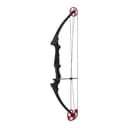
The Genesis on this page publishes 35 1/2 inches axle-to-axle, which is firmly in the long, stable, target-bow end of that spread and is a large part of why it is the bow school programmes use. Neither Bear publishes an axle-to-axle figure on its tracked listing, so those cells are blank in the table below rather than filled with a number we would have to guess.
Brace height
The distance from the string at rest to the deepest part of the grip. Short brace height means the string drives the arrow for longer, so the bow shoots faster and punishes small form errors; tall brace height means a slower, far more forgiving bow. Hunting bows trend short and fast; target bows trend tall and forgiving.
The Genesis publishes 7 5/8 inches, which is tall. That is the engineering choice behind a bow designed for beginners to shoot accurately rather than for a 300 fps arrow.
Let-off
The percentage of peak draw weight the cams take off your fingers once you are at full draw. A hunting bow with 75 or 80 percent let-off lets you hold at full draw while a deer takes four more steps. Target bows frequently run lower let-off, because a little more holding weight steadies the pin — and the Genesis takes that to its logical end with zero let-off by design: the archer holds the entire draw weight the whole time they aim.
Zero let-off is excellent for teaching form and impossible for hunting. That single spec is the practical difference between the two categories in one line.
Draw weight, which is the legal one
Here is where the comparison stops being preference. States set a minimum draw weight for hunting deer with a bow, and the Genesis adjusts from 10 to 20 pounds — below every minimum we have checked.
- Minnesota: the bow must have a pull of no less than 30 pounds at or before full draw.
- Wisconsin: Wis. Admin. Code NR 10.09 requires a bow with a minimum draw weight of 30 pounds.
- Pennsylvania: a 35 pound peak draw weight minimum.
A 20-pound ceiling does not reach any of those. That is not a criticism of the Genesis — it is a target bow and NASP’s single approved bow for school programmes, which is exactly what it is built to be. It is a warning about buying one and expecting to hunt with it.
The three bows, spec by spec
Every figure below is read from the tracked listing or the maker’s published spec page. Where a maker does not publish a number, the cell says so rather than carrying an estimate.
| Spec | Bear Species XT | Genesis Original | Bear Cruzer G4 |
|---|
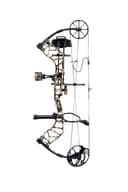
| Built for | Hunting | Target / school programmes | Both |
| Draw weight | Up to 70 lb | 10–20 lb | 10–70 lb |
| Draw length | Factory set | 15–30 in universal | 14–30 in |
| Let-off | Not published on listing | Zero (by design) | Not published on listing |
| Axle-to-axle | Not published on listing | 35 1/2 in | Not published on listing |
| Brace height | Not published on listing | 7 5/8 in | Not published on listing |
| Mass weight | Not published on listing | 3.5 lb | 3.2 lb |
| Package | Ready-to-hunt (sight, rest, quiver) | Bow only | Ready-to-hunt accessory kit |
| Legal for deer at its ceiling? | Yes | No — below every state minimum we checked | Yes |
| Our value score | 9.1 | 8.3 | 8.7 |
The pattern in that table is the honest state of the budget market: the target bow publishes a full spec sheet and the two hunting packages publish almost none. Genesis prints axle-to-axle, brace height, let-off, mass and warranty; the Bear listings print draw weight and what is in the box. That is worth knowing before you try to compare budget hunting bows on paper — mostly, you cannot.
Can you hunt with a target bow?
Only if it makes the legal draw weight where you hunt, and most dedicated target bows do not. The sequence to check, in order:
- Draw weight ceiling versus your state minimum. If the bow cannot reach it, the conversation is over.
- Let-off. Holding full draw weight while a deer walks in is not realistic for most people, whatever the law says.
- Length in your actual hunting position. A 38-inch bow in a ground blind is a problem you will discover at the worst moment.
- Arrow and broadhead fitment. Target bows are usually set up for light target arrows; hunting needs heavier arrows with the right spine for broadheads. Our arrow guide covers spine matching, and broadhead grain covers the front end.
Can you shoot targets with a hunting bow?
Yes, and almost everyone does — it is how you get good enough to hunt. A short, fast hunting bow is less forgiving of a sloppy release than a long target rig, so your groups at 40 yards will be marginally wider than a target archer’s. For practice, for 3D courses and for backyard shooting, that is irrelevant.
This is the reason the asymmetry resolves the way it does. The hunting bow does both jobs acceptably; the target bow does one job superbly and the other not at all. If you are buying one bow and there is any chance you will hunt with it, the decision is made.
Where the adjustable bow fits
Between the two sits a third category that barely existed twenty years ago: the wide-adjustment hunting bow. The Cruzer G4 covers 10 to 70 pounds and 14 to 30 inches of draw length, which is a span from a child learning form to an adult hunting elk, in one bow.
It is the right answer for a specific and common situation — one bow, more than one person, several years. You pay for it in top-end performance: a bow engineered to do everything gives up a little speed and a little refinement against one built for a single draw length. For a budget household that is a trade worth making, and it is why the Cruzer appears on both our budget compound bow roundup and our youth bow page. The Cruzer G4 against the Species XT head-to-head works through that choice specifically.
Fit beats category, every time
None of this matters if the bow does not fit you. The Archery Trade Association’s consumer guidance gives the rough method — wingspan in inches divided by 2.5 for a starting draw length — and warns that a draw length even an inch too long or short causes problems ranging from reduced accuracy to injury.
Draw weight follows the same rule: the correct weight is one you can draw smoothly, seated, without hitching your shoulder, in cold weather, after sitting still for three hours. That is usually less than people buy. Our draw weight guide covers the legal minimums and the practical ceiling, and how to choose a budget compound bow covers the rest of the buying decision.