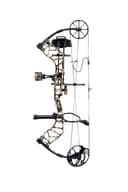
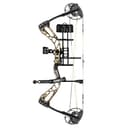
The spec sheets, side by side
Every row below is read from the tracked listing. Where a figure is not published we say so rather than quoting a number from a review site or a previous model year — model names carry over between generations in this category and the specs do not.
| Spec | Bear Species XT | Bear Cruzer G4 | Diamond Edge 320 |
|---|
| Draw weight range | Up to 70 lb | 10–70 lb | 7–70 lb |
| Draw length range | Factory set — range not published | 14–30 in | 15–31 in |
| Adjustable without a bow press | No | Yes | Yes |
| Mass weight | Not published | 3.2 lb | Not published |
| Published speed | Not published | Not published | Up to 320 fps |
| Sold ready to hunt | Yes — sight, rest, quiver, stabilizer | Yes — Trophy Ridge accessory kit | Yes — fully accessorized package |
| Hand options | Right / left | Not published on the listing | Not published on the listing |
| Our value score | 9.1 | 8.7 | 8.9 |
Difference 1: adjustability is a feature you pay for twice
The Cruzer G4’s 10–70 pound and 14–30 inch range is genuinely useful, and it is genuinely not free. A riser and cam system engineered to work across a sixteen-inch draw-length span is a compromise at every point in that span. That is where the bow spends its budget, and it is why the Species XT — which only has to be right at one setting — is the better-shooting bow for the hunter it fits.
You pay the second time in tuning. A bow set near the edges of its adjustment range rarely has the same arrow flight as one set in the middle, and a wide-range bow has far more edges. If you buy the Cruzer and plan to leave it at one setting forever, you have bought flexibility you will never use and given up a little performance to get it.
None of that matters if the alternative is the wrong-size bow. A draw length even an inch off costs you more accuracy than any cam design will give back, which is the same reason we send parents to the Cruzer in our youth compound bow roundup rather than to a cut-down adult rig.
Difference 2: who is going to shoot it, and for how long
Be honest about the household. The Cruzer G4 earns its design when there is a real second shooter — a kid who will grow into it, a partner who wants to try a season, a buddy who borrows it. One bow covering three people is excellent value, and no amount of single-setting refinement beats that.
It stops earning the moment the second shooter is hypothetical. A grown hunter buying their first bow, who is going to set it at 60 or 65 pounds and leave it there for five seasons, is paying for a range they will use once. That hunter should buy the Species XT and spend the saved attention on arrows, a target and range time.
The same logic applies to growth. A twelve-year-old will outgrow the Cruzer’s 30-inch ceiling eventually, but “eventually” is five or six years away, and a bow that fits for six years is a bow that got bought once. Our guide to choosing a budget compound bow walks through measuring draw length before you commit to either.
Difference 3: draw weight, and the number your state cares about
Both bows clear every state archery minimum we checked by a wide margin at their top end — Pennsylvania’s 35-pound peak, Minnesota’s 30-pound rule and Wisconsin’s 30-pound minimum are all far below 70. The number that matters is the one you will actually pull, not the one on the box.
That is where the Cruzer’s 10-pound floor becomes a trap worth naming. A bow set at 10 or 20 pounds is a practice bow and cannot legally be used for deer anywhere we looked. It is a fine way to teach form, but a parent who buys the Cruzer for a small child needs to understand that the hunting conversation starts when the child can hold 30 to 40 pounds at full draw, not when they can draw the bow at all. The full rule-by-rule breakdown is on our draw weight for deer hunting page.
Check your own state before you buy for anyone, child or adult. Minimums vary, they change, and they are the one specification on this page that a manufacturer cannot help you with.
Where the Diamond Edge 320 fits
If you read the case for the Cruzer and thought “yes, that is my problem,” look at the Diamond Edge 320 before you buy it. It covers a wider span on both axes — 7 to 70 pounds and 15 to 31 inches, adjustable with an Allen key and no press — and it is the only bow of the three that publishes a speed figure at all, at up to 320 fps.
The honest counter-argument is brand and resale. Bear is the better known name at the counter and the easier bow to hand on second-hand, and the Cruzer’s published 3.2-pound mass weight is a real advantage for a small shooter holding a bow steady. Neither Bear bow publishes a speed figure, which we mark as unpublished rather than filling in — if a specific IBO number is decisive for you, the Diamond is the only one of the three that gives you one.
The short answer
- One grown hunter, one bow: Species XT. Better bow at the setting you will hunt, and it arrives ready to shoot.
- A household with more than one shooter: Cruzer G4. The adjustment range is the product, and it is worth the small performance tax.
- A growing kid who will hunt within two seasons: Cruzer G4. The 14-inch draw-length floor is the spec doing the work, not the 10-pound draw weight.
- Maximum adjustability, brand second: Diamond Edge 320. Wider on both axes and the only published speed figure here.
Whichever you pick, budget for arrows cut to your draw length and a target you can shoot into at home. Both bows are sold ready to hunt, but ready to hunt is not the same as sighted in, and the gap between those two states is a hundred arrows. See the full field in our budget compound bow rankings.