Blaze & Budget

Best Budget Hunting Arrows

Arrows are the only part of your setup that leaves the bow, and the only part most budget archers buy on price alone. Spine matters more than brand, and straightness is what the money buys.

By Stephen V.Last updated How we rank

An arrow is a consumable that has to behave identically every time, which is an unusual combination. You will lose them, break them and bury them in the dirt, so cost matters. And every one of them has to leave the bow the same way as the last, or your groups open up and no amount of practice closes them again.

Two specifications decide almost everything, and only one of them is about money. Spine— the shaft’s stiffness — has to match your draw weight and arrow length, and getting it wrong ruins accuracy no matter what you paid. Straightness tolerance is what separates a thirty-dollar half-dozen from a ninety-dollar one, and it is the spec most budget listings decline to publish.

Below are four arrows across the budget range, plus an honest split we think matters: the cheapest carbon on the shelf is genuinely good for volume practice and should not go near a deer. We have not shot these. We compared published specs, checked what is actually in each box, ran the price-per-performance math on live prices, and marked every figure the listing does not state. Our method is here.

Read this before you order:the spine listed on each pick is the one we priced and linked. The same listing carries other spines, and you need the one that matches your bow — the chart below tells you which.

How this is funded:we earn a commission if you buy through our links, at no extra cost to you. It never changes which product we recommend, and we’ll tell you plainly when we’d skip one. Full disclosure.

Quick picks

Ranked on price-per-performance — the specs that matter divided by what it costs. Select a row to jump to the full write-up. We have not field-tested these — here is exactly what we do instead.

#ProductSpine / countScorePrice
1
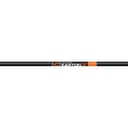
Gold Tip Hunter with Raptor Vanes (340 spine, 6 pk)

Gold Tip Hunter with Raptor Vanes (340 spine, 6 pk)

Best all-around

The default budget hunting arrow, and the one a pro shop is most likely to already stock in your spine. It arrives fletched and ready to shoot, which is the difference between hunting this weekend and building arrows this weekend.

340 · 6 pk
9.0/ 10
2
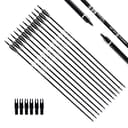
Victory Archery VForce Sport Fletched (350 spine, 6 pk)

Victory Archery VForce Sport Fletched (350 spine, 6 pk)

Best published straightness

The only arrow here that publishes a straightness tolerance on the listing — plus or minus .006 inches. That number is what you are actually buying when you move up in arrow price, and most budget arrows will not print it.

350 · ±.006
8.7/ 10
$49.88View on Amazon

Price as of September 5, 2026. #ad How we’re funded

3
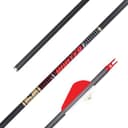
Easton 6.5 Bowhunter Shafts (400 spine, 12 pk)

Easton 6.5 Bowhunter Shafts (400 spine, 12 pk)

Cheapest per arrow

A dozen bare Easton shafts for around what six finished arrows cost. This is the cheapest real arrow per unit on the page, and the catch is honest: you are buying shafts, so vanes, inserts and nocks are your problem.

400 · 12 pk
8.5/ 10
$65.99View on Amazon

$69.996% off

Price as of September 5, 2026. #ad How we’re funded

4
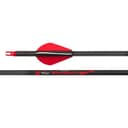
Tiger Archery 30" Carbon Practice Arrows

Tiger Archery 30" Carbon Practice Arrows

Best for practice volume

Practice arrows, and we are labeling them that on purpose. Shoot these into a block all summer and save your hunting arrows for hunting — that is the honest job for the cheapest carbon on the shelf.

30" · practice
7.9/ 10
$32.99View on Amazon

Price as of September 5, 2026. #ad How we’re funded

The picks in full

#1Best all-around9.0/ 10 value

Gold Tip Hunter with Raptor Vanes (340 spine, 6 pk)

The default budget hunting arrow, and the one a pro shop is most likely to already stock in your spine. It arrives fletched and ready to shoot, which is the difference between hunting this weekend and building arrows this weekend.

Strengths

  • Ships fletched with Raptor vanes — cut, insert and hunt
  • Gold Tip is a mainstream hunting brand, so replacements are easy to match
  • Sold in the spines that cover most 55-70 lb compound setups

Trade-offs

  • Straightness and weight tolerances are not published on the listing
  • Six arrows is a thin quiver once you start losing them in the dirt
Spine (this listing)340
Pack6 arrows
FletchingRaptor vanes, factory fletched
Straightness toleranceNot published

Specs read from the product listing, on August 19, 2026. “Not published” means the maker doesn’t state that figure. The score is our value rating, not a lab test — how we rank.

#2Best published straightness8.7/ 10 value

Victory Archery VForce Sport Fletched (350 spine, 6 pk)

The only arrow here that publishes a straightness tolerance on the listing — plus or minus .006 inches. That number is what you are actually buying when you move up in arrow price, and most budget arrows will not print it.

Strengths

  • Straightness stated as +/-.006 — a real, checkable number
  • Arrives fletched, so there is no build step
  • Consistency shows up downrange more than any spec on the box

Trade-offs

  • Weight tolerance is still not published
  • Sold six to a pack, like most of this bracket
Spine (this listing)350
Straightness+/- .006 in
Pack6 arrows
Weight toleranceNot published

Specs read from the product listing, on August 19, 2026. “Not published” means the maker doesn’t state that figure. The score is our value rating, not a lab test — how we rank.

#3Cheapest per arrow8.5/ 10 value

Easton 6.5 Bowhunter Shafts (400 spine, 12 pk)

A dozen bare Easton shafts for around what six finished arrows cost. This is the cheapest real arrow per unit on the page, and the catch is honest: you are buying shafts, so vanes, inserts and nocks are your problem.

Strengths

  • Twelve shafts per box — the lowest cost per arrow here by a wide margin
  • Easton is the reference brand for carbon hunting shafts
  • Building your own lets you match components exactly to your setup

Trade-offs

  • Bare shafts: fletching, inserts and nocks are extra time and money
  • The listing does not state straightness or whether components are included
Spine (this listing)400
Pack12 shafts
FletchedNo — bare shafts
Components includedNot published

Specs read from the product listing, on August 19, 2026. “Not published” means the maker doesn’t state that figure. The score is our value rating, not a lab test — how we rank.

#4Best for practice volume7.9/ 10 value

Tiger Archery 30" Carbon Practice Arrows

Practice arrows, and we are labeling them that on purpose. Shoot these into a block all summer and save your hunting arrows for hunting — that is the honest job for the cheapest carbon on the shelf.

Strengths

  • Cheap enough that burying one in the dirt costs nothing
  • Volume practice is the highest-return thing a budget archer can buy
  • Fits both compound and recurve setups per the listing

Trade-offs

  • No published straightness or weight tolerance — do not hunt with these
  • Consistency between arrows is the thing you are giving up
Length30 in
Intended useTarget and practice (per listing)
Spine optionsNot published
Straightness toleranceNot published

Specs read from the product listing, on August 19, 2026. “Not published” means the maker doesn’t state that figure. The score is our value rating, not a lab test — how we rank.

Spine: get this right or nothing else matters

When you release the string, the arrow does not fly straight off the bow. It flexes — bends sideways, recovers, bends back — in a phenomenon called archer’s paradox, oscillating around the rest as it clears the riser. Spine is the measure of how much it flexes.

The number is counterintuitive: lower is stiffer. A 300-spine shaft is stiffer than a 500-spine shaft. It comes from the test method, which hangs a weight on a supported shaft and measures the deflection in thousandths of an inch, so a bigger number means more bend.

Get it wrong in either direction and you have a problem practice will not fix:

  • Too weak (spine number too high): the shaft over-flexes, does not recover before it leaves the rest, and hits left or right of where you aimed depending on your handedness. Broadheads make it dramatically worse.
  • Too stiff (spine number too low): the shaft barely flexes, does not clear the rest cleanly, and you get erratic contact and inconsistent flight.

Two things drive the spine you need: draw weight and arrow length. Heavier draw weight needs a stiffer shaft. Longer arrows need a stiffer shaft, because a longer beam flexes more under the same force. Broadhead and insert weight shift it further — more weight up front effectively weakens the spine.

As a rough orientation, a 28-inch arrow at 60–70 lb typically lands around 340 spine; the same length at 50–60 lb lands around 400; and 70–80 lb pushes toward 300. Those are starting points, not answers — every manufacturer publishes its own spine chart for its own shafts and you should use theirs. If you are still deciding on poundage, our draw weight guide covers the legal minimums and what deer actually require.

Straightness: what the extra money buys

Straightness tolerance is stated as a plus-or-minus figure in thousandths of an inch: how far the shaft deviates from perfectly straight along its length. Common tiers are ±.006, ±.003, ±.001 and tighter.

Here is the part budget archers need to hear plainly. The difference between ±.006 and ±.001 is real, measurable, and almost entirely irrelevant at whitetail distances. At twenty to forty yards, with field points, the error a ±.006 shaft introduces is smaller than the error you introduce, and considerably smaller than the error a mediocre release introduces.

Where it starts to matter is past fifty or sixty yards, and with fixed-blade broadheads, which act like small wings and amplify any inconsistency in the shaft. If you shoot inside forty yards with mechanicals, buy ±.006 and stop thinking about it. If you shoot long or run fixed blades, tighter tolerance is a defensible upgrade. The broadhead half of that decision is in fixed blade vs mechanical broadheads.

What matters more than the absolute number is consistency across the set. Six arrows all bent the same amount group better than six arrows bent by random amounts, which is the real reason better-tolerance shafts shoot tighter. It is also why we would rather have six matched budget arrows than a mixed bag of expensive ones.

Fletched, bare shafts, and the hidden cost

The price comparison in this category is genuinely misleading if you do not read what is in the box.

Fletched arrows arrive with vanes attached and usually with nocks installed. You cut them to length, glue in an insert, and you are hunting. This is what most people should buy.

Bare shafts arrive as tubes. You supply vanes, inserts, nocks, glue and a fletching jig, and you spend an evening building them. The per-shaft price looks unbeatable and the finished per-arrow cost is much closer to a fletched arrow than the listing suggests, once you have bought a jig.

Building your own is worth it if you are already set up for it or plan to shoot enough arrows that the jig pays for itself. It is not a budget shortcut for someone buying their first dozen. The Easton shafts here are the cheapest per unit on this page precisely because they are bare, and we have ranked them accordingly rather than letting the sticker price flatter them.

Hunting arrows vs practice arrows: buy both

This is the single most useful budget move in archery and almost nobody does it.

Practice is the highest-return thing an archer can spend on, and it is free once you own arrows — except that every practice shot wears the arrows you plan to hunt with, and every stray one into the dirt costs you real money. The predictable result is that budget archers under-practice to protect their arrows, which is exactly backwards.

The fix: buy a half-dozen good arrows for hunting and a cheap dozen for volume practice. Shoot the cheap ones into a block all summer. Shoot the hunting arrows enough to confirm they hit where the practice arrows do — ideally with the broadheads you will hunt with, which is non-negotiable — and then leave them alone.

That is why the cheapest arrow on this page is labeled as a practice arrow rather than a bad arrow. It is a good arrow for the job we have given it, and a poor one for the job the listing implies.

Arrow weight, and the FOC question

Total arrow weight in grains determines kinetic energy and penetration. Heavier arrows carry more energy at the target and drop faster; lighter arrows shoot flatter and hit softer. Most states set no minimum arrow weight for deer, but many bow manufacturers specify a minimum grains-per-pound of draw weight, and shooting under it can damage the bow — check your bow’s manual before chasing speed.

FOC, or front-of-center, describes how far forward the arrow’s balance point sits. More weight up front stabilizes the arrow in flight and improves penetration, which is why heavy inserts and broadheads are popular. It also weakens the effective spine, so adding fifty grains of point weight can push you into the next spine up.

For budget whitetail hunting inside forty yards, do not overthink this. A correctly-spined arrow of ordinary weight with a 100-grain head kills deer efficiently and has for decades. FOC optimization is a real thing that matters at the margins of long-range and heavy-game hunting, and it is not what is limiting your season.

What we would skip

  • Aluminum arrows for hunting. Cheap, and they bend permanently on impact rather than breaking. A bent arrow that looks fine flies badly, and you cannot always see it. Carbon either works or splinters, which is a safer failure.
  • Mystery-spine bargain packs. If the listing does not state a spine, it cannot be matched to your bow, and an unmatched arrow is not a cheap arrow. It is a wasted one.
  • Very cheap carbon for hunting.Not because it will not fly — because you cannot verify consistency across the set, and a broadhead amplifies whatever inconsistency is there. Practice only.
  • Buying six and no more. You will lose arrows. A dozen matched shafts means your hunting arrows are still matched in November, after four of them went into a stump.

One safety note that is not optional: inspect every carbon arrow before you shoot it. Flex it and listen, or twist it near your ear. A cracked carbon shaft can shatter on release and drive through your bow hand. If an arrow has hit anything hard, treat it as suspect until you have checked it.
Check your state’s regulations. Hunting laws vary by state and change year to year — legal calibers, minimum bow draw weights, blaze-orange rules, seasons and treestand requirements included. Confirm the rules with your state wildlife agency before you hunt. Blaze & Budget is written by an enthusiast, not a game warden, and nothing here is legal advice.

Frequently asked questions

What arrow spine do I need for hunting?

Spine is set by your draw weight and your arrow length together, and the number runs backwards — lower is stiffer. As rough orientation, a 28-inch arrow at 60 to 70 pounds usually lands around 340 spine, the same length at 50 to 60 pounds lands around 400, and 70 to 80 pounds pushes toward 300. Those are starting points only. Every shaft manufacturer publishes its own spine chart for its own shafts, and heavier broadhead and insert weight effectively weakens the spine, so use the maker's chart with your actual point weight.

Does arrow straightness actually matter for deer hunting?

Less than the price difference implies, inside normal whitetail range. At twenty to forty yards with field points, the error a plus-or-minus .006 shaft introduces is smaller than the error you and your release introduce. It starts mattering past fifty or sixty yards and with fixed-blade broadheads, which act like small wings and amplify any inconsistency. What matters more than the absolute figure is that all your arrows are consistent with each other, since matched arrows group better than a mixed set.

Should I buy fletched arrows or bare shafts?

Fletched, unless you already own a fletching jig. Bare shafts look dramatically cheaper per unit and then need vanes, inserts, nocks, glue and a jig before they are arrows, and the finished cost lands much closer to a fletched arrow than the listing suggests. Building your own makes sense if you shoot enough volume for the jig to pay for itself or you want exact component control. It is not a shortcut for a first dozen.

How many hunting arrows do I need?

Buy a dozen if you can, and split them by job. Six good matched arrows for hunting and a cheap dozen for volume practice is the budget answer, because it removes the reason people under-practice — protecting the arrows they plan to hunt with. Shoot the cheap ones into a block all summer, confirm your hunting arrows group with the broadheads you will actually use, then leave the hunting set alone until the season.

Are cheap carbon arrows safe?

Carbon arrows are safe when they are intact and dangerous when they are cracked, and price does not change that — it changes how reliably the set is matched. Inspect every arrow before you shoot it: flex it, twist it near your ear and listen for cracking, and check for splinters, especially on any arrow that has hit something hard. A cracked shaft can shatter on release and drive through your bow hand. Never shoot an arrow you have not checked.

Can I use the same arrows for practice and hunting?

You can, and it is what most people do, but it is why most people practice less than they should. Every shot wears the arrow and every miss risks it, so archers protecting a six-pack of good arrows shoot fewer of them. Buying a cheap dozen for the block target removes that pressure for the price of a couple of broadheads. What you must not skip is confirming your actual hunting arrows and broadheads group where your practice arrows do.

Sources

Keep reading