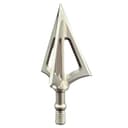
Blaze & Budget

Fixed Blade vs Mechanical Broadheads

One forgives a bow you never tuned. The other spends nothing opening and does not care how cold it is. The honest case for each, and the draw weight that settles it.

By Stephen V.Last updated How we rank

This argument has been running in archery for thirty years and it is usually conducted as a loyalty test. It should not be. Fixed and mechanical broadheads make a genuine engineering trade against each other, and which side of it you want depends on three things about your specific setup: your draw weight, how well your bow is tuned, and what your state allows.

The compressed version. A mechanicalhead flies like a field point because the blades are folded away in flight, so a bow that is not perfectly tuned still hits where you aim — and it pays for that by spending kinetic energy opening the blades on impact. A fixed head spends nothing on impact and has nothing to fail in the cold, and it pays for that by magnifying every tuning flaw in your setup into a flier at thirty yards.

Below is where each one wins, three picks that represent both camps and the middle ground, and a clear recommendation for a budget bowhunter. We do not own these heads and are not claiming to have shot them into animals; we compile the published specs, reason from the physics involved, and run price-per-performance math — our method is here. Where a maker does not publish a cutting diameter, we say so rather than estimating.

How this is funded:we earn a commission if you buy through our links, at no extra cost to you. It never changes which product we recommend, and we’ll tell you plainly when we’d skip one. Full disclosure.

Quick picks

Ranked on price-per-performance — the specs that matter divided by what it costs. Select a row to jump to the full write-up. We have not field-tested these — here is exactly what we do instead.

#ProductType / weightScorePrice
1
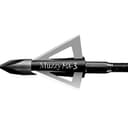
Muzzy MX-3 100 gr (3-pack)

Muzzy MX-3 100 gr (3-pack)

Best fixed blade

The cheapest fixed head here from a name that has been killing deer since the eighties. Muzzy's whole reputation is built on heads that fly straight and do not fold on a shoulder — this is the budget version of that promise.

Fixed · 100 gr
9.0/ 10
$29.50View on Amazon

$34.9516% off

Price as of September 5, 2026. #ad How we’re funded

2
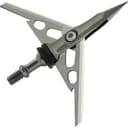
Rage Hypo 2 +P 100 gr (4-pack)

Rage Hypo 2 +P 100 gr (4-pack)

Best mechanical

The mechanical on the page, and the honest reason to buy one: it flies like a field point, so a bow you have not perfectly tuned still hits where it is aimed. You pay for that with energy spent opening the blades.

Mechanical · 100 gr
8.6/ 10
$49.99View on Amazon

$54.999% off

Price as of September 5, 2026. #ad How we’re funded

3
G5 Outdoors Montec Crossbow 100 gr (3-pack)

G5 Outdoors Montec Crossbow 100 gr (3-pack)

Best one-piece

One-piece machined steel with nothing to come apart — the Montec is what you reach for when the shot might hit bone at crossbow speed. It also sharpens back to hunting-ready with a file instead of a new blade pack.

One-piece · 100 gr
8.7/ 10
$39.91View on Amazon

Price as of September 5, 2026. #ad How we’re funded

The picks in full

#1Best fixed blade9.0/ 10 value

Muzzy MX-3 100 gr (3-pack)

The cheapest fixed head here from a name that has been killing deer since the eighties. Muzzy's whole reputation is built on heads that fly straight and do not fold on a shoulder — this is the budget version of that promise.

Strengths

  • The lowest cost per head on this page from a serious broadhead maker
  • Fixed blade — nothing mechanical to fail in the cold
  • Muzzy's steel is known for holding up on heavy bone

Trade-offs

  • Fixed heads magnify any bow-tuning problem you have not fixed
  • The listing does not publish a cutting diameter
Grain weight100 gr
TypeFixed blade
Pack size3 heads

Specs read from the product listing, on August 11, 2026. “Not published” means the maker doesn’t state that figure. The score is our value rating, not a lab test — how we rank.

#2Best mechanical8.6/ 10 value

Rage Hypo 2 +P 100 gr (4-pack)

The mechanical on the page, and the honest reason to buy one: it flies like a field point, so a bow you have not perfectly tuned still hits where it is aimed. You pay for that with energy spent opening the blades.

Strengths

  • Flies like a field point — no broadhead tuning session required
  • 1.75 in cut leaves a blood trail a beginner can actually follow
  • Four heads per pack at a fair per-head cost for a mechanical

Trade-offs

  • Mechanicals spend kinetic energy opening — a real cost on a low-poundage bow
  • More parts means more that can fail in cold, wet, or on a bone hit
Grain weight100 gr
TypeMechanical (expandable)
Cutting diameter1.75 in

Specs read from the product listing, on August 11, 2026. “Not published” means the maker doesn’t state that figure. The score is our value rating, not a lab test — how we rank.

#3Best one-piece8.7/ 10 value

G5 Outdoors Montec Crossbow 100 gr (3-pack)

One-piece machined steel with nothing to come apart — the Montec is what you reach for when the shot might hit bone at crossbow speed. It also sharpens back to hunting-ready with a file instead of a new blade pack.

Strengths

  • One-piece construction — no blades to loosen, bend or fall out
  • Rated by the maker for crossbow speeds, where lesser heads shed blades
  • Re-sharpenable, so the same three heads can serve for years

Trade-offs

  • Re-sharpening a one-piece head takes practice and a decent file
  • Priced above the Muzzy for the same three-head count
Grain weight100 gr
TypeOne-piece fixed blade
Rated forCrossbow

Specs read from the product listing, on August 11, 2026. “Not published” means the maker doesn’t state that figure. The score is our value rating, not a lab test — how we rank.

The physics, in one section

Everything else on this page follows from a single fact: an arrow carries a fixed, and on a budget setup fairly small, amount of kinetic energy, and everything the broadhead does has to be paid for out of that account.

A mechanical head arrives with its blades folded and must deploy them. Deploying blades takes energy, and that energy is subtracted from what is available for penetration. On a 70-pound bow shooting a well-built arrow, that cost is affordable. On a 45-pound bow, a youth setup, or a short-draw shooter, it is a much larger fraction of a much smaller budget — which is exactly why the “mechanicals do not penetrate” complaint is simultaneously true and overstated, depending on whose bow is being discussed.

A fixed head has no deployment cost. Every bit of energy goes into cutting and driving forward. Its cost is paid earlier, in flight: a fixed head has blade surface exposed to the air the whole way, so it behaves like a small rudder. If your arrow leaves the bow at any angle other than perfectly straight, that rudder amplifies the error instead of hiding it.

Where fixed blades win

Low draw weight and short draw length

If you shoot under about 55 pounds, or you have a short draw length that reduces your power stroke, a fixed head is the safer choice. You have less energy to spend and nothing to spend it on. This applies to a lot of youth setups, many women shooting adjustable bows, and anyone still building up draw weight — see what draw weight you actually need for the legal and practical minimums.

Bone and heavy angles

A quartering shot that catches shoulder is where mechanicals fail most visibly. There are more parts to deform, blades can fold or break on impact with heavy bone, and the deployment happens at exactly the wrong moment. A solid one-piece fixed head is the most forgiving thing you can have on that shot.

Cold, wet and neglect

Mechanical heads have moving parts, O-rings, collars or retention bands. Those get gritty, freeze, corrode, or get knocked out of position rattling in a quiver on a truck ride. A fixed head has nothing to go wrong other than getting dull. On a late-season hunt in wet cold, that simplicity is worth something real.

Cost per head

Fixed heads are generally cheaper per head, and several are genuinely resharpenable, which changes the running cost. A pack of three good fixed heads can serve for several seasons; mechanicals are usually a single-use blade set with replacements to buy.

Regulations

Some states restrict or prohibit mechanical broadheads, and some specify a minimum cutting diameter or a minimum number of blades. A fixed head is legal essentially everywhere a broadhead is legal. Check your own regulations rather than assuming — they change, and this is one of the more commonly amended rules in archery.

Where mechanicals win

Your bow is not perfectly tuned, and honestly will not be

This is the real argument and everyone dances around it. Proper broadhead tuning — paper tuning, bare shaft tuning, walk-back tuning, adjusting rest and nock point until fixed heads group with field points at thirty yards — takes hours and often a bow press.

A budget hunter shooting a ready-to-hunt package bow, set up at a shop in July, is realistically not going to complete that process before opening day. A mechanical head flying like a field point out of the box is not a shortcut in that situation; it is the difference between an arrow that hits where you aimed and one that does not. An imperfectly tuned bow shooting mechanicals kills deer more reliably than the same bow shooting fixed heads that print six inches left at thirty yards.

Blood trails for a newer hunter

Larger cutting diameters mean more damage and, generally, an easier trail to follow. For a hunter who has not tracked many animals, that is a genuine benefit rather than a spec-sheet boast — the hardest part of a first bow kill is very often the recovery, not the shot. Take a good headlamp to that job regardless of what head you shoot.

Longer shots and crossbows

Field-point flight matters more the further the arrow travels, because tuning errors compound with distance. And a crossbow, with far more energy on tap than a vertical bow at the same nominal poundage, can afford the deployment cost comfortably — which is why mechanicals are so common in the crossbow world. If that is your setup, our crossbow sighting guide covers verifying broadhead point of impact separately from field points.

The middle option: one-piece and cut-on-contact

The choice is not strictly binary. A solid one-piece fixed head — machined from a single billet with no separate blades to replace or align — sits between the two camps. It gives you fixed-blade reliability with better flight characteristics than a large three-blade replaceable head, because the profile is more compact and better balanced.

Cut-on-contact designs, where the point itself is a blade edge rather than a chisel tip, begin cutting immediately instead of punching through, which reduces the energy needed to start the wound. On low-poundage setups that is a meaningful advantage.

Both are usually resharpenable, which is why hunters who shoot a lot of arrows drift toward them over time. The full field, including replaceable-blade fixed heads, is in our broadhead rankings.

Rules that apply whichever you buy

  • Match the weight of your field points. One hundred grain is the default for a reason. If you practice with 100-grain field points, hunt with 100-grain heads, and do not mix weights between practice and season.
  • Shoot your actual broadheads before the season. Not one, and not into a foam block that ruins them. Shoot at least one head from each pack at your longest realistic distance and confirm where it lands relative to your field points. This step is non-negotiable and it is the one people skip.
  • Spin-test every head on its arrow. Rest the assembled arrow tip-down on a hard surface and spin the shaft. Any visible wobble means the head is not aligned with the shaft, and that arrow will not fly straight regardless of head type.
  • Replace or resharpen after every animal. Broadhead edges are done after one impact. A dull head is a wounded deer.
  • Check your arrow’s total weight. Cheap light arrows plus a mechanical head on a light-poundage bow is the combination most likely to produce a poor result.

The recommendation

Shoot fixed if you draw under about 55 pounds, if you hunt late-season cold and wet, if you are willing to spend an afternoon tuning, or if your state restricts mechanicals. It is also the cheaper long-run answer.

Shoot mechanical if you draw 60 pounds or more with a shop-set package bow you have not tuned and will not tune, if you are shooting a crossbow, or if this is your first bow season and you would rather remove one variable from the shot.

And if you cannot decide: buy a pack of the one-piece fixed heads, spin-test them, and shoot three at thirty yards next to your field points. If they group together, you have your answer for less money. If they do not, you have just learned something important about your bow — and a mechanical head is the honest fix until you tune it.
Check your state’s regulations. Hunting laws vary by state and change year to year — legal calibers, minimum bow draw weights, blaze-orange rules, seasons and treestand requirements included. Confirm the rules with your state wildlife agency before you hunt. Blaze & Budget is written by an enthusiast, not a game warden, and nothing here is legal advice.

Frequently asked questions

Are mechanical broadheads bad for low draw weight bows?

Below roughly 55 pounds, they are a real risk. A mechanical head has to spend kinetic energy deploying its blades on impact, and that energy comes out of the same limited budget that drives penetration. On a 70-pound bow the cost is affordable; on a 45-pound bow it is a much larger share of a much smaller total. If you shoot light poundage, a compact fixed or one-piece head — ideally cut-on-contact — puts more of your energy into the animal.

Do I have to tune my bow for fixed blade broadheads?

Yes, and this is the honest cost of shooting them. A fixed head has blade surface exposed in flight, so it behaves like a rudder and amplifies any imperfection in how your arrow leaves the bow. A setup that shoots field points beautifully can print fixed heads several inches off at thirty yards. Expect paper or bare-shaft tuning, rest and nock adjustments, and a couple of hours. If you will not do that work before opening day, a mechanical is the more responsible choice.

Are mechanical broadheads legal everywhere?

No. Some states restrict or prohibit expandable broadheads, and others specify a minimum cutting diameter, a minimum number of blades, or minimum head width. These rules change and vary between big game species within the same state. Check your current state regulations before you buy — a fixed head is legal essentially everywhere a broadhead is legal, which is one more small argument in its favor if you hunt multiple states.

What grain broadhead should I shoot?

One hundred grain, unless you have a specific reason to differ. It is the default that virtually every field point, arrow build and bow setup is arranged around, so it keeps your practice and hunting arrows identical. The critical rule is not the number itself but consistency: practice with the same grain weight you hunt with. Heavier heads at 125 or 150 grains increase front-of-center balance and penetration and are worth exploring later, but they change your point of impact and require re-sighting.

How many times can you use a broadhead?

Blades are done after one animal. Replaceable-blade fixed heads take a fresh blade set; one-piece and cut-on-contact heads can usually be resharpened, which is a real running-cost advantage if you shoot a lot; most mechanicals need a new blade set or a new head. A head that has hit bone should be inspected and retired even if it looks intact — a bent ferrule will not fly straight, and a dulled edge is what turns a good shot into a lost animal.

Do bigger cutting diameters make better blood trails?

Generally yes, and for a newer bowhunter that is worth something real, because recovery is often harder than the shot. But a big cut is only useful if the arrow gets through — a wide mechanical that stops in the far shoulder produces a much worse trail than a narrow fixed head that passes through and leaves two holes. Match the cutting diameter to the energy your setup actually produces rather than buying the widest head on the shelf.

Sources

Keep reading