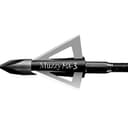
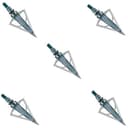
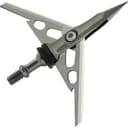
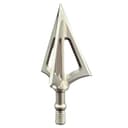
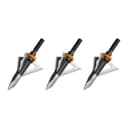
Fixed vs mechanical: the honest version
This is the entire decision, and the internet argument around it generates more heat than light. Here is the plain trade-off.
Fixed blades
A fixed head has no moving parts. Nothing to fail in the cold, nothing to deploy late, nothing to break on bone. It uses all of the arrow’s energy on penetration rather than spending some of it opening blades. On a low-poundage bow, a youth setup, or a shot that hits heavy bone, a fixed head is the more reliable choice by a clear margin.
The cost is aerodynamic. A fixed head has blade surface out in front of the arrow, which acts like a steering vane. If your arrow is leaving the bow with any wobble at all, that blade surface amplifies it, and your broadheads will not group with your field points. This is not a defect in the head; it is the head telling you the truth about your tuning.
Mechanical (expandable) blades
A mechanical flies with its blades folded against the ferrule, so it behaves aerodynamically like a field point. That is the whole appeal: it hides tuning problems. For a hunter with a budget bow, a factory rest and no press access, that is a genuine and legitimate benefit rather than a cheat.
The cost is energy and complexity. Opening the blades consumes kinetic energy that would otherwise go into penetration, and there are moving parts that can fail on a hard angle, on bone, or in the cold. Mechanicals want a bow producing decent energy behind them.
The rule we would give a budget hunter
- Under about 55 lb draw weight, or any youth setup: shoot a fixed head. You cannot afford the energy a mechanical spends.
- 60 lb and up, and you have tuned your bow: either works. Fixed is the more robust choice.
- 60 lb and up, and your broadheads will not group with your field points: shoot a mechanical, or shoot a short-profile fixed head, and tune the bow over the off-season.
- Crossbow: either, but buy heads explicitly rated for crossbow speeds. Crossbows launch bolts fast enough to shed blades from heads not built for it.
Cutting diameter: bigger is not automatically better
Cutting diameter is the width of the hole the head makes. A wider cut leaves a better blood trail, which genuinely matters for recovery, especially for a newer hunter who has not tracked many deer.
But width costs penetration. A 2-inch mechanical from a 70 lb bow at close range is devastating; the same head from a 50 lb bow at a steep treestand angle may not reach the far lung. The general budget answer is to take a moderate cut — roughly 1 to 1.25 inches for a fixed head, 1.5 to 1.75 for a mechanical — and prioritize passing all the way through. A pass-through gives you two holes, which produces a far better blood trail than one large entry wound.
Replaceable, one-piece and cost per head
Budget broadhead economics are not just the sticker price:
- Replaceable-blade heads ship with a ferrule and slot-in blades. After a hit you fit fresh blades rather than a new head. Blade packs are an ongoing cost, but the per-shot cost is the lowest of the three.
- One-piece heads are machined from a single block of steel. Nothing to loosen, and you re-sharpen them with a file. Highest durability, and the only ongoing cost is your time.
- Mechanicals generally need a new O-ring or shock collar after every shot, sometimes a new blade set. Highest per-shot cost.
Over a season where you shoot practice heads plus a couple of animals, those differences are real money on a budget.
The three things to do before opening day
- Shoot your actual broadheads at your actual distance. Not a practice head, not once at 20 yards. Most packs include a practice head for exactly this. If your broadheads print away from your field points, you have a tuning problem to fix, not a head to blame.
- Check blade tightness before every hunt. Replaceable-blade heads loosen from vibration in a quiver. This takes ten seconds and prevents a blade coming apart on impact.
- Hunt with unshot heads. A head you have shot into a target has a dulled edge and possibly a bent blade. Keep a dedicated practice head and hunt with fresh ones.
- Decide which angles you will take. A head only works on a shot you should have taken, and the angle you accept matters more than the head you screwed on. Our guide to where to shoot a deer with a bow covers the aiming point for each angle and the ones to pass.
Regulations you must check first
Broadhead legality is set by your state and is not uniform. States commonly regulate minimum cutting diameter, minimum number of blades, whether mechanicals are legal at all, and minimum draw weight for the bow launching them. Some states also set rules specific to crossbow broadheads.
Read your own state’s regulations before you buy, not after. An illegal head is illegal regardless of how well it performs, and “the website said it was fine” is not a defense anywhere.
Matching heads to the rest of your setup
A broadhead is the end of a chain. If you are still building the chain, our budget compound bow roundup covers ready-to-hunt packages, and budget crossbows covers the crossbow route. If you have not decided between the two yet, compound bow vs crossbow works through cost, learning curve and season length. And if head weight is the question you came in with, what grain broadhead for deer explains why every head on this page is 100 grain.