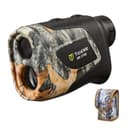
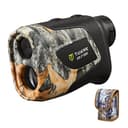
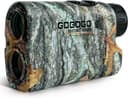
The spec sheets, side by side
Every figure below comes from the maker’s own product page or, where the maker page is silent, from the product listing we track. Where neither publishes a number, the table says so rather than filling the gap.
| Spec | TIDEWE 700 | TIDEWE 1000 | Gogogo GS03 Camo |
|---|
| Max range on the box | 700 yd | 1,000 yd | 1,200 yd |
| Minimum range | 3 yd | 3 yd | Not published |
| Stated accuracy | ±1 yd | ±1 yd | ±1 yd |
| Magnification | 6x | 6x | 6x (listing) |
| Angle-compensated reading | Yes, horizontal distance | Yes, horizontal distance | Yes, angle mode |
| Scan and speed modes | Both | Both | Both |
| Display | LCD | LCD | Red |
| Power | 750 mAh rechargeable | 750 mAh rechargeable | CR2 cell |
| Weight | 0.35 lb | 0.35 lb | Not published |
| Water rating | IP54 | IP54 | Not published |
| Warranty | One year | One year | Not published |
Read down the two TIDEWE columns and they match on every row but the first. TIDEWE also lists a measuring time under half a second, a battery rated for 20,000 measurements per charge, a size of 4.12 by 2.61 by 1.50 inches, a Class 1 eye-safe laser, and a carrying bag and lanyard in the box, again once for both sizes. At 0.35 lb, either one weighs about 5.6 ounces (0.35 × 16), light enough to carry on your chest in a bino harness with a rangefinder pouch rather than at the bottom of a pack.
That leaves two things the extra money can be buying: the bigger number on the box, and whatever difference in reach it makes on a real animal. TIDEWE publishes the first and not the second.
What the extra 300 yards buys on a deer
TIDEWE publishes one range figure per model and no separate figure for a deer or any other soft, non-reflective target. That matters, because, as our guide to choosing a rangefinder explains, the box figure is a best case rather than a deer case. The guide gives a working rule: divide the box number by about three for a deer-sized animal. That is a rule of thumb, not a TIDEWE specification, but it makes the comparison concrete. By that rule, the 300-yard gap on the box shrinks to something closer to a hundred yards on an animal (300 ÷ 3), and those hundred yards sit at the far end of each unit’s reach, well past the average distances in the one study below.
How far are most deer shot? Nobody publishes a national figure we would trust, but one state-agency study is worth knowing. A South Carolina DNR biologist tracked 603 shots at deer on a 4,500-acre coastal-plain club, where hunters sat stands over long, narrow food plots with scoped centerfire rifles. The mean distance of all shots was 132 yards. Shots that killed a deer averaged 127 yards; misses averaged 150, a difference the study calls significant. That is one property and one style of hunting, not a national average, but it is a setup built around long openings, and it still averaged well under 150 yards.
Vortex makes the same point from the optics side: even rifle hunting in the Midwest, in its words, “tends to take place closer to bow range” than the long western shots people picture. Put the box numbers against those distances and the 700 is not close to its limit on a hunt like the one in that study. Even divided by three (700 ÷ 3 is about 233) it clears the 150-yard miss average with room to spare. The 1000’s extra reach exists, on paper, in a band whitetail hunters in timber and along field edges rarely shoot in.
Bowhunters: the 1000 adds nothing you will use
For a bow, the feature that matters is the angle-compensated reading, and here the two are identical. TIDEWE lists a horizontal distance alongside the straight-line distance on both sizes. A review TIDEWE hosts on its own blog describes that mode as “horizontal distance for tree stands and other height difference situations,” which is exactly the job: from an elevated stand, the horizontal number is the one you hold for. Why that number differs from the straight line, and why it matters most at close range from height, is laid out in our rangefinder guide.
Both sizes also carry the scan mode, which TIDEWE says you trigger by long-pressing the power button. Scan is the other bowhunting essential, because sweeping across a deer in brush and watching the numbers change is how you tell the animal’s reading from the branch in front of it. Every useful bow feature on the 1000 is also on the 700, and a bow will never ask for the extra reach. Put the difference toward the rest of an archery setup instead.
Where the 1000 genuinely earns its keep
There is a real case for the bigger box, and it belongs to the rifle hunter in open country: sage, prairie, big clearcuts, a bean field glassed from a far fence line. Vortex’s own guidance treats the West as a different job from Midwestern timber: more magnification, and the long shots that Midwest whitetail hunting usually does not involve. In that country two things happen that the timber hunter rarely deals with.
- You range landmarks, not animals. A deer at distance is a small, soft target; a rock, a lone tree or a fence post near it may be easier to get a reading from. The farther out those landmarks sit, the more headroom you want on the box.
- You range before the animal arrives. Hunters who sit a long field often range the corners, the trail exits and the far edge in advance. On a big field the far edge is exactly where a 700-yard ceiling, divided down for a softer target, can start to run short.
If that is your hunting, the 1000 is a simple way to buy margin, because it changes nothing else. Same body, same modes, same battery, same warranty. What it does not do is make a long shot a good idea. In the SCDNR study, misses came at a longer average distance than kills. A rangefinder tells you how far; whether you should shoot is a question for your practice and your rest, which is where a verified zero comes in.
The weakness both TIDEWEs share: an LCD at last light
Both TIDEWE sizes use an LCD, which TIDEWE describes as clear, and in daylight there is no reason to doubt it. The trouble is the last minutes of legal light against dark timber, and first and last light are, in Vortex’s words, when deer “like to move.” The same review on TIDEWE’s blog is candid about it: in extreme low light, “the black from the LCD can tend to fade and make it difficult to read.” Our rangefinder guide makes the same argument about black LCDs in general and recommends a red or illuminated display for hunters who spend their best minutes in the woods at dusk.
That is the case for the third pick. Gogogo’s camo GS03 has what the maker calls a “high-contrast red display,” 1,200 yards on the box, angle and speed modes, and a stated accuracy of plus or minus one yard. It was priced in the same bracket as the TIDEWE 1000 when we wrote this; the table above has today’s numbers. You give up three things for the red display:
- Recharging. It runs on a CR2 cell, which the maker frames as “no charging required.” That is a genuine plus if you forget to charge things, and a small running cost if you do not. Either way, carry a spare.
- Published durability. Gogogo’s product page states no weight, no water rating and no warranty term. TIDEWE publishes all three. Where a maker says nothing, treat the silence as the answer.
- A hunting-first interface. The GS03 is a do-both golf and hunting unit, and its menus lean golf. What that means for target priority in the woods is covered in hunting versus golf rangefinders.
What IP54 means, and does not
TIDEWE’s page lists “Waterproof: IP54” for both sizes. The IP code comes from the IEC 60529 standard, and the two digits are separate ratings. The 5 is dust protection, classed as dust protected. The 4 is the splashing-water test. Immersion is a different, higher class: to be rated IPX7, a device has to pass immersion testing to one meter. So both TIDEWEs are rated against splashing water, not immersion. Treat them as water-resistant: a wet day is much closer to what the rating describes than a creek crossing gone wrong, and a pouch or pocket in heavy rain costs nothing.
Battery: rechargeable or CR2
Both TIDEWE sizes use a 750 mAh rechargeable lithium-ion battery that the maker rates for 20,000 measurements on a full charge, and the review on TIDEWE’s blog notes it charges from a USB-C cable. That removes the hunt for an oddball cell at five in the morning; it replaces it with remembering to plug the unit in the night before the season opens. The GS03 goes the other way with a CR2. Neither choice changes how the unit ranges, and neither is a reason on its own to pick one over the other.
The short answer
Buy the TIDEWE 700 if you hunt whitetails in timber or along field edges, and always if you hunt with a bow. Everything that decides a shot at those distances is on the 700, and the 1000 adds only reach you are unlikely to use.
Buy the TIDEWE 1000 if you are a rifle hunter in genuinely open country who ranges landmarks and far field edges, and you want that margin without changing anything else. Check the live gap in the table: it buys the only thing that changes.
Consider the Gogogo GS03 instead of either if most of your chances come in the last minutes of light in dark timber, and a readable red display matters more to you than a rechargeable battery and a published water rating. For the wider field of budget rangefinders, including a step-up unit with better glass, see our budget rangefinder roundup.