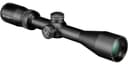
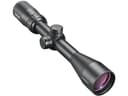
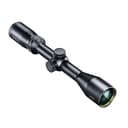
The spec sheets, side by side
Every figure below comes from the maker’s own product page or, for the Banner 2, from the product listing we track, because Bushnell’s site no longer carries a Banner 2 page. Where neither publishes a number, the table says so rather than filling the gap from a retailer’s spec sheet or from memory.
| Spec | Bushnell Banner 2 | Vortex Crossfire II | Bushnell R3 |
|---|
| Magnification / objective | 3-9x / 40 mm | 3-9x / 40 mm | 3-9x / 40 mm |
| Reticle | DOA Quick Ballistic (holdovers) | V-Plex (plain crosshair) | DOA Quick Ballistic (holdovers) |
| Focal plane | Not on current listing (retailers list it as second) | Second | Second |
| Field of view at 100 yd | Not on current listing | 34.1 ft (3x) to 12.6 ft (9x) | 37.5 ft (3x) to 13 ft (9x) |
| Eye relief | Not on current listing | 3.8 in | 3.7 in |
| Tube / turrets | 1 in, one-piece aluminum | 1 in, capped, 1/4 MOA clicks | 1 in, capped, 1/4 MOA clicks |
| Total adjustment | Not on current listing | 60 MOA elevation and windage | 65 MOA elevation and windage |
| Parallax | Not on current listing | Fixed, 100 yd | Not published |
| Lens coatings | Multi-coated, “Dusk & Dawn” | Fully multi-coated | Multi-coated, EXO Barrier outer coat |
| Water rating | IPX7 | Waterproof, O-ring sealed, nitrogen purged (no IP rating stated) | IPX7 |
| Length | Not on current listing | 12.2 in | Not published |
| Weight | 0.94 lb as listed (about 15 oz) | 14.8 oz | 14.6 oz |
| Rings in the box | Yes, Weaver-style aluminum | No (lens covers and cloth) | Not published |
| Maker’s list price | No current maker page | $189.99 | $149.95 |
| Warranty | Bushnell lifetime (materials and workmanship) | Vortex VIP, unlimited and unconditional | Bushnell lifetime (materials and workmanship) |
Two things jump out of that table before any opinion is added. First, the Banner 2 column has more blanks than the other two, because the only spec sheet we can cite for it is a retail listing rather than a maker page. Second, the two Bushnells share a reticle, a water rating and a warranty, and the R3 publishes a wider field of view and a larger adjustment range than the Vortex. On paper the R3 is the most complete scope here. Whether that beats a warranty that covers your own mistakes is the real question, and it comes later.
Where the Banner 2 went
The Banner is the older name by a wide margin. Bushnell has sold Banner scopes for decades, and the Banner 2 was the refresh of that line with, in the listing’s words, “improved optical performance over the original Banner.” When we checked Bushnell’s own website on September 20, 2026, its catalog had no Banner listing at all; a search for the word returned the R3 and R5 scopes instead, and the R3 3-9x40 page was the entry-level 3-9x40 the company was selling. The Banner 2 was still in stock through the listing we track the same day, at a price well under the R3’s maker list price.
That is exactly the kind of buy this site exists for: a last-generation product still on shelves, cheaper than its replacement, and not obviously worse for the job. It also comes with a caveat that a maker’s catalog silently makes real. Spec details vanish from the maker’s site, which is why the table above says “not on current listing” for eye relief, field of view and adjustment range. And support for a discontinued line usually gets thinner over time, even under a lifetime warranty. Neither is a reason not to buy one. Both are reasons to buy it with open eyes.
Reticle: holdover marks versus a plain crosshair
This is the biggest practical difference between the two named scopes, and it is a difference in philosophy, not quality. The Crossfire II we track carries Vortex’s V-Plex, a plain duplex-style crosshair: thick posts, fine center, nothing else. The Banner 2 and the R3 carry Bushnell’s DOA Quick Ballistic reticle, which adds aiming points below center for longer ranges, each with a short horizontal wind-hold line. Bushnell’s R3 page describes the reticle as having drop points out to 600 yards and 5-mph wind holds out to 500; the Banner 2 listing describes the same reticle as six dead-on aiming points set to the ranges the Bushnell Ballistics app works out for your cartridge and load.
Read that last clause again, because it is the catch. The holdover points are not marked in yards. They land at whatever distances the app calculates for your specific rifle, and they are only correct at one magnification, because these are second-focal-plane scopes: Vortex and Bushnell both say so for the Crossfire II and the R3, and retailers list the Banner 2 the same way. Vortex’s own explainer on focal planes says it plainly: an SFP reticle’s marks work only at the magnification they were calibrated for. So a DOA reticle is genuinely useful to the hunter who runs the app, sets the scope to the right power, shoots the load at those distances and writes down what each mark does. For everyone else, the marks are clutter between the hunter and a deer at 80 yards. Our budget scope roundup puts it more bluntly: a ballistic reticle you have not verified is decoration, not data.
How much range does a deer hunter actually need to hold for? One state-agency study is worth knowing. A South Carolina DNR biologist logged 603 rifle shots at deer on a 4,500-acre club where hunters sat over long, narrow food plots, about as open as eastern whitetail hunting gets. The mean shot distance was 132 yards. Shots that killed averaged 127 yards; misses averaged 150. At those distances a 3-9x40 zeroed at 100 or 200 yards needs no holdover at all with any common deer cartridge, which is why the plain V-Plex is not a compromise for most hunters. It is the simpler tool for the shot most of them take.
Glass: what each maker is willing to claim
None of these three publishes a light-transmission figure, and we have not measured one, so the honest comparison is what each maker puts in writing. Vortex says the Crossfire II’s lenses are fully multi-coated, meaning every air-to-glass surface gets multiple anti-reflective layers. Bushnell says the Banner 2 has “multi-coated surfaces” and its Dusk & Dawn low-light coating. Those are not the same claim. In Celestron’s published definitions, multi-coated means at least one major element has multiple anti-reflective layers on at least one surface, while fully multi-coated means every glass surface has them, and Celestron calls the latter “the best kind.” Whether Bushnell’s wording is modesty or precision, the Vortex is the one making the stronger claim in writing. The R3 adds an HD optical system and Bushnell’s EXO Barrier, an outer coating the maker says repels water, oil and dust, and it publishes the widest field of view of the three at 37.5 feet at 3x.
The physics both Bushnell scopes and the Vortex share is set by the numbers on the box. Exit pupil, the diameter of the beam of light leaving the eyepiece, is objective diameter divided by magnification, per Steiner’s glossary. At 3x a 40 mm objective delivers a 13.3 mm exit pupil; at 9x it is 4.4 mm. The same glossary puts a dark-adapted human pupil at roughly 5 to 7.5 mm. So all three scopes are brighter than your eye can use at low power and dimmer than it wants at 9x. In the last legal minutes, turn the power down; that does more for brightness than any coating name on any of these three. Wisconsin, to pick one state, closes deer shooting hours 20 minutes after sunset, which is exactly the window where this matters.
Eye relief and field of view, and the blank in the Banner column
Vortex publishes 3.8 inches of eye relief for the Crossfire II and Bushnell publishes 3.7 for the R3. Both are comfortable on a standard deer rifle; both are enough to keep the eyepiece off your brow on a .30-06 if the scope is mounted properly, and mounting it properly is the part that decides that. For the Banner 2, the current listing states no eye-relief figure and no field of view. Given that the tube, objective and magnification range are the same as the R3’s, the numbers are unlikely to be wildly different, but “unlikely to be different” is a guess, and we do not put guesses in a spec table. If eye relief matters to you because you shoot a hard-kicking rifle or a short length of pull, buy the scope that tells you the number.
Field of view is the number people underrate. At 3x the R3 shows 37.5 feet of the woods at 100 yards, the Crossfire II 34.1. Three and a half feet is a real difference when a buck is moving through timber at 60 yards and you are trying to find him in the scope. It is not a reason to pick the R3 on its own, but it is the one optical spec where the newer Bushnell is measurably ahead of the Vortex by the makers’ own numbers. Whether that gap survives in the Banner 2 we cannot say, for the reason above.
Adjustment, turrets and parallax
Vortex publishes 60 MOA of total elevation and windage travel on the Crossfire II, in 1/4 MOA clicks with 15 MOA per turret rotation and a fixed 100-yard parallax. Bushnell publishes 65 MOA of travel on the R3 with the same click value and rotation. The Banner 2 listing publishes none of that. In practice it does not decide anything: at roughly one inch per MOA at 100 yards, per NSSF’s explainer, 60 MOA is around five feet of correction end to end, and a deer rifle with a sound mount uses a fraction of it to zero. All three have capped turrets, which is what you want on a hunting rifle: set the zero, cap it, and stop touching it. Where the turrets actually differ is in feel and repeatability, and that is a claim we can only make from a bench we have not sat at. Our roundup’s note that the Banner’s clicks feel coarser than the Vortex’s is a common owner report, not a measurement, and we treat it that way.
Waterproofing: IPX7 versus “waterproof”
Here the Bushnells publish more than Vortex does. Both the Banner 2 and the R3 carry an IPX7 rating, which under the IEC 60529 code means the housing passed immersion testing to one meter. Vortex describes the Crossfire II as O-ring sealed, nitrogen purged, waterproof and fogproof, and stops there; no IP figure appears on its page. That does not mean the Vortex leaks, and a nitrogen purge is the thing that stops internal fogging on a cold morning. It means that if a tested immersion rating is what you want to see in writing, Bushnell is the one writing it.
Rings in the box, and what the price gap really is
The Banner 2 ships with Weaver-style aluminum rings, and Weaver-style rings mount on a Picatinny rail as well as a Weaver base. The Crossfire II ships with lens covers and a cloth. That matters to the math, because a scope with no rings is not a working scope, and our roundup budgets roughly $30 to $60 for a decent set plus a torque wrench. So the real gap between the two, for a hunter starting from an empty rail, is the live price difference in the table plus the rings. On the day we wrote this that combined gap was large enough to matter to anyone shopping on a ceiling.
The counter-argument is that the included rings are basic aluminum rings, and that the rifle you already own may have a base that wants something else. If your rifle has a Picatinny rail, the free rings are usable and the saving is real. If it has bare receiver holes, you are buying a base anyway and the rings are a smaller share of the saving than they look.
Warranty is the biggest real difference
Both makers say “lifetime,” and the words hide different promises. Bushnell’s warranty page lists riflescopes under its lifetime warranty and states the trigger: “If your product has an issue due to materials or workmanship, we’ll repair it or replace it.” That is a defect warranty. It is a good one, and it is more than most scopes in the Banner’s price bracket offer.
Vortex’s VIP warranty is a different animal, and its own page says why: if the product “becomes damaged or defective, we’ll repair or replace it at no charge to you,” unlimited, unconditional and transferable, with the stated exclusions being loss, theft, deliberate damage and cosmetic damage that does not hinder performance. Damaged means the scope you dropped on a rock, the one that went over in the truck bed, the one a treestand ladder swung into. A hunting scope lives that life. The Crossfire II’s price premium over the Banner 2 is, in large part, the cost of that promise, and for a public-land hunter who is hard on gear it is the single best reason to pay it.
Price per performance, honestly
Live prices are in the ledger at the top of the page and change daily, so we will not anchor a number here. What was true when we checked, and is likely to stay true, is the shape: the Banner 2 is the cheapest of the three by a clear margin, and the Crossfire II and the R3 sit within a few dollars of each other, both well under their makers’ list prices. That shape is what makes the R3 the interesting third option rather than an afterthought. At Crossfire money it offers a wider published field of view, an IPX7 rating, the newest glass claims of the three and a ballistic reticle. It gives up the unconditional warranty and a long track record; the R3 is a recent line, and the Crossfire II has been on rifles since well before 2018, the release date on the listing we track.
One more thing the price gap should buy before it buys a better scope: a binocular. You will glass a hundred times for every time you look through the riflescope, and a scope should never be the thing you scan the woods with. If the Banner 2’s saving funds a pair from our under-$100 binocular roundup, you have made the better trade.
The short answer
Buy the Vortex Crossfire II if you can stretch to it. The plain V-Plex reticle is the right tool for the distances deer are actually shot at, every spec that matters is published, and the VIP warranty means the day you fall on the rifle is Vortex’s problem. Budget for rings. Our full Crossfire II review covers who should skip it.
Buy the Bushnell Banner 2 if the ceiling is the decision: it is the cheapest scope here we would still put on a deer rifle, it is IPX7 rated, and the rings in the box make it a complete purchase for a Picatinny-railed rifle. Go in knowing the line is no longer on Bushnell’s site, that several specs are unpublished, and that the warranty covers defects, not drops. Learn the DOA reticle or ignore everything below the center crosshair.
Consider the Bushnell R3 if you want the Bushnell reticle and IPX7 rating with the most complete published spec sheet of the three, and you are paying Crossfire money anyway. It is the scope Bushnell now sells in this slot. It is also the newest and least proven of the three, and it carries the defect-only warranty. Whichever you choose, the scope will shoot better than the mount lets it: sight it in properly and check zero a week before season.