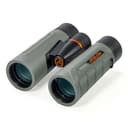
What HD actually means, and what it does not
“HD” on a binocular is not a regulated term. There is no standards body that audits it. What it conventionally signals is that the objective lenses use extra-low-dispersion glass elements, whose job is to bring different wavelengths of light to focus at the same plane.
When they do not, you get chromatic aberration — a colored fringe, usually purple or green, on any high-contrast edge. The hunting version of that edge is a dark deer standing against a bright skyline, or a black antler tine against gray November cloud. The fringe does not stop you identifying the animal. It smears the exact boundary you were trying to read, which is why counting points at distance is harder through cheap glass than the magnification number suggests.
An HD system reduces that fringing. Athlon states HD on this model; Vortex states it on the Diamondback HD and the Crossfire HD. Different makers implement it to different standards, and none of them publishes how much dispersion their glass actually corrects, so treat the label as a directional signal rather than a measurement. What it is not is a substitute for looking through the thing, which is a limitation this review shares with the label.
Eye relief: the spec nobody compares and glasses-wearers live by
Eye relief is the distance behind the eyepiece where your pupil can sit and still see the full field of view. Move outside it and the image vignettes into a black tunnel.
If you do not wear glasses, this is a comfort spec. If you do, it is the spec. Your spectacle lens pushes your eye back roughly ten to fifteen millimeters from where it would otherwise sit, and a binocular with short eye relief simply cannot show you its full field through glasses. You end up either taking them off — in the dark, in the cold, in a treestand — or living with a cropped image and not understanding why the pair feels claustrophobic.
Athlon calls the eye relief generous on this model, which is the practical reason we rank it above the Bushnell Engage X it competes with. A quarter of American adults who hunt wear corrective lenses of some kind, and this spec addresses all of them.
10x42 in the woods: the honest assessment
Ten power and a 42 mm objective is the most common configuration in hunting optics and it is a reasonable default, but it is not the right answer for everyone and this pair does not change that.
Ten power magnifies hand shake as much as it magnifies the deer. This binocular is not heavy enough to damp it especially well, so if you glass freehand with cold hands you will see the wobble. The fix is a rest — a tree, a knee, a pack — and the fix is free, but it is a habit you have to build.
The 42 mm objective is the reason to buy this over any compact. Exit pupil is objective diameter divided by magnification, so 42 divided by 10 is 4.2 mm. A dark-adapted human pupil opens to roughly 5 to 7 mm depending on age. That means at true last light your eye can accept more light than this binocular delivers, which is exactly why every budget binocular feels dimmer at dusk than it does at noon — and why an 8x42, with its 5.25 mm exit pupil, holds on a few minutes longer. We work through that trade in our binocular buying guide.
The warranty question, stated plainly
This is where Athlon costs you something, and it is worth being precise rather than vague about it.
Vortex’s VIP warranty is the reference point in budget hunting optics: unlimited, lifetime, transferable, no receipt, no fault question. It is a genuine competitive moat and it is why the Crossfire and Triumph appear on every budget list including ours.
Athlon offers a lifetime warranty of its own, and the listing does not publish the full terms, so we are not going to characterize them beyond that. What we can say is structural: Athlon has a thinner dealer network than Vortex or Bushnell, which means a warranty claim is more likely to be a shipping exercise than a conversation at a counter. For some hunters that is a non-issue. For a hunter three hours from the nearest sporting goods store who wants a human being to hand a broken binocular to, it is the whole decision.
Who should skip this binocular
- The hunter who wants a name their buddies recognize backing the purchase. This is not a frivolous reason. If a recognized badge is what makes you comfortable spending the money, buy the Vortex Crossfire HD and do not think about it again.
- The hunter who breaks things.If your gear genuinely takes a beating — horses, brush country, a pack that gets thrown in a truck bed — the no-questions Vortex VIP terms are worth more than the optical edge.
- The hunter with unsteady hands and no rest. Take the 8x version of whatever you buy, from any brand. Steady beats magnified.
- The hunter under $100. This pair sits above that line. The honest options down there are in our under-$100 roundup, and they are real options — just smaller ones.
The verdict
The Talos G2 HD is the most optical performance you can buy under $150, and the price you pay for it is brand comfort rather than image quality. That is an unusual trade in budget gear, where you normally pay for the badge with performance rather than the other way round.
Buy it if you evaluate glass on what it does rather than whose name is on it, and if the idea of shipping a binocular back for a warranty claim does not bother you. Buy the Vortex instead if it does. Both are defensible, and anyone telling you there is only one right answer here is selling something.
Whatever you choose, buy a chest harness with it. The pair you carry comfortably gets used forty times a day; the pair on a neck strap ends up in the pack by ten in the morning, and unused glass has an effective resolution of zero.