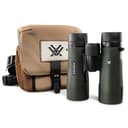
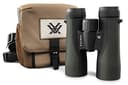
What is actually different
Strip away the marketing and three things separate these two binoculars. Everything else — the roof-prism layout, the rubber armor, the sealed and purged barrels, the VIP warranty — is shared.
1. Optical system
Both carry Vortex’s HD designation, but the Diamondback sits a tier above the Crossfire in Vortex’s own lineup and uses a better-corrected optical system. In practice that means less color fringing on high-contrast edges — think a dark deer against a bright skyline — and edges of the field that stay sharp instead of going soft. On a bright afternoon you would struggle to tell them apart. At 20 minutes past sunset, with a deer at 300 yards in shadow, the Diamondback resolves detail the Crossfire is starting to smear.
2. Field of view and handling
The Diamondback shows a slightly wider field of view at the same magnification. That does not sound like much until you are trying to pick up a moving animal in timber, where a narrow field means you find the deer, lose it, and hunt for it again. The Crossfire is perfectly usable here; it is simply a little tighter. If most of your glassing is scanning open ground rather than tracking movement in cover, this difference will not register.
3. Price
This is the one that decides it for most people, and it is why the live prices at the top of this page matter more than any paragraph we could write. The gap moves. On a bad week for the Crossfire it narrows enough that the Diamondback is the obvious buy; on a good week for the Crossfire it widens enough that the Diamondback stops making sense for a first binocular. Check the numbers above rather than trusting a figure from an article written last year.
What is identical, and why that matters
The VIP warranty is the same on both, and it is the single most underrated feature in budget optics. It is unlimited, fully transferable, and it does not care how the damage happened. You do not need a receipt. Drop them off a stand, close a truck door on them, get them wet in a way they were never rated for — Vortex repairs or replaces them. On a ten-year ownership horizon that is worth more than the optical gap between these two models.
Both are also genuinely waterproof and fogproof, which means sealed barrels and inert gas purging. Neither will fog internally when you carry them from a freezing truck into a warm blind, and neither cares about a full day of November rain.
Who should buy the Crossfire HD
- First-time binocular buyers. The Crossfire is more than enough glass to learn on, and the money saved goes further in boots or tags.
- Timber and stand hunters. If your longest realistic glassing distance is 150 yards through hardwoods, the Diamondback’s edge sharpness at 400 yards is not a benefit you will collect.
- Anyone hard on gear. Same warranty, lower replacement anxiety, cheaper to hand to a kid or a hunting partner.
- Hunters who need a rangefinder too. The price difference between these two is close to the cost of a decent budget rangefinder, and a Crossfire plus a rangefinder beats a Diamondback alone for most hunts.
Who should buy the Diamondback HD
- Open-country hunters. Prairie, sage, clearcuts, mountain basins — anywhere the decision to move is made entirely through glass at long range.
- Hunters who glass for hours. Long sessions punish a mediocre optic; better correction means measurably less eye strain by afternoon.
- Anyone hunting the last legal minutes. If your best encounters come in the final ten minutes of light, that is precisely where the Diamondback earns its price.
- Buy-once buyers. This is the pair you keep when you upgrade the rifle, the pack and the boots.
The short answer
If this is your first hunting binocular and you hunt timber or stands, buy the Crossfire HD and spend the difference elsewhere. If you hunt open country, glass for hours, or want to buy once and stop thinking about it, buy the Diamondback HD. There is no wrong answer here — both are more binocular than a hunter could get for this money ten years ago, and both come with the same warranty saying Vortex will stand behind whichever you pick.
Still deciding between 8× and 10×, or unsure what “42” even refers to? Start with how to choose hunting binoculars and come back to this page once magnification is settled.