What Muck is genuinely known for
Three things, and only one of them is easy to buy cheaply.
- The construction.Neoprene bootie inside a rubber shell, pull-on, no laces. Muck states it plainly: “made with premium neoprene and rubber.” This is the part that is easy to buy cheaply, because all three picks on this page are built the same way — 6 mm of neoprene in the Kalkal, 7 mm in the TIDEWE, natural ZXT rubber over a lining in the LaCrosse.
- The fit and the flex. This is the hard part to replicate and the reason people stay with the brand. A pull-on boot lives or dies on the shape of the last and the stretch of the neoprene around the instep, and there is no spec sheet for that. We are not going to claim a $80 boot matches it, because we cannot measure it and we have not worn either.
- The service behind it. Muck is owned by Rocky Brands, and there is a published warranty with an address to send a boot to. That is worth real money, and it is what the off-brand picks here do not have.
What Muck publishes, and what it does not
This is where the comparison gets useful, because the gap is not where you would expect.
Muck publishes a 1-year limited warrantyto the original purchaser covering “manufacturing flaws, defective materials, and workmanship.” Separately — and this is the line worth reading twice — “Muck waterproof boots are guaranteed waterproof for 6 months from date of purchase.” Normal wear and tear, worn toe holes, punctures, cuts and abrasion from outside causes are excluded, and total liability is capped at the price paid. Coverage applies only to boots bought from Rocky or a Rocky-authorized US seller, which matters if you are shopping marketplace listings.
What Muck does notpublish, anywhere on the pages we read, is a temperature rating or an insulation weight. Its own story page carries no construction detail at all — no sole spec, no closure spec, no insulation figure. That is a brand choice, not a criticism; plenty of makers decline to put a number on warmth because the number is easy to game.
But it does mean something concrete for a budget buyer: on the one spec a cold-weather boot can be compared on, two of the three cheaper boots on this page publish more than the premium original does. TIDEWE states a comfort range of −50°F to 40°F with 800 g of insulation over a 7 mm bootie. The TIDEWE Steel Shank model we track elsewhere states −4°F to 68°F. The Kalkal states it is insulated and publishes no figure, which we hold against it on its own page and will hold against it here.
Which of the three you actually want
These three are not interchangeable, and the choice is about season rather than price.
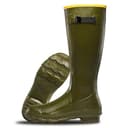
- Early and mid season, whitetail, scent matters most: the LaCrosse Grange. The all-natural ZXT rubber is naturally scent-free, which is a real edge on a property you hunt repeatedly, and 18 inches of height crosses a creek without thinking. The model we track is uninsulated, so it is cold once temperatures sit near freezing.
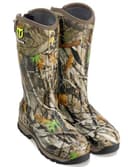
- Late season, long cold sits:the TIDEWE 800g. It is the only boot here with a number you can plan a sit around. The published 40°F top end is the catch and it is a real one — this is too much boot for an early-October walk-in, and you will sweat in it.
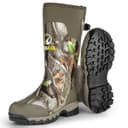
- Cheapest route in: the Kalkal. 6 mm neoprene, a breathable lining, an adjustable calf buckle and a steel plate for arch support, for less than an uninsulated pair from a name brand. Its listing publishes neither a gram weight nor a temperature range, sizing runs large, and off-brand durability is unproven over many seasons. At the price, those are fair trades.
The honest case for buying the Muck anyway
We will make it, because a page that cannot is not worth reading.
If you have worn Mucks and the last fits your foot, the saving on this page is not worth a boot that rubs. Pull-on boots cannot be adjusted; a bad fit is a bad boot forever, and you cannot try these three on before they arrive. If you hunt commercially hard — every weekend, all season, year after year — the published warranty and a real service address are worth the premium on their own, because the off-brand boots here have no comparable recourse.
And if you hunt wet ground more than cold ground, note what the warranty actually says: the waterproof guarantee is six months. Any rubber boot that gets walked through briars will eventually get punctured, and that is excluded from every warranty in this category, premium or not. For that specific failure mode, cheap boots you replace are a defensible strategy — which is the argument behind the whole of our rubber hunting boot roundup.
Where a cheap boot genuinely loses
Walking. Every boot on this page, and the Muck too, is a pull-on boot with no lacing, which means your heel lifts and your arch does work your boot should be doing. Only one budget rubber boot we track has a steel shank, and it is not on this page — it is the TIDEWE Steel Shank, which leads our under-$100 boot page. If you cover real distance, the honest answer is not a cheaper rubber boot or a dearer one; it is a laced leather boot, and rubber versus leather works that choice through properly.