Draw weight is the spec that decides whether it is a hunting bow
Every state that sets an archery minimum for deer does it in pounds of draw weight, and those minimums are the reason two bows on this page are target bows. Check your own state’s regulation before you buy anything — it is a one-line lookup and it is the difference between a legal hunt and a citation.
What a minimum is actually protecting is penetration. A light bow throws an arrow that may not reach the far lung on a quartering shot, and a wounded animal is the outcome the rule exists to prevent. That makes draw weight the first number to read on a cheap bow and the one not to compromise on.
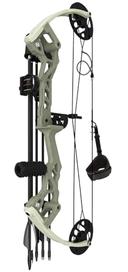
The two hunting-capable picks here handle it differently. The TOPOINT is adjustable from 19 to 70 lb, which means it grows with a new archer from a weight they can hold steady to a weight that hunts. The SAS Outrage is a fixed-ish rig to 70 lb — plenty on paper, but 70 lb is a lot of bow for someone who has never drawn one, and pulling too much weight is how new archers learn bad form that takes a season to unlearn. Our draw weight guide works through what you can actually hold at full draw for thirty seconds, which is the number that matters rather than the number on the box.
Package or bow only — the hidden cost of the cheapest option
This is where a $130 bow becomes a $230 bow. Two of these four are sold bare.
- The SAS Outrage is bow only. You buy a sight, a rest, arrows and a release separately, and at the cheapest functional end that is realistically another hundred dollars. It is still the cheapest way to get a 70 lb compound in your hands, but it is not the cheapest way to get shooting.
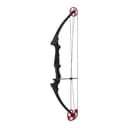
- The Genesis Original is also bow only on the listing we track: no sight, rest, quiver, arrows or release.
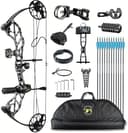
- The TOPOINT Trigon and Sanlida Dragon X6are complete. The Sanlida kit in particular includes 12 arrows, a release, an arm guard, a sight, a rest, a quiver, a stabilizer and a peep — nothing else has to be bought to start shooting, which is the entire argument for it.
For a first bow, complete beats better. A bare bow sitting in a closet because you have not got round to buying a rest is worth nothing, and the component upgrade path is always open later. Our how to choose a budget compound bow guide covers which of those components is actually worth replacing first.
Let-off: the spec nobody reads and everybody feels
Let-off is the percentage of the draw weight the cams take off your fingers once you reach full draw. At 75% let-off, a 60 lb bow holds at about 15 lb while you aim. At zero let-off you hold the whole thing the entire time.
The Genesis Original has zero let-off by design — that is the point of it as a teaching bow, because every archer in a school program shoots the same bow at the same hold and form is the only variable. It is also why it is miserable for hunting even if the draw weight were legal: holding full weight while a deer decides whether to step clear of a branch is not a thing you can do.
The Sanlida X6 publishes roughly 70–75% let-off, the TOPOINT and SAS listings publish none. That silence is normal at this price and it is worth knowing: if let-off is not stated, assume you will find out at the range rather than on the spec sheet.
What the two-hundred-dollar ceiling costs you
- Component quality, mostly.The riser and cams on these bows are serviceable; the sight, rest and string are the parts that disappoint. Both the TOPOINT and the Sanlida carry that as a published reservation, and the TOPOINT’s own listing expects you to replace the string and upgrade the sight eventually. A new string and a decent sight is a cheaper upgrade path than a new bow.
- Pro-shop support. This is the real cost. A shop that stocks Bear and Diamond will not have spares for an off-brand bow, and it may decline to press one. If you do not have a bow press or a shop relationship, buying a brand your local shop recognises is worth money that does not show on a spec sheet.
- Resale. A used Bear or Diamond sells. An off-brand package does not, which matters if you are testing whether bowhunting sticks.
- Tune and speed at the top end.The TOPOINT’s 320 fps IBO figure is real hunting speed on paper, and an IBO figure is measured under standard conditions you will never replicate. At your actual draw length and arrow weight, expect meaningfully less. That is true of every bow at every price.
The honest alternative: spend $100 more
We will say it plainly because the whole site is built on saying it. The step up from this ceiling is large and it is the clearest price-to-value jump in archery. For roughly another hundred dollars you reach the Bear Limitless and the Sanlida Dragon X8 — bows with wide adjustability, published warranty terms and, in the X8’s case, a 0–70 lb span that covers a twelve-year-old through a grown adult on one bow.
For roughly $250 more you reach the Bear Cruzer G4 and the Diamond Edge 320, which is where a bow stops being a compromise and starts being the bow you keep. Both lead our best hunting bow for beginners page for exactly that reason. If you can stretch, stretch — and if you cannot, buy the TOPOINT package, shoot it all summer, and upgrade when you know you want to.
One last note for anyone shopping for a young archer: a bow that is legal to hunt with is not automatically a bow that fits a child. Our youth compound bow roundup ranks five bows on minimum draw length and mass weight, which are the two specs that decide whether a kid can hold one up.
What the next hundred dollars buys
Mostly a complete kit from a brand a pro shop will service. If the ceiling is flexible and what you actually want is everything in one carton, our ready-to-hunt bow package roundup ranks four of them on published draw range, and the widest-range pick there fits a child and an adult out of the same box.