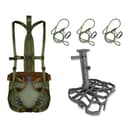
What is in each box
A saddle hunter needs four things in the tree: something to hang in (the saddle and its bridge), something to stand on (the platform), something to climb with (sticks), and a connection to the tree that never comes off (the tether and a harness or lineman’s belt). Here is how the two kits divide that list, as published by their listings.
| Component | UIIHUNT Gen 2 | XOP Complete System |
|---|
| Saddle | Yes, large padded seat | Yes |
| Bridge | Yes, adjustable rope bridge | Yes (part of the system) |
| Platform | No — separate purchase | Yes |
| Harness | No | Yes |
| Climbing sticks | No | No |
| Published weight | Not published | Not published |
| Published weight rating | Not published | Not published |
| Our value score | 8.8 | 8.6 |
Two of those rows are the honest finding of this comparison: neither listing publishes a weight or a weight rating. In a category where packability is the entire selling point and where the equipment is holding a person off the ground, those are the two numbers a buyer most wants, and both brands are silent. We will not estimate them. If a published rating is non-negotiable for you, that is an argument for buying a saddle from a maker that prints one, not for picking between these two on a guess.
The comparison people actually make, and why it is wrong
The usual way this gets compared is sticker to sticker, which makes the UIIHUNT look like a landslide. It is not the right sum. The UIIHUNT is a saddle; a saddle by itself cannot be hunted from, and the listing says so in its own words — you still need a platform and sticks.
Do the comparison in complete setups instead:
- UIIHUNT route:saddle + a budget steel platform + a four-pack of steel climbing sticks + a harness or lineman’s rope.
- XOP route: the system box + the same four-pack of sticks.
Priced that way on the live numbers in the ledger above, the gap narrows sharply, and what you are really choosing between is a cheaper kit with more pieces from more makers, or a dearer kit that arrives coherent. Our saddle setup cost breakdown does that arithmetic line by line with live prices.
Where the UIIHUNT wins
Comfort per dollar, and the exit cost.The UIIHUNT listing leads on a large padded seat, which is the specification that most decides whether you last four hours in a saddle, and it includes an adjustable rope bridge rather than a fixed one — bridge length is how you tune lean angle and shot comfort, and a fixed bridge is a common cheap-saddle compromise.
It is also the lowest-risk way to answer the only question that matters for a first-year saddle hunter: do you actually like hanging in a strap all morning? A meaningful number of people try saddle hunting and go back to a hang-on stand. Finding that out with the cheapest saddle on the page costs less than finding it out with a complete system.
The cost of that choice is bulk. The listing concedes the saddle is heavier and less packable than a premium ultralight, and if your hunt is a two-mile walk in, weight is the thing you will notice first.
Where the XOP wins
Coherence, and one fewer decision. XOP is a mobile-hunting brand rather than a general outdoors brand that added a saddle, and the system ships the saddle, platform and harness designed to work together. For a hunter who already knows they are staying with saddles, that removes the most common first-season failure: a platform that does not sit right with the saddle you bought, or a harness bought as an afterthought.
It also puts a harness in the box. The site’s standing position is that the harness is the one category never to buy used and never to skip, and a kit that includes one removes the temptation to climb before you have bought it. The Tree Stand Safety Awareness Foundation’s whole message is that falls are the dominant hunting injury and that being connected from the ground up is the mitigation; a kit that includes the connection makes that easier to get right.
The honest cost is money and flexibility. You pay a brand premium, you cannot choose your own platform, and if you decide after one season that saddle hunting is not for you, you have more money tied up in that answer.
The part that is missing from both, and it is not optional
Climbing sticks are the third purchase and neither box includes them. Four steel sticks is the budget default; three long aluminium sticks is the mobile answer. Which one you buy changes the weight of your whole system more than the saddle choice does — sticks are the heaviest part of a saddle setup, by a wide margin.
We cover the field in the budget climbing sticks roundup, and the arithmetic of how many you need in how many climbing sticks do you need. If you are buying the UIIHUNT, the harness page is the other thing to read before you climb.
Public-land rules apply to both
Saddle setups are portable, which is most of why they suit public land, but portability is a legal category as well as a convenience. Federal and state agencies commonly prohibit anything that penetrates a tree — screw-in steps, nails, lag bolts — and many units require portable equipment to be removed daily or to carry your name and contact details. Both kits here attach with straps and both pack out, so neither is the problem; the sticks and the overnight question usually are. Our public-land treestand rules page covers the variation.
The verdict in one line each
- UIIHUNT Gen 2— buy it if money is the constraint, if you are testing the discipline, or if you already own a platform. Budget immediately for a platform, sticks and a harness.
- XOP Complete System— buy it if you are committed, if you would rather make one decision than four, or if you want the harness in the same box. Budget for sticks and nothing else.
- Either way— sticks are a separate purchase and the heaviest part of the kit. Decide that before you decide the saddle.