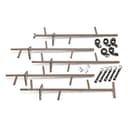
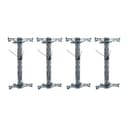
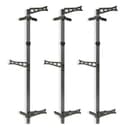
The spec sheets, side by side
Read from each tracked listing. Neither the Guide Gear nor the Hawk listing publishes a per-stick or set weight, which is frustrating because weight is the whole argument — so the table says “not published” and the material row does the work instead.
| Spec | Guide Gear 20' Rapid | Hawk Helium Gen 2 | XOP Aluminum 34" |
|---|
| Sticks in the set | 4 | 4 | 3 |
| Material | Steel | Aluminum | Aluminum |
| Published climb height | 20 ft across the set | Not published | Not published as a set |
| Stick length | Not published per stick | Not published | 34 in each |
| Attachment | Rope or strap (cam buckle) | Not published | Straps |
| Standoff brackets | Yes | Not published | Not published |
| Set weight | Not published | Not published | Not published |
| Our value score | 8.5 | 8.6 | 8.7 |
Difference 1: steel versus aluminum is a carry decision
Steel and aluminum sticks hold a person up equally well. The difference is mass, and mass only matters while the sticks are on your back. That means the honest version of this question is not “which is better?” but “how many times a season do I walk with these?”
Hunters who set up one or two trees before the season and leave the sticks hanging are carrying them twice a year. For them the steel set is straightforwardly the better buy and the weight penalty is irrelevant. Hunters who move trees based on wind and sign — which is the whole premise of saddle hunting — are carrying them forty or fifty times, often uphill, often in the dark, usually on top of a saddle, a platform and a pack.
Neither listing publishes a weight, so we will not quote a figure for the difference. What we will say is that the gap between steel and aluminum in a four-stick stack is the kind of difference you feel in the last quarter mile, and that is the quarter mile that decides whether you hunt the far side of the ridge or settle for the tree near the gate. Our climbing stick rankings cover the rest of the field on the same terms.
Difference 2: noise, and when it costs you
Steel against aluminum against tree bark is the sound that ruins dark-morning setups. The Hawk listing calls out a quiet attachment, and quietness is one of the two things you are buying with the price difference. A clang at 5:40 a.m. in a timber bottom carries further than most hunters think, and on pressured public land the deer that hears it changes its pattern rather than its mind.
That said, technique beats material here. Sticks strapped together face-to-face with a strip of foam or an old bike inner tube between them are quiet regardless of what they are made of, and clipping them to the outside of a pack is the single most common reason a hunter sounds like a toolbox walking in. If you buy the Guide Gear set, budget ten minutes to silence it rather than treating noise as a fixed property.
Difference 3: height per stick, and why XOP is here
The Guide Gear set publishes 20 feet of climb across four sticks. That is the number most budget hunters are actually buying, and it is enough: most whitetail hunters set up between 15 and 20 feet, and going higher narrows your shot angles more than it hides you.
Neither Hawk nor XOP publishes a set climb height, but XOP does publish 34 inches per stick, which is the specification worth understanding. Longer sticks mean fewer sticks for the same height — less weight, fewer pieces to hang, fewer moves in the dark at the point of the climb where you are most exposed. That is why the three-stick XOP set is on this page despite having one fewer stick than both four-packs.
The counter is that three sticks alone will not get most hunters to 20 feet, so an XOP buyer is usually also buying aiders — the short step ladders that hang off a stick and add a few feet each. Aiders are the cheapest height in the category and the most technique-dependent. We cover the setup in how to hang climbing sticks.
What both sets require, and it is not optional
Climbing sticks put you in a tree. Falls from elevated stands are the most common serious hunting injury, and the published safety guidance is consistent on the point that matters: you should be attached to the tree from the moment your feet leave the ground until they are back on it. Sticks alone do not do that.
That means a full-body harness every time, and a lineman’s belt or tether for the climb itself, not just for when you are settled at height. A linesman setup is what keeps you on the tree while both hands are busy hanging the next stick, which is exactly the moment the fall statistics care about. Budget for it with the sticks rather than after them — our harness picks start at a fraction of either stick set.
Check your public-land rules too. Many national forests and state wildlife areas restrict screw-in steps, overnight stand placement, or leaving equipment on a tree unattended — which can rule out the “hang them once and leave them” strategy that makes the steel set attractive in the first place. The specifics are in public-land treestand rules.
The short answer
- Private land, one or two set trees: Guide Gear steel. Twenty published feet of climb for the price of one premium stick, and the weight never leaves the woods.
- Mobile public-land hunting: Hawk Helium aluminum. You are paying for carry weight and quietness, which are the two things that decide whether a mobile setup stays mobile.
- Carrying the least metal possible: XOP 34-inch, plus aiders. Three long sticks and a pair of aiders is the lightest honest way to 20 feet.
- First saddle setup on a tight budget: Guide Gear now, aluminum later. Spend the difference on a harness and a platform instead. Both matter more than stick material in your first season.