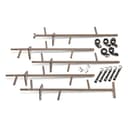
What you get
Four steel climbing sticks, each roughly five feet, stacking to about twenty feet of climb. Standoff brackets hold the steps away from the trunk. They attach with either rope or cam-buckle straps depending on what you prefer, which is worth more than it sounds and we come back to it below.
Twenty feet is a meaningful number. It is high enough to get your scent stream and your outline above a deer’s normal browsing plane in most terrain, and it is the height a great deal of whitetail hunting actually happens at. Sets that get you fifteen feet leave you wanting; sets that get you twenty-five are mostly selling you weight.
The weight, stated honestly
These are steel. Aluminum sticks exist and cost two to three times as much, and the reason people pay it is that steel is heavy in a way that compounds.
The compounding is the part worth understanding. A saddle hunter is already carrying a saddle, a platform, a lineman’s rope, a tether, a bow or rifle, and a pack with everything else in it. Adding steel sticks to that load does not just make the pack heavier; it makes you slower, sweatier and less willing to go the extra distance — and on public land, distance from the parking lot is the single best predictor of hunting quality.
So the honest framing is not “are these too heavy” but “how far are you carrying them” — the same question we work through in Hawk Helium vs Guide Gear climbing sticks:
- Under about a quarter mile: the weight is a non-issue. Buy the steel, spend the savings elsewhere.
- A quarter mile to a mile:noticeable, workable, and a fair trade for the price difference — particularly if you are hanging and leaving the sticks rather than carrying them in and out daily.
- Over a mile, carried every trip: this is where aluminum starts genuinely earning its price, and where we would tell a hunter to save up rather than buy these.
The standoff brackets are the underrated feature
Standoff brackets hold the step out away from the trunk instead of flush against it. This sounds like a detail and it changes the climb substantially.
With a flush step, your boot toe has to fit between the step and the bark, which on a rough-barked oak means your foot is fighting for space and your weight sits at an awkward angle. With a standoff, your whole boot lands on the step, your weight goes straight down, and you climb with your legs rather than your arms. In the dark, in the cold, with a pack on, that is a real safety and energy difference.
Premium aluminum sticks generally get this right too, so it is not a differentiator against them — but it is a genuine differentiator against the very cheapest sticks on the market, several of which skip it, and it is a reason we rank these above the absolute bottom of the category.
Attachment: rope versus cam buckle
These accept either method and that flexibility is worth knowing about because the two behave differently.
Cam-buckle strapsare faster to set and easier for a beginner to get tight. They are also louder — the ratcheting noise carries a long way in still timber — and the excess strap tail flaps in wind.
Rope attachment with a cam cleat or a versa-button style setup is quieter and lighter, and it is what most experienced mobile hunters convert to. It takes a little practice to set consistently under tension.
The practical advice: learn on the straps, convert to rope once you are confident hanging sticks, and do the conversion at home in daylight rather than working it out at 5 a.m. Our guide to hanging climbing sticks covers the sequence either way.
Noise, and what to do about it
Steel on steel is loud. Sticks stacked in a pack clatter against each other on every step, and that noise is worse than the weight for a morning walk into a hunting spot.
The fix is free and effective: separate the sticks with something soft when you pack them. Foam pipe insulation, an old sleeping mat cut into strips, or purpose-made stick wraps all work. Wrap the steps and the contact points, band the stack together tightly so nothing shifts, and the walk in becomes quiet. Hunters who complain that budget sticks are unusably noisy are, in our reading of the category, usually describing an unwrapped stack.
Where these stop being enough
- Very large trees.Four sticks and a fixed strap length assume a tree within a certain diameter range. A big cottonwood or an old-growth oak can exceed what the straps reach around. Check the maker’s stated capacity and carry a longer strap if you hunt big timber.
- Run-and-gun hunting. If your style is hanging a set, sitting two hours, and moving, the setup and teardown time on four separate sticks becomes the limiting factor and lighter, faster-deploying options are worth the money.
- Aiders and single-stick climbing. Advanced mobile hunters use aiders to climb higher on fewer sticks. That is a technique with a real learning curve and its own risks, and these sticks are not the natural platform for it.
- Anywhere public-land rules restrict what you can hang. Screw-in steps are banned in many places, overnight stand rules vary, and some areas require a name tag on anything left in a tree. Our public-land treestand rules guide covers the questions to answer before you hang anything.
Safety, which is not optional on this product
Climbing sticks put you fifteen to twenty feet in the air and the climb is where the majority of treestand falls happen. Two rules that are not negotiable regardless of what you paid:
Use a lineman’s rope while hanging sticks. You are attached to the tree the entire time you are working, both hands free, from the ground up. This is the single practice that separates mobile hunters who have close calls from ones who do not.
Wear a full-body harness and be attached before your feet leave the ground. The picks in our budget safety harness roundup cost a fraction of these sticks. There is no version of this where saving that money is rational.
Also inspect the sticks before every season: check the welds at the step joints, check the straps or ropes for UV damage and abrasion, and replace any strap that shows wear. Steel does not fail gracefully, and straps are the cheap component that fails first.
The verdict
These sticks are the reason a budget hunter can hunt mobile at all, and that is a bigger deal than any spec on the listing. Twenty feet, standoff brackets that make the climb easy, and either attachment method, for a price that leaves money for the harness and the platform that actually make the system work.
Buy them if you are within a mile of the truck or you hang and leave them. Wrap them before the first walk in. Save for aluminum if you are carrying them a long way every trip, and in the meantime hunt with these rather than not hunting at all — which is the actual alternative for most people asking the question.