What Morakniv actually publishes
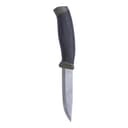
The Companion in this configuration is a fixed-blade knife with a 4.1-inch stainless blade, a rubberized grip handle and an included plastic sheath. Three things carry the review: the blade length and grind, the handle material, and the sheath.
4.1 inches is the right length, and people buy longer
New hunters consistently buy too much blade. A field dressing is precision work in a confined space with an animal’s pelvis and ribcage in the way, and a long blade makes it harder rather than easier — more knife to control, more chance of nicking the paunch, which is the one mistake that genuinely ruins meat.
Somewhere between three and four and a half inches is the working range for whitetail-sized game, and the Companion sits neatly inside it. It is not a survival knife, it is not for splitting a pelvis, and it should not be batoned through wood. It is a knife for opening and dressing an animal, which is what you actually need.
The Scandi grind: sharper, easier, more fragile
Morakniv’s knives use a Scandinavian grind — a single wide bevel running to the edge with no secondary micro-bevel. Two consequences follow, and they are the heart of this knife.
First, it slices exceptionally well. A wide flat bevel with a keen edge separates hide and tissue with very little pressure, which matters when your hands are cold and wet and you want to be pushing gently rather than sawing.
Second, it is remarkably easy to sharpen. Lay the flat bevel on a stone and the geometry sets the angle for you — there is no angle to hold and no guide needed. For a hunter who has never sharpened a knife properly, this is a genuinely large advantage over a conventional convex or compound grind.
The trade is edge fragility. A Scandi edge is thinner behind the cutting edge than a heavy hunting knife, so it will chip if you pry with it or drive it into bone. That is a usage limit, not a defect — and it is the one people run into.
The handle is the underrated part
The rubberized grip is the feature that separates this from every other cheap knife, and it gets less attention than the steel.
Field dressing happens with hands that are cold, wet and covered in blood. A polished wood or smooth metal handle in that condition is genuinely dangerous, and a slipped grip on a sharp blade in the middle of the woods is a serious problem a long way from help. The textured rubberized handle stays gripped, and it is warm to hold when steel would be painful.
The sheath is basic, and that is fine
A plastic friction sheath with a belt clip. It retains the knife, it drains, it wipes clean, and it does not absorb blood the way leather does. It is not attractive and it is not going to be handed down. For a working knife that gets rinsed under a tap, plastic is the more practical material and we would not pay to upgrade it.
Where it is genuinely beaten
It is not a skinner. The drop-point blade is a generalist. A dedicated skinner with a sweeping belly and a rounded tip removes hide faster and with less risk of cutting through it, and if you skin a lot of animals you will notice. For opening, gutting and general cutting, the generalist shape is the more useful one.
It is not a replaceable-blade knife.If you would rather never sharpen anything, a replaceable-blade knife gives you a surgical edge on demand and you swap the blade instead of maintaining it. That convenience is real and it is a different product philosophy — our fixed versus replaceable comparison covers the trade properly. Replaceable blades are also more prone to snapping if you lever with them.
It is not a buy-once heirloom. If you want a knife your child inherits, buy a full-tang knife with a leather sheath from a maker who builds them for that reason. That is a legitimate thing to want and this knife does not offer it.
Tang construction.Morakniv’s standard Companion uses a partial tang rather than a full one, which is perfectly adequate for cutting and dressing and is the reason it should not be batoned or pried with. If you intend to abuse a knife as a general camp tool, buy a full-tang blade for that job and keep this one clean for the animal.
Two hunters who should spend more
- The high-volume skinner. If you process several animals a season yourself, a dedicated skinner and a caping blade will save you real time and frustration.
- The hunter who will not sharpen. Be honest. If a stone will never come out of the drawer, buy replaceable-blade and accept the running cost of blades.
How to actually use it well
- Buy two. At this price, a second knife costs less than most sheaths. One lives in the pack, one in the truck. A dull knife halfway through a field dressing is solved by reaching for the other one.
- Sharpen it before the season, not during. The Scandi grind makes this a five-minute job on a cheap stone. Lay the bevel flat, work both sides evenly, finish with a strop or the back of a leather belt.
- Do not pry with it. No levering joints, no splitting pelvises, no using it as a chisel. That is what breaks this knife and it is entirely avoidable.
- Rinse and dry it immediately. Stainless resists corrosion; it is not immune. Blood left on a blade overnight does real damage, and the plastic sheath makes rinsing trivial.
- Carry gloves.Not a knife feature, but the cheapest upgrade to the whole job — see our field dressing guide for the rest of the kit.
The verdict
Buy it. For nearly every budget hunter this is the correct knife, and the money you do not spend here belongs in optics or in a headlamp, both of which affect your hunt more than a knife ever will.
The honest caveats are narrow and easy to work around: it is not a skinner, it should not be pried with, and it is not an heirloom. Buy two, keep them sharp, and put the difference toward gear that finds deer rather than gear that processes them. Full context against the alternatives is in our budget hunting knife rankings.