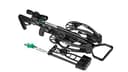
What 400 fps actually does, and what it does not
Speed buys you two things in the woods and neither is what the marketing implies.
It flattens trajectory,which reduces the cost of misjudging distance. A faster bolt drops less between twenty and forty yards, so a ten-yard range error moves the point of impact less than it would on a slower crossbow. That is a genuine benefit, and it matters most to hunters who do not carry a rangefinder — which is a problem better solved by buying a rangefinder than by buying velocity.
It shortens flight time,which slightly reduces the window in which a deer can react to the sound of the shot and drop underneath the bolt. Whitetails do react — the phenomenon is real — and less time in the air means less time to move.
What speed does not do is improve penetration proportionally, because kinetic energy is a function of mass as well as velocity and crossbow bolts are light. It does not improve accuracy. And it does not compensate for a bad shot angle, a poorly-tuned scope or a hunter who has not practiced at the distance in question.
The honest summary: at whitetail distances, a 350 fps crossbow and a 400 fps crossbow both kill deer cleanly, and the difference in outcomes is far smaller than the difference in marketing. Buy the speed if it comes attached to other things you want — as it does here — not as the reason.
The cocked width is the spec that should decide this purchase
CenterPoint states a narrow cocked width on the Hellion, and for a treestand hunter that is worth considerably more attention than the speed figure.
Here is why. A crossbow’s limbs have to clear everything on both sides for the shot to happen. In a treestand you are sitting in a chair-sized space surrounded by the tree trunk, the stand rails, the safety harness tether and whatever branches you did not trim. A wide crossbow physically cannot be swung to the left in that space, which means a deer that comes in from the wrong side is a deer you do not shoot.
This is the most common practical complaint about crossbows from treestands and it never appears in a marketing comparison, because width is not a number anyone brags about. If you hunt from a stand or a saddle — which most budget public-land bowhunters do — narrow is worth paying for and fast is not.
The hunt-ready kit, and what “ready” means
CenterPoint packages this as a Hunt Ready Kit: crossbow, scope, quiver, bolts, and — unusually at this price — broadheads.
Broadheads in the box is a genuinely useful inclusion and worth calling out, because it is the accessory budget buyers most often forget to budget for and it is not optional. A crossbow package with field points only is a crossbow you cannot legally hunt with until you spend more money, and buyers routinely discover this in October.
Two honest cautions about kit scopes and kit accessories generally. First, a bundled scope is built to a package price and is the component most owners eventually replace — it works, and it is not the scope you would have chosen. Second, and more important, you still have to sight it in and verify it with the broadheads you will hunt with.A multi-reticle crossbow scope’s lower stadia lines are calibrated to an assumed velocity, and if your actual setup differs, those lines are wrong at the exact distances you needed them. Our crossbow sight-in guide covers verifying each reticle line rather than trusting the box.
185 pounds of draw weight, and the cocking question
A 185-pound draw weight is what produces the speed, and it is also what you have to deal with every time you cock the crossbow.
With a rope cocker — which halves the effort — that is roughly ninety pounds of pull, standing, usually in the dark, often with cold hands and a harness on. Most fit adults manage it. Some hunters, including many younger, older or smaller-framed ones, will find it a genuine struggle, and struggling with a cocking rope fifteen feet up a tree is not a small safety consideration.
A crank cocking device removes the problem entirely and is the single most worthwhile crossbow accessory there is. Budget for one if you have any doubt, and factor it into the price of this crossbow rather than the price of the next one.
The other consequence of high draw weight is wear. More energy stored means more stress on strings, cables and limbs, and CenterPoint’s factory strings benefit from waxing and a check before the season. A crossbow string that lets go at 185 pounds is a repair bill and potentially an injury.
Weight, and where this crossbow is wrong
The Hellion is heavier than the lighter budget crossbows we rank it against, and weight on a crossbow costs you in two places: carrying it in, and holding it steady on a long freehand aim.
For a hunter who walks two hundred yards to a permanent stand, the weight is irrelevant. For a mobile public-land hunter carrying a saddle, sticks, a pack and a crossbow a mile and a half in the dark, it is a real consideration, and one of the lighter options in our cheap crossbow roundup may serve better despite giving up velocity.
Who should skip the Hellion 400
- The hunter who only needs a deer crossbow. If you shoot inside forty yards at whitetails, a slower and cheaper crossbow does the job identically. Put the difference into a rangefinder and better broadheads.
- The hunter who cannot comfortably cock 185 pounds. Either budget for a crank device on top of the purchase, or buy a lower-poundage crossbow. Do not plan to tough it out in a treestand.
- The mobile public-land hunter. Weight compounds with everything else you are carrying, and a lighter crossbow you take further beats a faster one you leave in the truck.
- Anyone buying speed as the feature. Buy this for the narrow width and the complete kit. The 400 number is the least useful reason to choose it.
The verdict
The Hellion 400 is a lot of crossbow for the money, and the reasons it is worth buying are not the reasons it is advertised. The narrow cocked width solves the real problem crossbow hunters have in treestands. The included broadheads close a gap that catches budget buyers out every season. The speed figure is fine and largely beside the point.
What you give up against a premium crossbow is refinement: a better scope, a smoother trigger, quieter shot, and strings that need less attention. What you give up against the cheaper crossbows on our list is weight and some money, and you gain the width and the kit.
Before you order, check your state’s crossbow regulations. Legality during archery season, minimum draw weight and broadhead requirements all vary by state and change between years, and that is the one thing no review can answer for you.