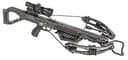
What 405 fps actually buys you
Crossbow marketing is a speed arms race, and the numbers have long since outrun their usefulness for deer hunting. Here is what speed genuinely does.
It flattens trajectory, which forgives ranging errors
This is the real benefit. A faster bolt drops less between yardage marks, so a 5-yard error in your range estimate costs you less vertical error at the target. At 30 yards, the difference between a 350 fps bow and a 405 fps bow is small. At 50 yards it becomes meaningful. If you hunt open ground where 40-to-50-yard shots happen, speed has real value.
It adds kinetic energy, which you mostly did not need
Every crossbow in our roundup, including the slowest, produces far more energy than is required to pass through a whitetail’s chest cavity. Speed adds margin for a bad angle or heavy bone. That margin is worth something, but it is not the difference between killing a deer and not killing one.
What speed costs
More speed means more stored energy, which means more noise, more vibration and more stress on strings, cables and cams. It also means more punishment for a broadhead that is not rated for crossbow speeds — see our broadhead roundup for why that matters. Fast crossbows want their strings waxed and inspected more often, not less.
The honest verdict on the number
For a hunter shooting inside 40 yards — which is most whitetail crossbow hunting —405 fps is more speed than the job requires. It is not a reason to avoid this crossbow, and it is not the reason to buy it either. Buy it for the package. If you are choosing between this and its slightly faster stablemate, we put the two side by side in Lethal 405 vs Burner 415.
The package is the actual product
This is where the Lethal 405 earns its ranking. Work out what a bare crossbow costs you once it is hunt-ready:
- Scope— a crossbow-specific multi-reticle scope, without which you have no aiming system at all.
- Cocking device— a rope cocker halves the effort and, more importantly, makes cocking repeatable. An inconsistent hand-cock changes your point of impact.
- Bolts— you cannot shoot without them, and crossbows are particular about bolt weight and spine.
- Quiver— a mounted quiver, which also changes the balance of the bow.
Buying those four separately typically adds a substantial fraction of the crossbow’s own price. A package that includes them is not a marketing bundle, it is a genuinely different purchase. This is why we rank complete packages above bare bows in the budget bracket, and why a “cheaper” bare crossbow is frequently the more expensive way to start hunting.
The honest downsides
Included scopes are included scopes
The optic in any budget crossbow package is adequate rather than good. It will hold zero and it will get you to 40 yards, and it is usually the first thing an owner upgrades after a season. Budget for that eventually rather than being disappointed by it. It is not a defect; it is what allows the package to exist at this price.
Weight and bulk
Budget crossbows are heavy. They are built from steel and heavier composites where premium bows use machined aluminum, and you feel it when carrying one up climbing sticks or holding it steady offhand. For a ladder stand or a blind this is irrelevant. For a mobile saddle-hunting setup it is genuinely awkward, and it is one reason some hunters end up back with a compound bow.
Noise
Fast crossbows are loud. A deer at 40 yards can and does react to the shot, and string-jumping is a real phenomenon at crossbow distances. String stops and limb dampeners help; there is no budget crossbow that is genuinely quiet. Take the closer shot when it is offered.
Service parts
Strings and cables are consumables and need replacing every few hundred shots or every couple of seasons. On budget bows those services can be harder to source locally than for the big archery brands. Ask before you buy whether a shop near you will work on it.
Who should buy it
- First-time crossbow hunters who want to buy once and be hunting the same week.
- Hunters who need everything in one box because they have no local pro shop to assemble a setup for them.
- Anyone hunting from a fixed stand or blind where the weight does not matter.
- Hunters in states with crossbow-inclusive archery seasons who want the longest possible season for the least money.
Who should buy something else
- Mobile and public-land hunters carrying gear a long way — a lighter compound is a better tool.
- Anyone who wants to develop archery skill as its own pursuit. A crossbow is a mechanical device you aim; a compound is a skill you build.
- Hunters who already own a decent crossbow scope and cocking device, for whom the package advantage disappears and a bare bow may be cheaper.
Before you hunt with it
Three non-negotiables. First, check your state’s crossbow regulations — legality varies by season and sometimes by hunter age or disability status, and some states set minimum draw weight or bolt specifications. Second, sight it in properly and confirm that your broadheads print with your field points, not just near them. Third, buy broadheads explicitly rated for crossbow speeds; standard compound heads can shed blades at 400 fps.
The verdict
The Lethal 405 is the crossbow we would hand a hunter who wants to be in a stand this season with a working setup and no research project attached. It is not the fastest, not the lightest, and the scope is not the one you will own in five years. What it is, more completely than most bows at this price, is finished— and for a budget hunter, a finished setup beats a better bow you cannot afford to complete.